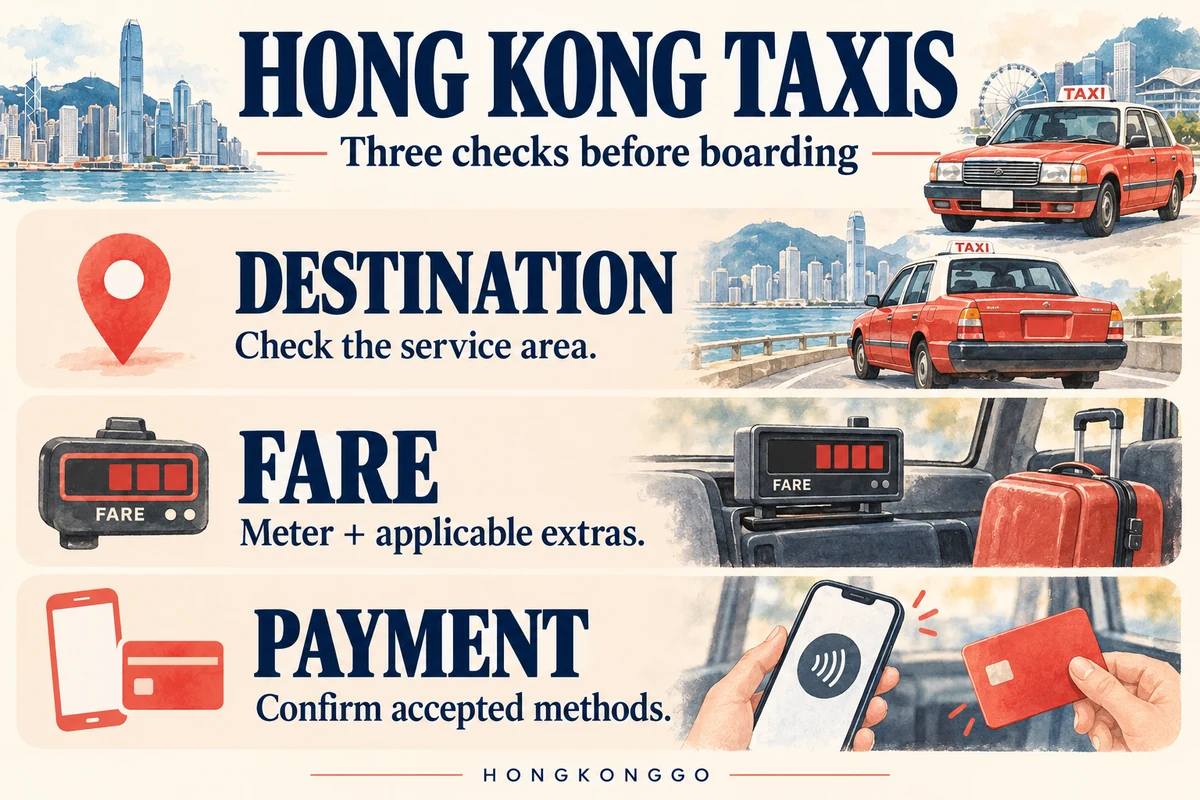
Choose a Hong Kong taxi by service area, then confirm metered charges and payment. Red urban taxis cover most of Hong Kong, while green New Territories and blue Lantau taxis have restricted operating areas. All three can serve the airport, but they cannot take every airport passenger to every destination. The electronic-payment requirement introduced in April 2026 does not mean every vehicle accepts every card or wallet.
Give the driver a complete destination before boarding
Save your hotel, venue or building's full name and entrance address. Showing the Chinese address together with a map location helps avoid confusion between similarly named properties. Confirm the destination before loading luggage: a hotel brand or a broad district name may cover several possible drop-offs.
Checked on 30 October 2026 against the Transport Department's taxi information, this guide concerns local metered taxis. Chartered vehicles, cross-border bookings and other app products have their own terms; this meter table is not their price list. Airport advice here assumes you have entered Hong Kong's landside area, with admission and baggage arrangements already resolved.
Red, green and blue describe operating areas
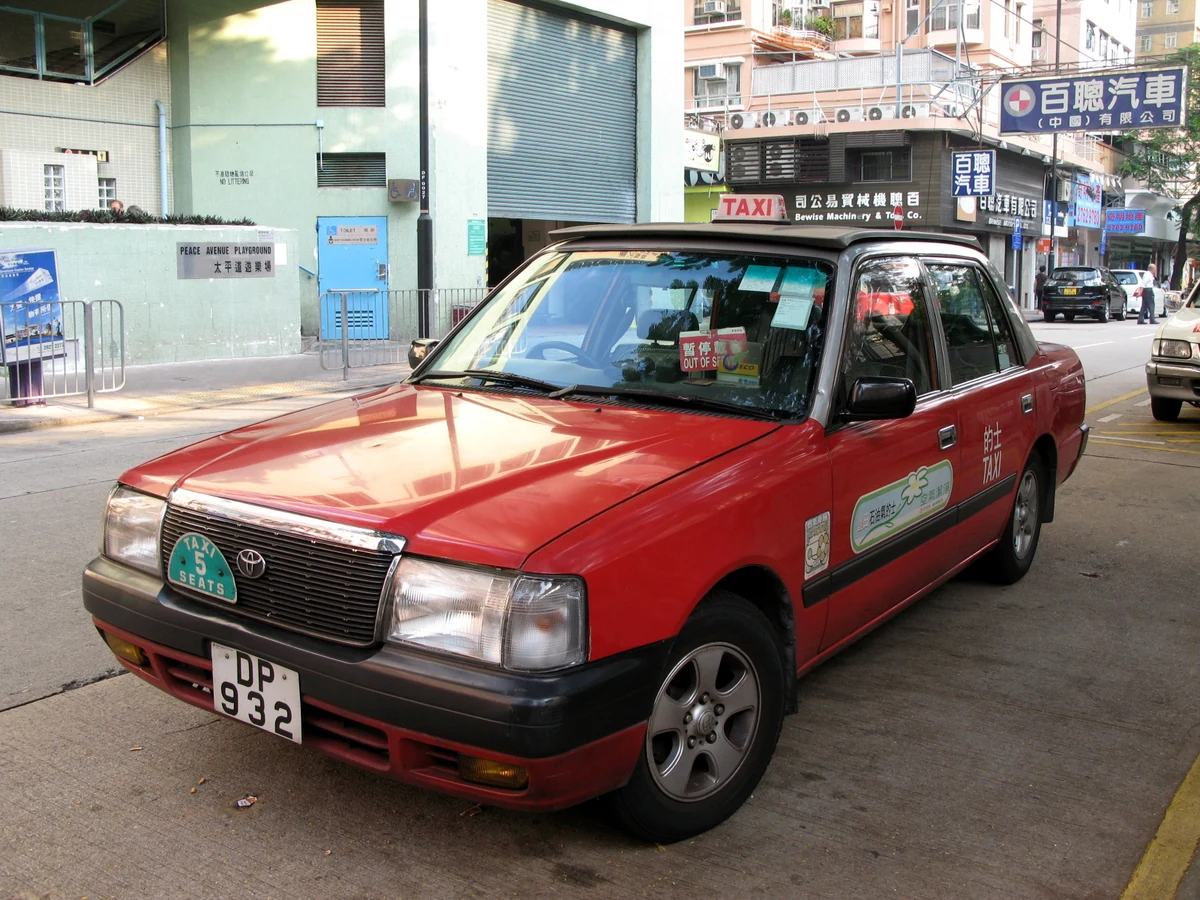
Colour does not rank comfort or offer interchangeable cheap and expensive options for any route. The department's detailed area rules specify areas, additional destinations and permitted routes.
| Category | A useful starting point | Avoid this assumption |
|---|---|---|
| Red urban taxi | Broad service across Hong Kong, including the New Territories, except Tung Chung Road and roads in South Lantau | “Urban” does not mean Hong Kong Island and Kowloon only |
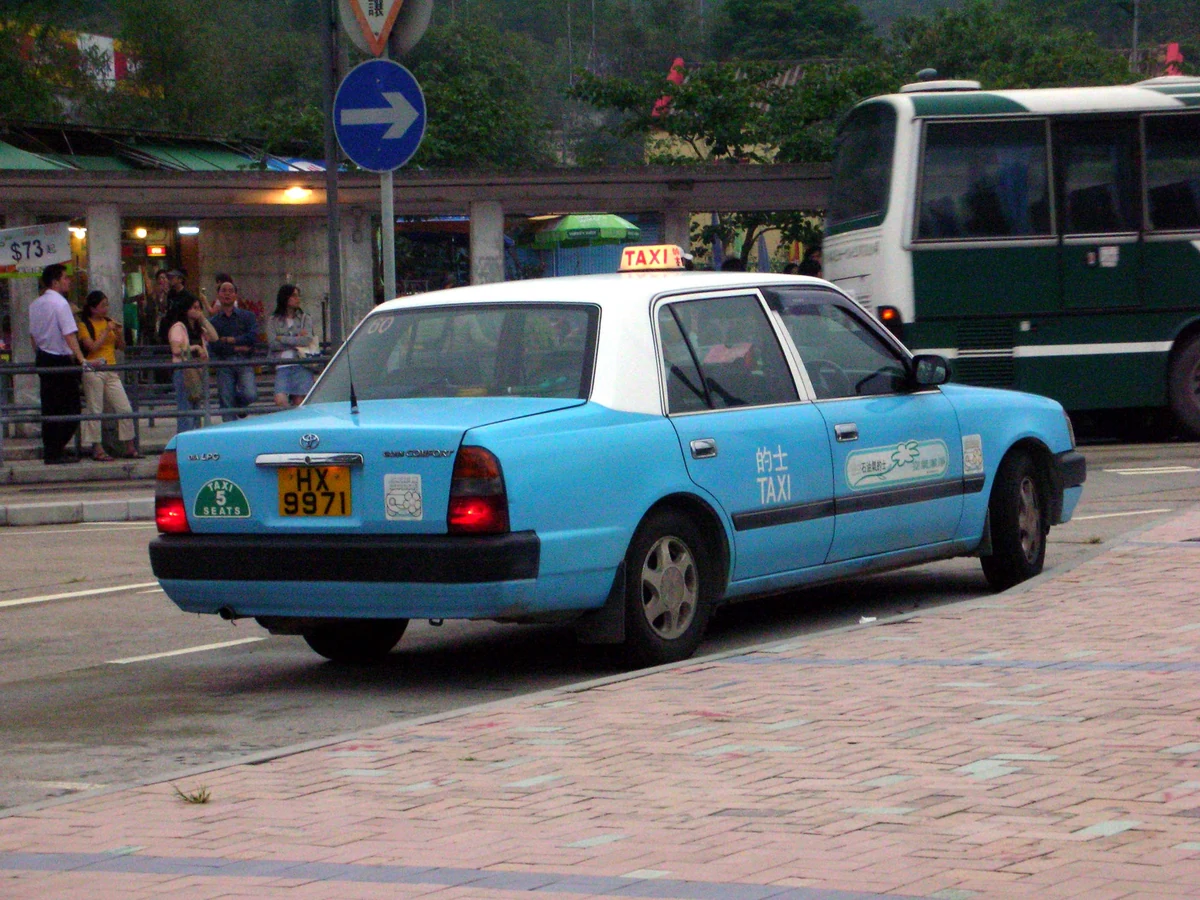
| Green New Territories taxi | Mainly Tuen Mun, Yuen Long, Tai Po, North District, Ma On Shan and most of Sai Kung, with specified routes to places such as the airport | It does not cover every New Territories location or freely serve Hong Kong Island and Kowloon |
| Blue Lantau taxi | Lantau Island, Chek Lap Kok and the Hong Kong–Zhuhai–Macao Bridge Hong Kong Port public transport interchange | It is not the choice for an airport journey to Central or Tsim Sha Tsui |
Green-taxi rules are more precise than administrative district names. The Sai Kung coverage, for example, excludes Tseung Kwan O New Town, while certain destinations outside the normal area are accessible only by specified routes. Give the actual address when it lies near a boundary or at a special facility; a map label saying “New Territories” cannot settle eligibility.
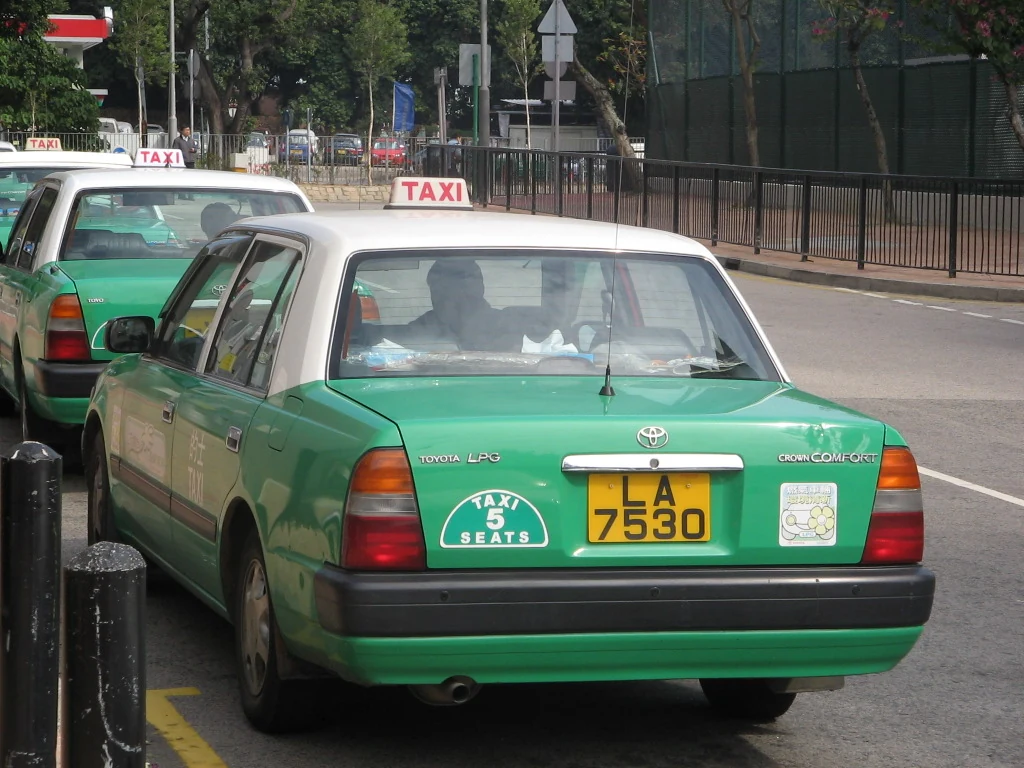
Red taxis may serve the New Territories. The Transport and Logistics Bureau reiterated this in its 14 October 2026 reply. You therefore need not change from red to green simply to travel from Kowloon to Tai Po. Conversely, picking up a passenger at the airport does not give a green taxi unrestricted access throughout Hong Kong.
At the airport, choose by your final address
All three types may serve the passenger terminals. Follow the taxi-area signs and choose the appropriate queue for the destination; show the full hotel address to staff if unsure. For Central, Wan Chai or Tsim Sha Tsui, use the urban-taxi service-area rules. For a Lantau destination, confirm the particular road and suitable taxi category.
Where the drop-off is not the hotel door, account for walking, steps and moving bags. Permission to serve an area does not allow stopping at every point. Waiting, actual fares and available vehicles depend on conditions; historical photographs and navigation estimates cannot establish current supply.
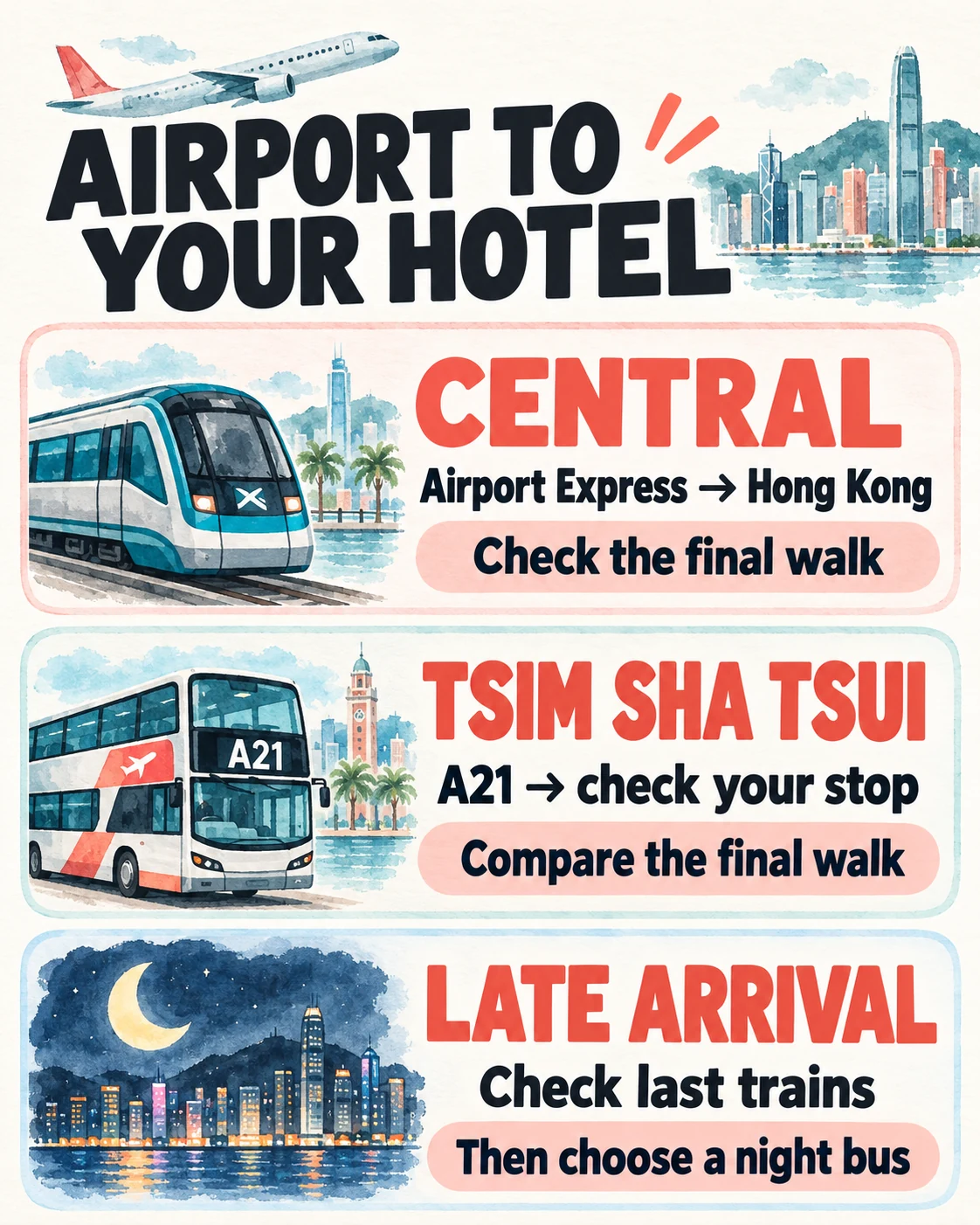
With light bags and a hotel close to a station or stop, also consider the Airport Express and airport-bus comparison. Compare the whole journey to the entrance. Different flagfalls are not a reason to join a queue whose taxis cannot serve your destination.
Read the meter as distance and waiting, not a fixed route quote
The official fare table lists the following Hong Kong dollar rates, effective from 14 July 2024 and checked here on 30 October 2026. The initial charge covers the first two kilometres or any part of them. Subsequent units are each 200 metres or part thereof, or each minute of waiting or part thereof.
| Taxi | First 2 km | First-stage increment per unit | Later increment |
|---|---|---|---|
| Red urban | HKD 29 | HKD 2.1 until the fare reaches HKD 102.5 | HKD 1.4 thereafter |
| Green New Territories | HKD 25.5 | HKD 1.9 until HKD 82.5 | HKD 1.4 thereafter |
| Blue Lantau | HKD 24 | HKD 1.9 until HKD 195 | HKD 1.6 thereafter |
Those thresholds are not extra lump-sum charges. Nor is the whole distance multiplied by one flat per-kilometre price. Road conditions, waiting and applicable extras affect the total, so a map's hotel-to-airport distance is not a guaranteed fare. Check the meter and displayed tariff, and ask for an explanation of unclear items when the vehicle is safely stopped.
Baggage and harbour tunnels can add to the meter
Chargeable baggage costs HKD 6 per piece for all three types. The official rule generally covers each item in the boot, and items in the passenger compartment whose combined length, width and height exceed 140 cm. Light personal hand baggage in the cabin is exempt. Prams follow those baggage rules; wheelchairs and crutches carried by disabled passengers are free. Establish the size and placement of bags before loading them.

Two chargeable suitcases would add 2 × HKD 6 = HKD 12 to the actual meter and any other applicable extras. This example does not guarantee that any model can hold two large cases alongside your party. Consider people, dimensions and equipment together. The table also lists HKD 5 per animal or bird and HKD 5 for telephone booking; these are conditional items, not charges to add automatically to every journey.
For red urban taxis, the Cross-Harbour, Eastern Harbour and Western Harbour crossings each list a HKD 25 toll, potentially with a further HKD 25 return toll. The return toll is not payable when the hiring begins at a cross-harbour taxi stand, or when the final destination is not on the opposite side of the harbour. It does not purchase a return passenger journey. Check the applicable condition rather than accepting that every tunnel trip always has identical extras. Other tolled tunnels have their own rates.
Electronic payment: identify your actual card or wallet
Since 1 April 2026, drivers must provide at least one QR-code and one non-QR electronic payment method. A vehicle offering a particular wallet and a particular contactless tool may meet that requirement without accepting your overseas credit card. am730's implementation guide suggests checking window stickers and asking the driver; the underlying requirement was separately checked against the department's current page.

Ask whether this specific card or wallet is accepted before boarding, rather than only whether electronic payment is available. Check battery, connectivity and any account authorisation your chosen tool needs. Clarify any payment-platform charges before paying, and do not assume that accounts from different regions have identical conditions just because they share a wallet brand.
Cash remains a useful option; small-denomination Hong Kong dollars are practical. The department notes that inability to change a HKD 500 or HKD 1,000 note is not itself an offence by the driver. Avoid relying on one large note as your only alternative. If a digital transaction does not clearly succeed, check the status and amount with the driver before switching methods, rather than rushing into a duplicate payment.
Finish with a receipt and a check of the seats and boot
You may request a printed receipt; a handwritten receipt should be provided if the printer is out of order. Keep the registration number, date, pickup and drop-off locations and payment record, then check the seats, phone and boot. These details help explain a charge or reconstruct the trip if something is missing later. For an actual loss, use the appropriate channels in the Hong Kong lost-property guide.
A taxi can suit a spontaneous point-to-point trip. Multiple stops, continuous waiting, specific child equipment or cross-border travel need separate arrangements. Saying that you will return in the evening does not reserve the same vehicle all day. State the times, stops and waiting requirement before comparing an agreed service.
Your pre-journey checklist
- Save the full address and confirm the taxi's area, rather than relying on a district label.
- At the airport, queue for the destination and allow for loading and the final walk.
- Check the meter, chargeable bags and tunnel extras, including return-toll exceptions.
- Confirm your own card or wallet before boarding and prepare a workable alternative.
- Request a receipt, check seats and luggage, and retain the registration and payment record.
Sources & further reading
This article draws on the media coverage and public information below. Event and transport arrangements can change; check the latest details before travelling.
- Transport Department: taxis and electronic paymenttd.gov.hk (Opens in a new tab)
- Transport Department: detailed operating areastd.gov.hk (Opens in a new tab)
- Transport Department: fares and additional chargestd.gov.hk (Opens in a new tab)
- Transport and Logistics Bureau: urban taxis in the New Territoriestlb.gov.hk (Opens in a new tab)
- am730: electronic-payment implementation guideam730.com.hk (Opens in a new tab)
Make it your journey
For a cross-border itinerary, multiple stops or a group with several bags, send HONGKONGGO the complete addresses, people, luggage and timing to compare a suitable transfer. Local metered taxis remain subject to their own applicable tariff.