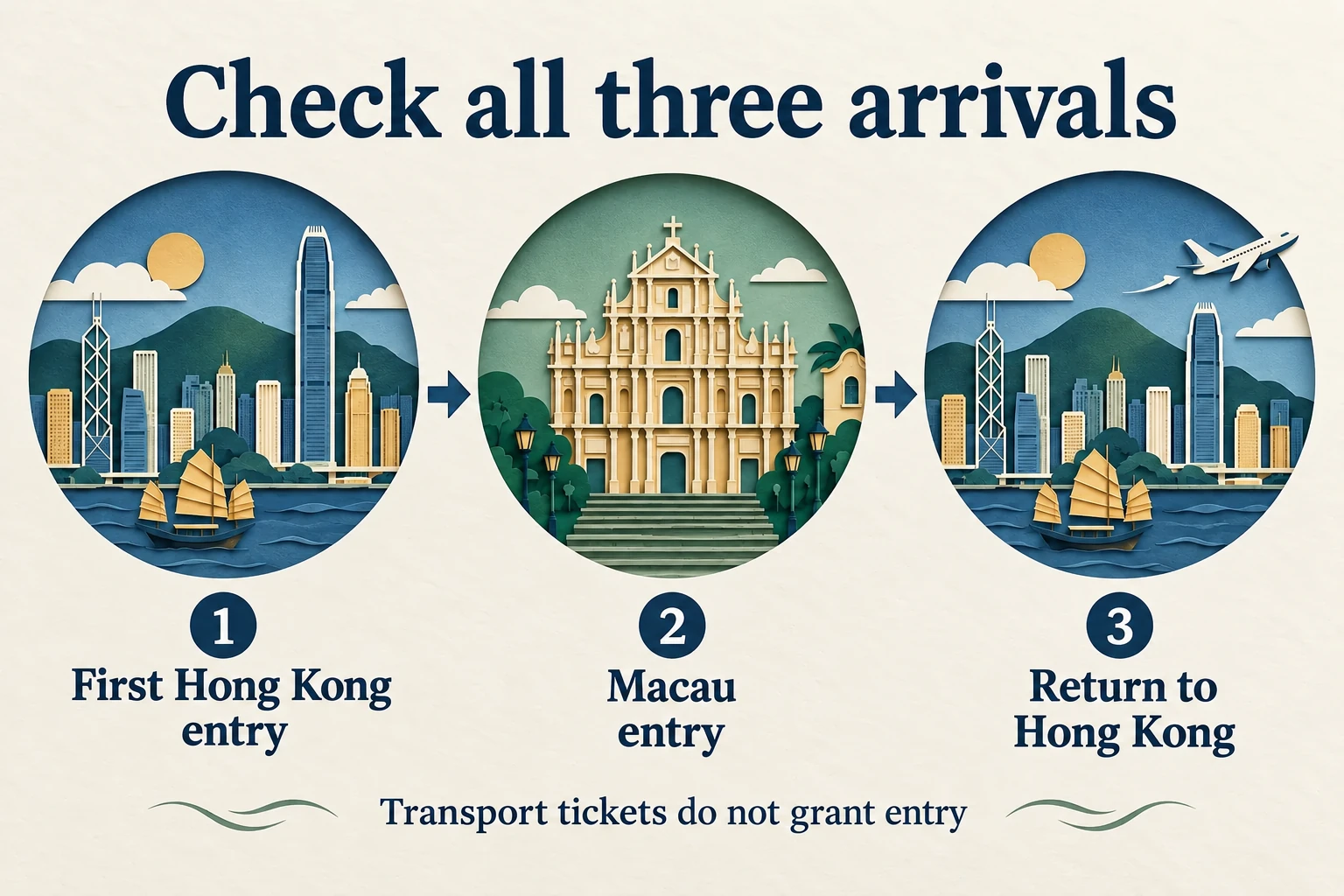
Travelling from Hong Kong to mainland China does not automatically qualify you for the 240-hour visa-free transit policy. Check your passport nationality, the last country or region immediately before mainland China, the first one immediately afterwards, your actual entry port and confirmed onward arrangements. A short return trip from Hong Kong is not eligible simply because it lasts less than ten days.
Decide whether your itinerary is actually transit
If you hold a foreign ordinary passport and want to add Guangzhou or Zhuhai to a Hong Kong holiday, start with the structure of the journey rather than a ten-day sightseeing plan. The 240-hour transit policy, entry with a Chinese visa, other visa-exemption arrangements and permission to enter Hong Kong are separate matters. Conditions from different schemes should not be mixed together.
At this check, the National Immigration Administration's announcement of 20 August 2026 covers eligible nationals of 57 countries, entering through 65 designated ports and remaining for up to 240 hours in specified areas of 24 provincial-level regions. It is not permission for every foreign passport, every mainland border crossing or unrestricted travel throughout China. Current NIA announcement and port table
An HK01 report published the same day provided a news lead about Vietnam and Kyrgyzstan joining the list. Immigration authority information and the examination at entry remain the basis for deciding eligibility. Older articles may still refer to 54 or 55 countries or 60 ports; a search-result summary is insufficient for booking.
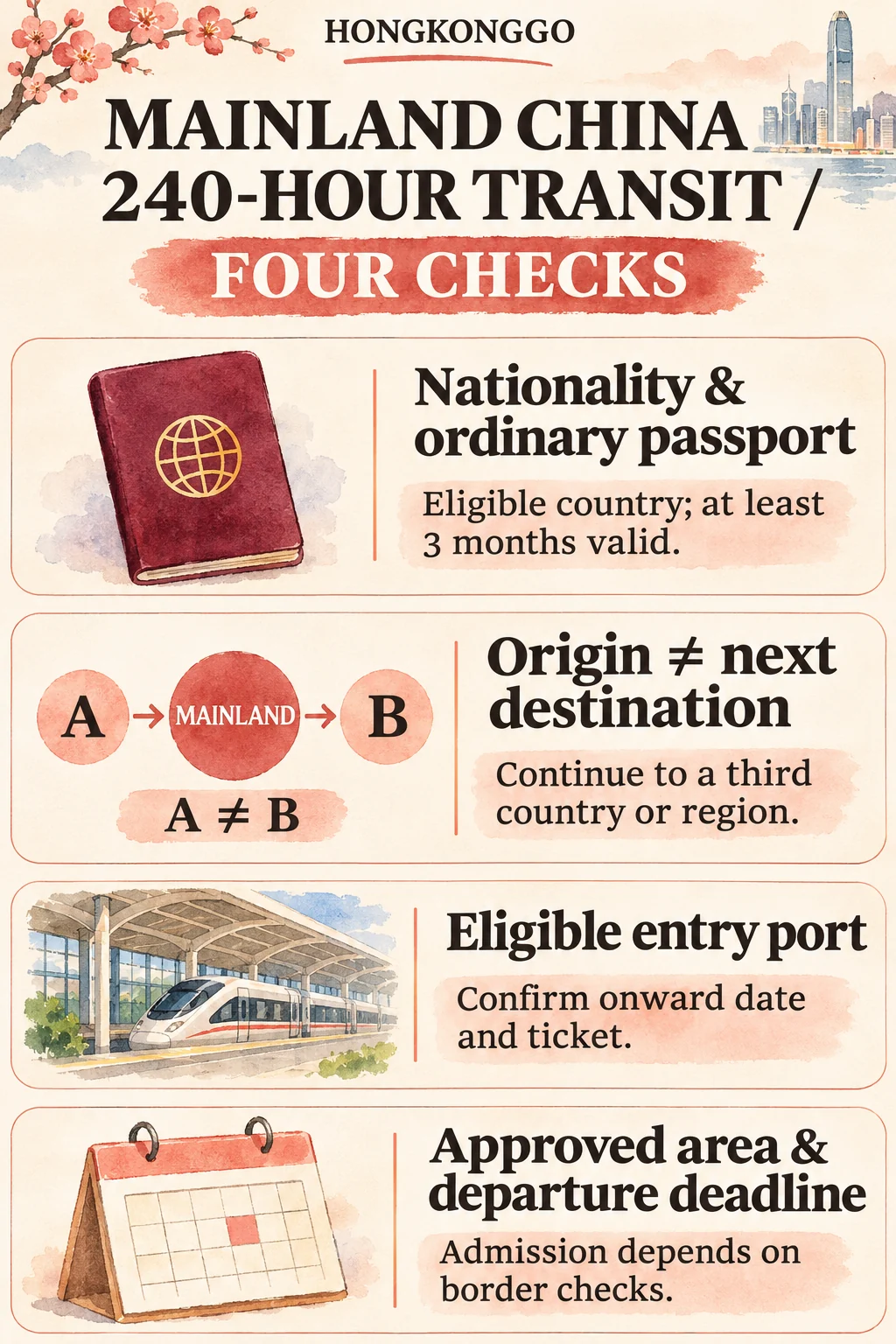
Hong Kong can be one end of the transit, but not both
The important comparison is between the country or region immediately before mainland China and the one immediately after it. Your nationality and the starting point of your entire holiday do not replace those two stops. The Beijing government's transit questions explain this through a European itinerary: entering from France and returning to France does not qualify merely because an earlier flight started in Switzerland.
| Planned journey | How to assess it |
|---|---|
| Hong Kong → Guangzhou → Tokyo | Hong Kong and Japan are different countries or regions for this itinerary test; nationality, documents, ports, onward arrangements and permitted stay must still qualify |
| Hong Kong → Guangzhou → Hong Kong | The stops immediately before and after mainland China are both Hong Kong; a one-night stay or a different airline does not change that |
| London → Hong Kong → Guangzhou → Hong Kong | Hong Kong is still immediately before and after mainland China; the earlier London flight cannot replace it as the preceding stop |
| United States → Shanghai → Hong Kong → United States | An official Shanghai immigration answer confirms that this third-region structure can be considered under the conditions, subject to examination on arrival |
The final example comes from Shanghai's official answer about an onward high-speed train to Hong Kong. It also shows that an onward journey need not always be a flight. However, eligible departure arrangements must be settled in advance; “I will buy a ticket later” is not equivalent. The Guangzhou examples explain itinerary structure, not a promise that a particular car, vessel or flight can process your application.
Check nationality, passport validity and onward proof together
An ordinary passport from a listed country is a starting point. The official implementation requirements specify valid international travel documents, a passport valid for at least three months and compliance with the entry conditions of the next country or region. Travellers need onward tickets or relevant evidence with confirmed dates and journey arrangements and must apply to border inspection on arrival. Shanghai's passenger guidance also stresses confirmed onward dates and seat arrangements. NIA implementation requirements
The current 57-country list is grouped below for checking passport nationality. These groupings are a reading aid: residence, permanent-resident status or a Hong Kong visa does not replace nationality requirements.
| Region | Countries currently listed |
|---|---|
| Europe: 40 | Austria, Belgium, Czech Republic, Denmark, Estonia, Finland, France, Germany, Greece, Hungary, Iceland, Italy, Latvia, Lithuania, Luxembourg, Malta, Netherlands, Poland, Portugal, Slovakia, Slovenia, Spain, Sweden, Switzerland, Monaco, Russia, United Kingdom, Ireland, Cyprus, Bulgaria, Romania, Ukraine, Serbia, Croatia, Bosnia and Herzegovina, Montenegro, North Macedonia, Albania, Belarus and Norway |
| Americas: 6 | United States, Canada, Brazil, Mexico, Argentina and Chile |
| Oceania: 2 | Australia and New Zealand |
| Asia: 9 | South Korea, Japan, Singapore, Brunei, United Arab Emirates, Qatar, Indonesia, Vietnam and Kyrgyzstan |
Check your passport, Hong Kong entry arrangements, mainland arrival journey, confirmed departure evidence and eligibility for the next destination together. A hotel booking, an undecided onward plan or a vehicle quotation does not replace the onward evidence required by the authorities. Apparently complete paperwork is not itself permission to enter.
From Hong Kong to Guangdong, identify the actual entry port
The current NIA table of 65 ports lists ten entry ports for Guangdong. Match the precise port name to your transport plan. A city name such as Guangzhou, Shenzhen or Zhuhai does not mean all its land, sea and air crossings are covered.
| Type | Guangdong entry ports in the current table |
|---|---|
| Airports | Guangzhou Baiyun International Airport, Shenzhen Bao'an International Airport and Jieyang Chaoshan International Airport |
| Passenger seaports | Nansha Port, Shekou Port, Guangzhou Port's Pazhou Hong Kong and Macao Passenger Terminal, and the passenger terminal in Zhongshan Port's Zhongshan Port Area |
| Land and railway ports | Hengqin Port, the Hong Kong–Zhuhai–Macao Bridge's Zhuhai Highway Port, and West Kowloon Station Port on the Guangzhou–Shenzhen–Hong Kong high-speed railway |
This is an eligibility list of ports, not an operating guarantee for every route, vehicle or departure time. Shenzhen Bay does not appear in this Guangdong entry-port table. The inclusion of Shenzhen Bao'an Airport does not mean that an ordinary cross-border car trip from Hong Kong through Shenzhen Bay can use the same application route. Before choosing a car, ferry or train, confirm the actual routing and processing arrangements with its operator; check eligibility and document questions with immigration authorities.
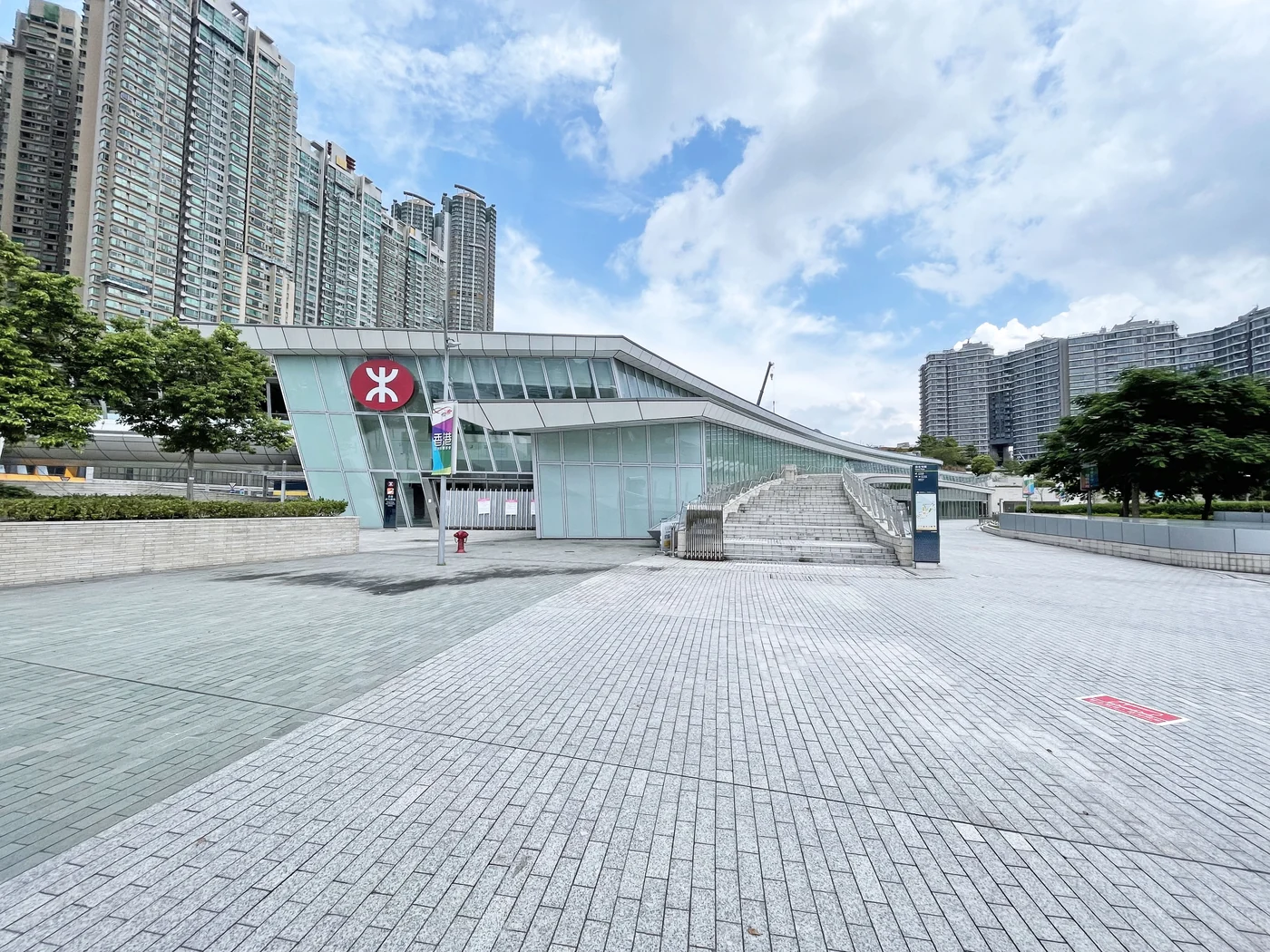
West Kowloon Station is physically in Hong Kong, but the relevant item here is the listed mainland entry-processing port, not the hotel from which your transfer begins. Travelling into mainland China by high-speed rail and using a train to Hong Kong as your onward departure are also different directions: check entry-port eligibility and departure evidence separately.
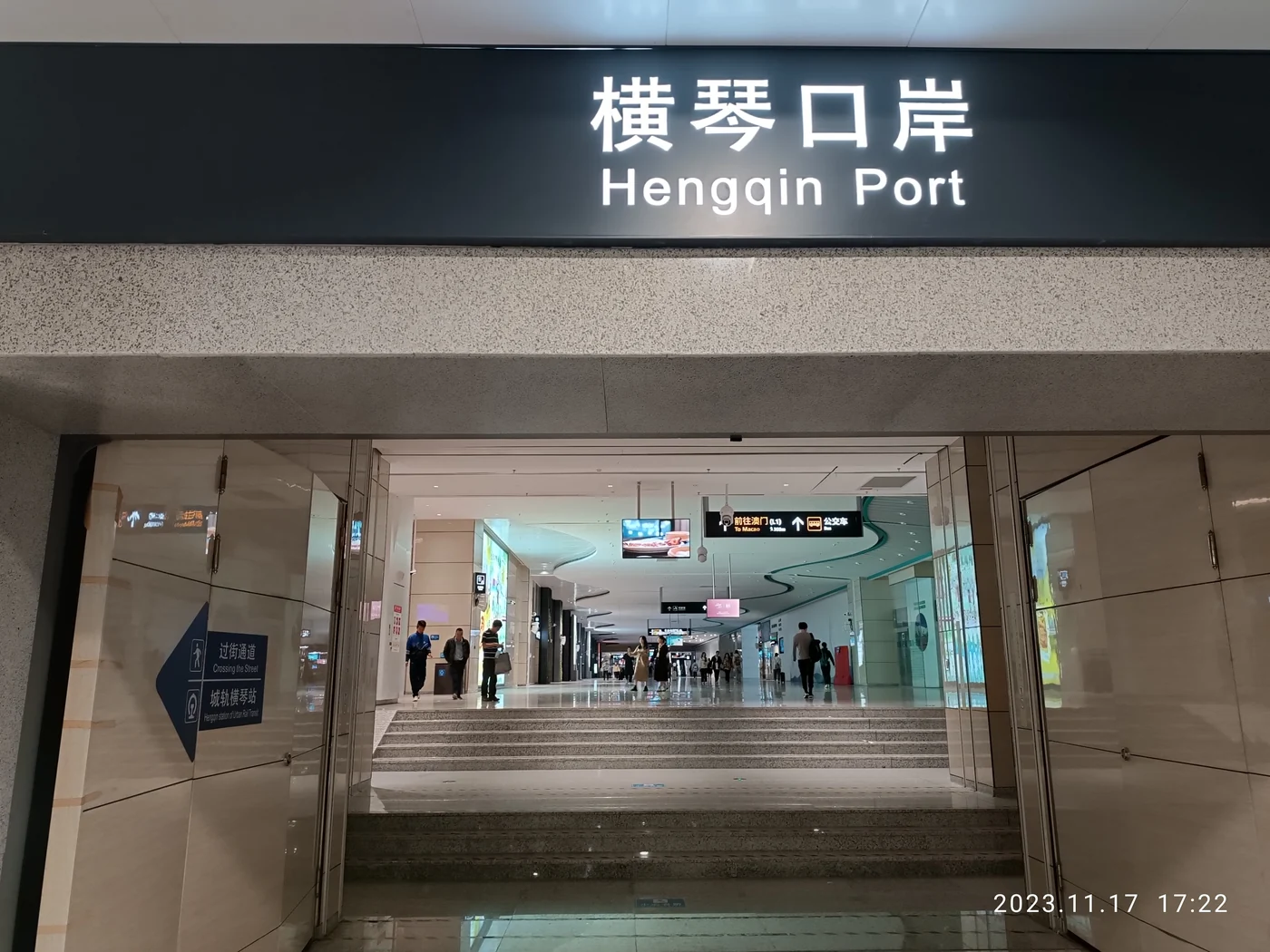
Hengqin and the bridge's Zhuhai Highway Port are separate entries in the table. For a journey involving Zhuhai, write down the precise port, transport mode and next destination rather than asking only about “crossing near Macao”. This guide does not treat an unverified cross-border connection as an approved itinerary.
Guangdong's permitted area does not mean unrestricted national travel
For Guangdong, the current table gives the permitted stay area as Guangdong Province and notes that departure is possible through all of its ports open to international traffic. Distinguish the designated ports through which the transit policy can be requested on entry from the permitted exit options. The latter are not confined to the same ten-entry-port list.
For travel beyond Guangdong, consult the specified areas of other participating provincial-level regions and the conditions actually granted to you. Not every one of the 24 regions covers its entire province. Permission to travel across participating specified areas should not be read as permission to visit any city in China. Nor does the ease of arranging a car establish that its destination lies within your allowed area.
The implementation explanation calculates the 240-hour period from 00:00 on the day following entry. Nevertheless, book against the stay deadline actually granted and check the date and time on your documents. Leave room for intercity transport and exit formalities. A booking that is expected to reach a crossing at the final moment does not ensure timely departure. Implementation conditions and calculation
Separate immigration evidence from ordinary travel bookings
The policy allows qualifying activities such as tourism, business and visits to family or friends. It cannot replace the appropriate visa for activities with separate visa requirements, including employment, study or journalism. Applicable accommodation-registration requirements still apply after entry, and a changed itinerary does not automatically extend the permitted area or stay.
Before booking, put the preceding stop, actual entry port, mainland destinations, exit port and next stop on one itinerary. Compare ticket dates, names and travel-document details. Keep questions for border authorities about eligibility separate from questions for operators about timetables, baggage and connections. This makes it easier to identify what has actually been confirmed.

If you also need to complete a foreigner's arrival card, continue to the China arrival-card guide. Completing a form does not grant visa-free transit or replace examination at the border.
For whether a connection at Hong Kong International Airport requires entry into Hong Kong, read the Hong Kong airport transit and entry guide. That is a separate border decision and cannot determine eligibility for mainland China's 240-hour policy.
Your pre-journey checklist
- Check passport nationality, type and validity rather than substituting your place of residence.
- Compare the stops immediately before and after mainland China, not simply the beginning of the holiday.
- Use the current designated entry-port table and confirm the operator's actual route and arrangements.
- Settle your departure date, seat or relevant onward proof and the next destination's entry requirements in advance.
- Follow the area and deadline actually granted; a form, hotel booking or transfer reservation is not immigration approval.
Sources & further reading
This article draws on the media coverage and public information below. Event and transport arrangements can change; check the latest details before travelling.
- NIA: current policy and port table, 20 August 2026nia.gov.cn (Opens in a new tab)
- NIA: implementation conditions and time calculationen.nia.gov.cn (Opens in a new tab)
- Shanghai official FAQ: onward rail travel to Hong Kong and visa-free transitenglish.shanghai.gov.cn (Opens in a new tab)
- Beijing government: preceding and onward itinerary examplesenglish.beijing.gov.cn (Opens in a new tab)
- HK01: Vietnam and Kyrgyzstan added to the listhk01.com (Opens in a new tab)
Make it your journey
For a Hong Kong or Guangdong transfer, state the actual crossing, transport departure and mainland destination on the HONGKONGGO quotation form. Vehicle arrangements should fit a verified immigration plan; eligibility and admission remain decisions for the authorities.