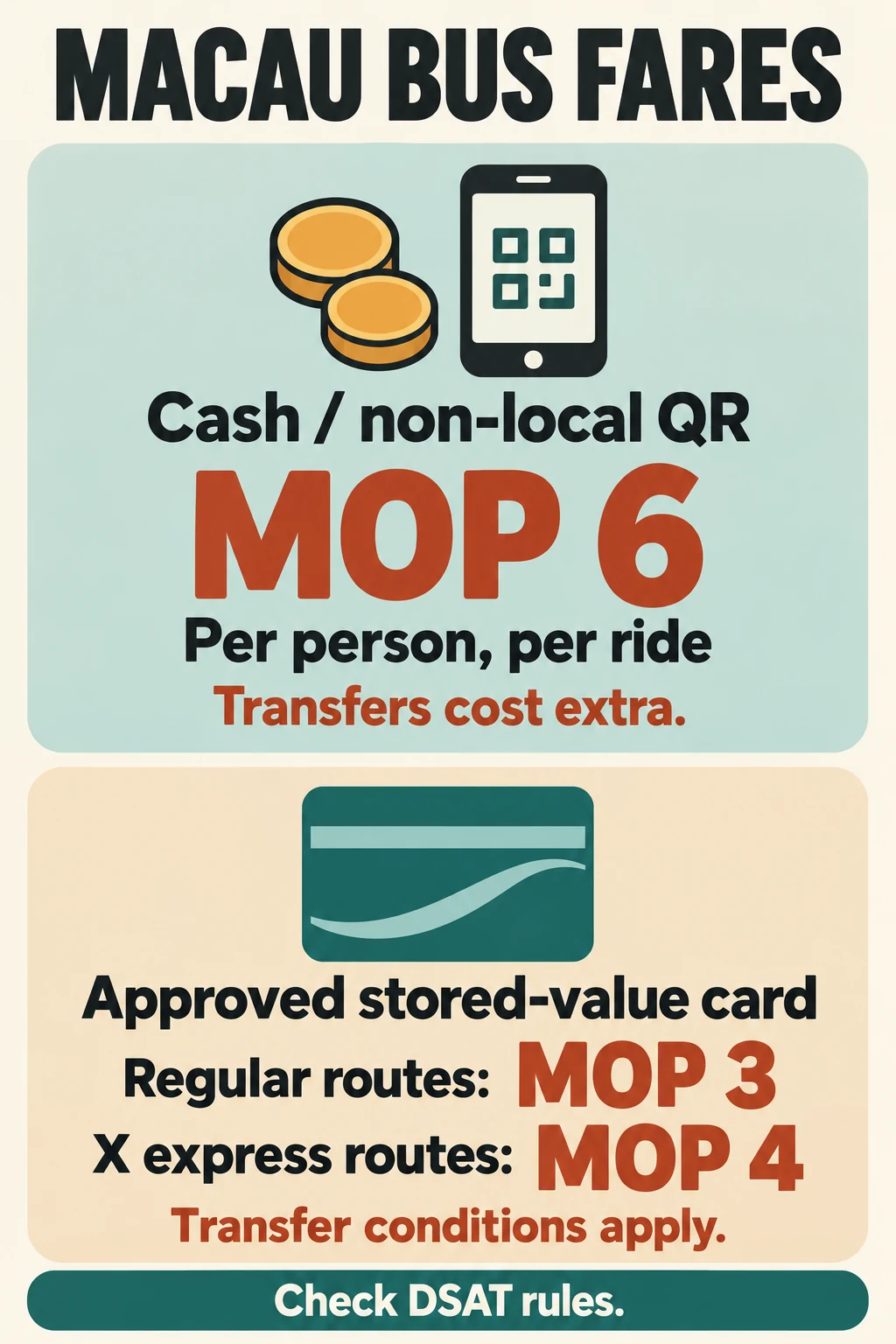
For a first Macau bus journey, check the route and direction at the stop, then prepare the payment method you actually hold. Cash and supported non-local transit QR payments normally cost MOP 6 per person per ride. Approved stored-value cards cost MOP 3 on regular routes or MOP 4 on X express routes, with conditional transfer concessions. Paying by phone does not automatically give you the discounted fare.
Save the destination and the stop where you will get off
Macau hotels, resorts and attractions can have several entrances. Save the full destination name and street or hotel entrance, then use the point-to-point and route-information links on the Transport Bureau’s bus information page. The nearest stop pole is not necessarily the right one for your direction. An outward route and its return should not be assumed to follow identical streets in reverse.
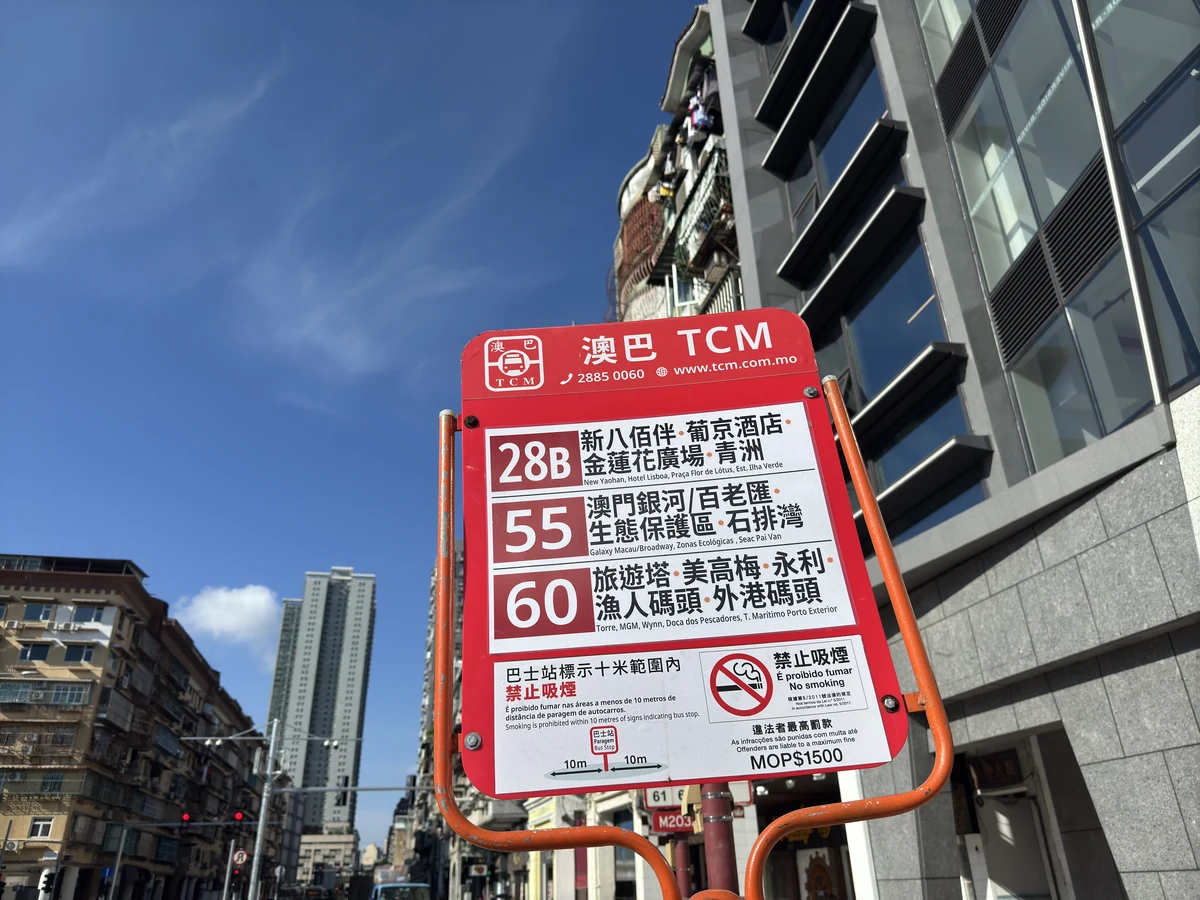
At the stop, match the route number, stop name and direction. If your destination appears only in the opposite-direction stop sequence, find that boarding point before joining a queue. Larger interchanges have several waiting positions; follow the route signs rather than the longest queue. Saving the stop immediately before your destination can also help you recognise when to prepare for getting off.
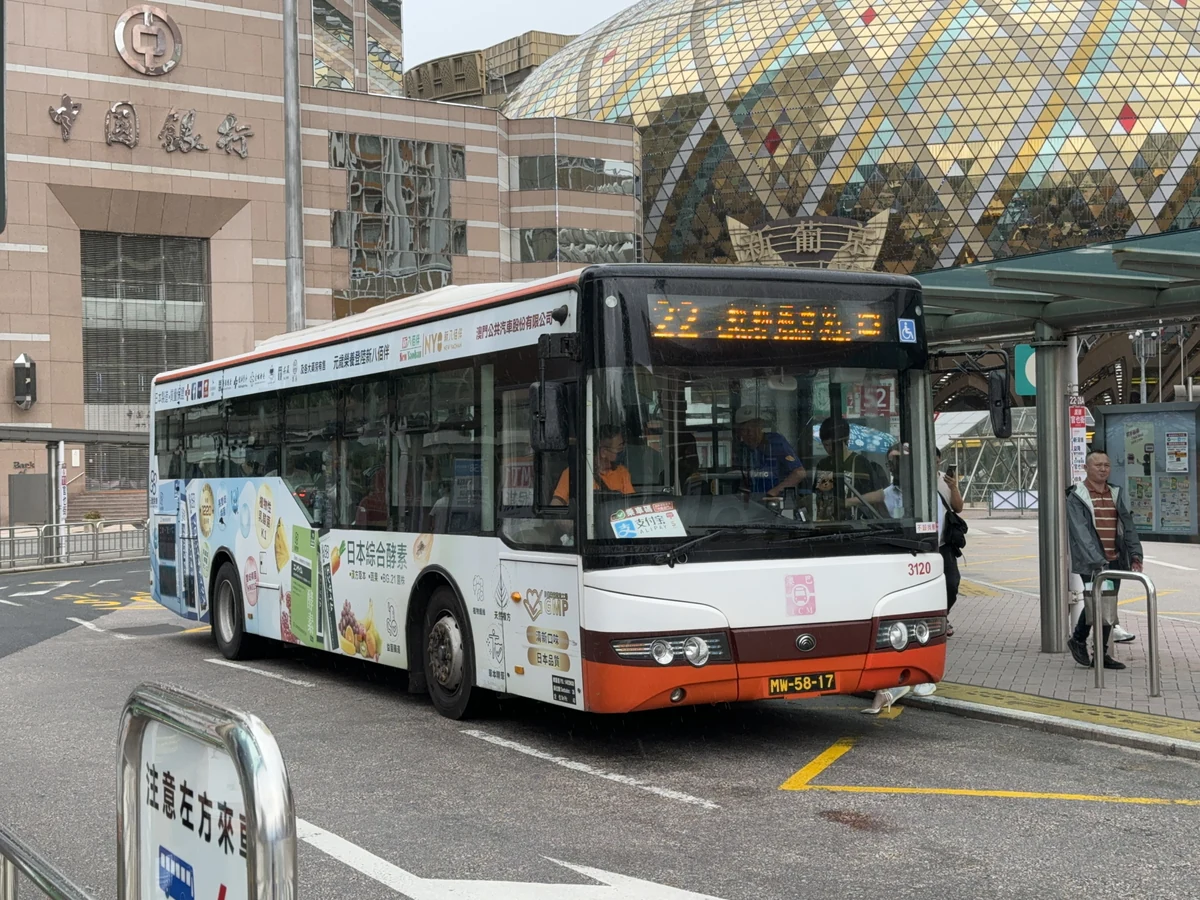
Look up the return separately. One-way streets, works and temporary event diversions can mean the return stop is not across the road. Check the bureau’s temporary bus adjustments before travelling rather than relying on an old screenshot. The historical photographs here explain vehicles and stop signs; they are not a current route map.
Understand who pays MOP 6, MOP 3 or MOP 4
The official fare rules distinguish the normal fare from approved concessionary payment. Two people using phones can pay different amounts because their payment tools and eligibility differ.
| Payment or passenger condition | How to budget |
|---|---|
| Cash or supported non-local transit QR | Normal fare MOP 6 per person per ride; non-local QR has no fare or transfer discount |
| Approved stored-value card | MOP 3 on regular routes; MOP 4 on express routes with X in the route number |
| Approved electronic payment for Macau financial-institution customers | The applicable local electronic fare and transfer rules apply; a wallet brand alone does not establish eligibility |
| Child no taller than one metre, accompanied by an adult | Exempt under the official rule; exactly one metre is included |
Student, elderly and disability concessions depend on approved card categories. Visitors should not budget for half-price or free travel solely because of age or possession of any student ID. If buying a stored-value card, consider purchase, top-up and any refund arrangements as well as the per-ride saving. For one or two journeys, convenience may matter more than an extra trip to obtain a card.
Activate the right transit QR before joining the queue
The bureau lists supported non-local payments including Mainland China and Hong Kong Alipay, UnionPay QuickPass linked to a non-local-issued UnionPay card, and Mainland China and Hong Kong WeChat Pay. In WeChat, the relevant mini-programme can be found by searching “搭車碼” and selecting Macau travel. Open the transit code for the service rather than assuming an ordinary merchant payment code is interchangeable.
Complete authorisation at the hotel or before the bus arrives. Check data access, battery and an available payment source. Menus and activation steps can change between app versions, so follow the Macau service shown in your own account. Finding that you must log in, authorise payment or switch regions at the door makes boarding more difficult for everyone.
HK01’s AlipayHK guide illustrates why QR payment can reduce the need to prepare coins; it is older media guidance, so fares and accepted tools here were checked separately with the bureau. If you lack a supported account, cannot connect or prefer not to activate a new service, prepare the Macau pataca fare instead. Transmac’s passenger information states that the correct fare is paid when boarding and change is not given. Failure of one app is not evidence that all bus payment options have failed.

Companion payment and transfer discounts are separate things
Supported apps now offer companion codes. The government’s February 2026 announcement explicitly covers payment for up to two additional companions through Mainland China and Hong Kong WeChat Pay and Mainland China Alipay. The current fare page also records the subsequent addition of Hong Kong Alipay. Check that your app offers the Macau companion function before relying on it; repeatedly scanning a personal code is not a substitute for that function.
For non-local companion codes, each person still pays MOP 6 per ride. Two adults without a free-travel entitlement taking two separate buses would therefore pay 2 people × 2 rides × MOP 6, or MOP 24. This example includes no additional concession and does not imply an unlimited day ticket.
Approved stored-value-card holders can normally transfer to another route within 45 minutes of starting the first journey. The defined cases involving the Macau peninsula and the Coloane fare zone allow 60 minutes. Where the first fare is at least as high as the second, the second ride is free; if the second fare is higher, the difference is payable. The Coloane fare zone runs south of Lotus Road to Coloane, excluding the University of Macau campus. Do not extend the 60-minute rule to every bridge or Cotai journey, or apply it to non-local transit QR payments.
Signal to board, then prepare early for your stop
The bureau advises waving to an approaching bus, queuing and using the designated doors only after the vehicle has stopped. Check the route before boarding. Ask a brief question while the bus is safely stopped if necessary, rather than distracting the driver while moving. After payment, move farther inside and hold a handrail; do not stay at the door to reorganise bags or inspect the transaction.
Listen to announcements and compare them with the stop name you saved. Transmac asks passengers to press the stop-request bell early. Keep children, older companions and belongings together, and wait for the bus to stop before getting on or off. If you miss your stop, remain aboard until the next normal stopping point and replan there; do not request an unscheduled roadside stop. Follow each vehicle’s door markings rather than importing Hong Kong tram boarding habits.
Do not eat or drink on board, occupy seats with bags or obstruct the aisle. Before leaving, check for a phone, card or small bag around your seat. Once off the vehicle, move to a safe place before opening the map. Agreeing the stop with your companions beforehand is easier than calling across a crowded bus at the last moment.
Baggage and pushchairs still need clear space
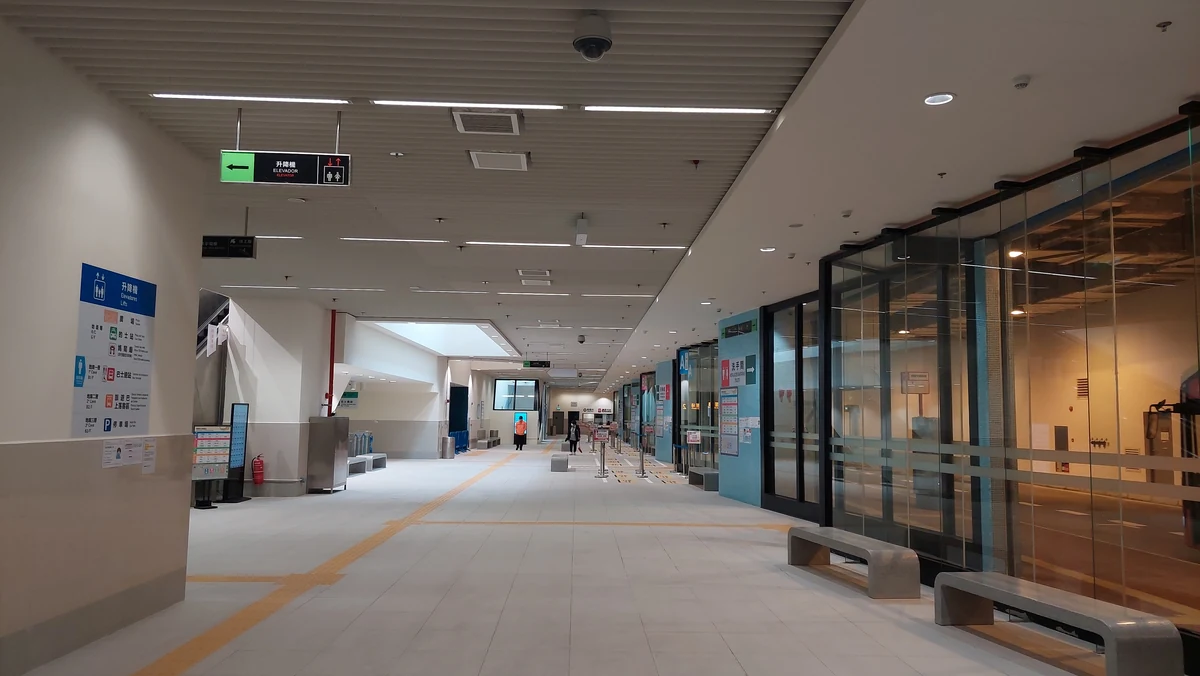
The bureau’s passenger safety rules limit ordinary carried items to a combined length, width and height of 170 cm, with no side longer than 130 cm. Both conditions apply. A cabin-size suitcase does not settle the question if you also have bulky bags or long objects, and belongings must not inconvenience other passengers.
Musical instruments, sporting equipment, pushchairs and wheelchairs are exempt from those dimension limits. Bicycles must be foldable, and folding bicycles and pushchairs must be properly folded on board. Families can consolidate hanging bags and have another adult look after the child while preparing the pushchair, rather than trying to manage everything at the door. Battery-powered mobility devices are generally prohibited, except an electric wheelchair used by the disabled passenger themself.
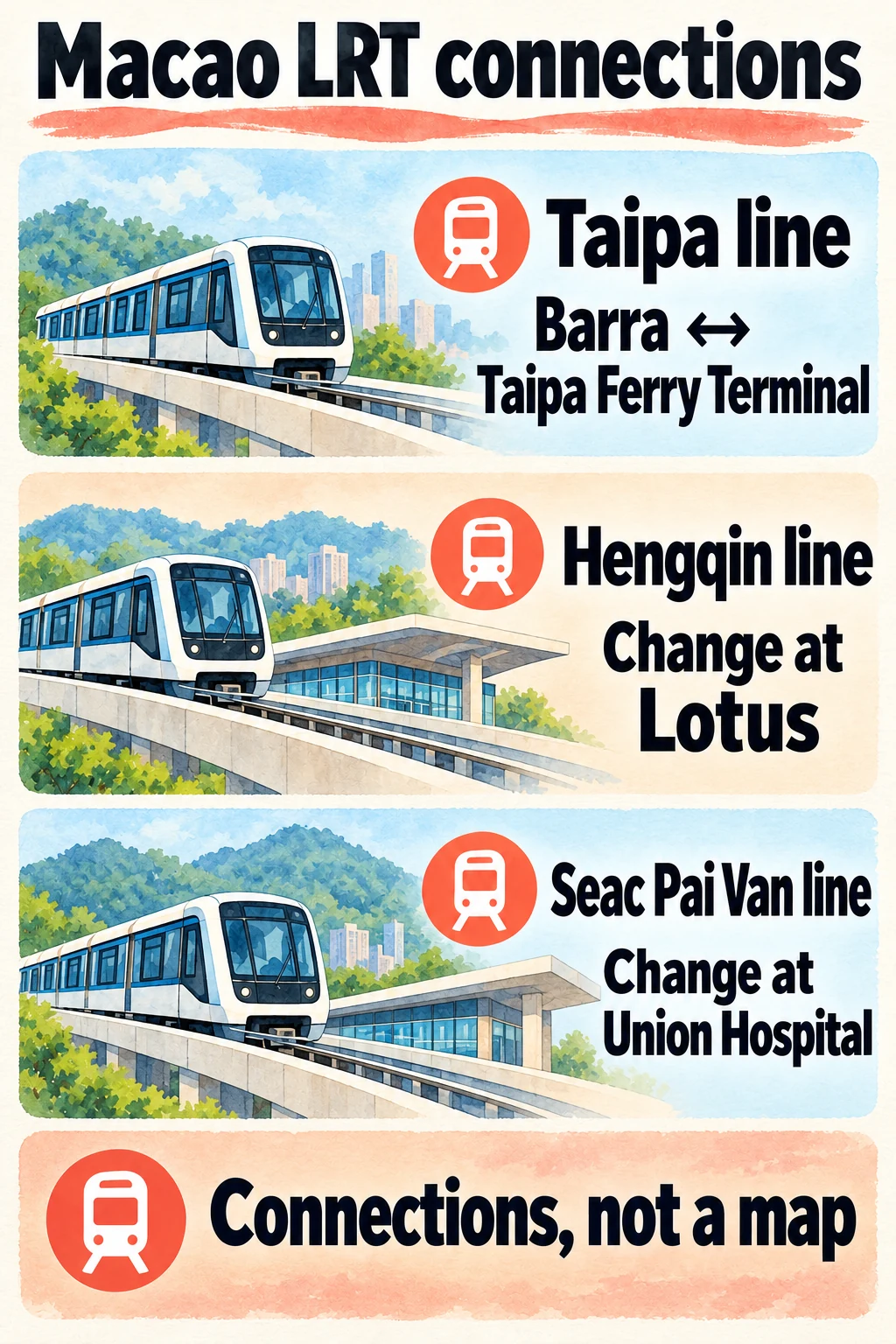
The driver may refuse an item that causes inconvenience or a safety risk even when its dimensions comply. A group with several cases, an infant needing continuous attention or a companion with limited mobility should compare the practical boarding effort. If your destination is near the railway, the first-time Macau LRT guide offers another option, although the walk from a station to the hotel still needs consideration.

Compare the complete journey before choosing a transfer
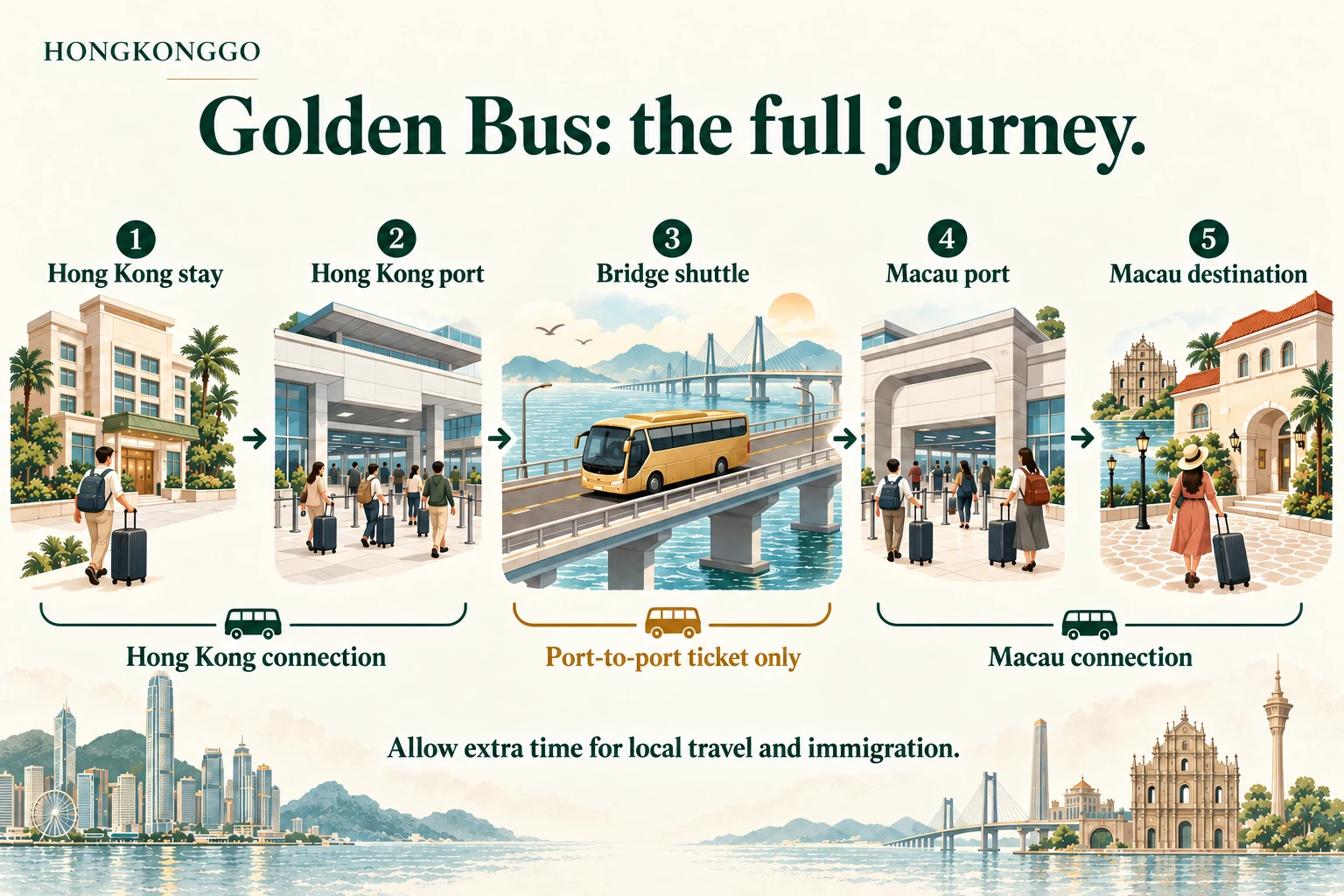
With a small bag, a clear route and manageable walking, buses work well for exploring Macau in stages. After checkout with several cases, for someone who cannot stand comfortably, or when an appointment leaves little flexibility, compare a point-to-point transfer. Consider people, luggage, walking and waiting rather than comparing one bus fare with the cost of an entire vehicle.
For a transfer enquiry, provide the full hotel or address, departure window, passenger count and bags. Price, waiting and permitted stopping points require confirmation. A public bus stop is not automatically a place where a private driver can wait. Bus fares, routes and temporary changes should likewise be checked with the authority and operator at the time of travel.
Your pre-journey checklist
- Route direction, boarding position and destination stop checked; return looked up separately.
- Cash, non-local QR or approved stored-value fare identified without assuming a concession.
- Companion count, child exemption and phone battery checked.
- Baggage dimensions, pushchair folding and help for companions planned.
Sources & further reading
This article draws on the media coverage and public information below. Event and transport arrangements can change; check the latest details before travelling.
- Macau Transport Bureau: bus fares and electronic-payment rulesdsat.gov.mo (Opens in a new tab)
- Macau Transport Bureau: passenger safety and carried-item limitsdsat.gov.mo (Opens in a new tab)
- Macau government: February 2026 companion-code announcementgov.mo (Opens in a new tab)
- Transmac: passenger information, correct cash and stop requeststransmac.com.mo (Opens in a new tab)
- HK01: AlipayHK Macau transit guide; earlier media backgroundhk01.com (Opens in a new tab)
Make it your journey
If your Macau journey involves hotel luggage, a border crossing or travel to a nearby city, share the people, bags and full addresses with HONGKONGGO to compare a point-to-point transfer for that leg.