You do not need to memorise dynasties or kiln names to enjoy Hong Kong’s Museum of Tea Ware. Choose two or three objects and ask how they were used, what their surfaces reveal and why they were decorated that way. The exhibition area of the K.S. Lo Gallery will close for renovation from 27 October 2026 to March 2027. This guide centres on the main Flagstaff House building; check the museum’s latest notice before visiting.
Find the right museum and separate the two buildings
The Flagstaff House Museum of Tea Ware is inside Hong Kong Park at 10 Cotton Tree Drive, Central. Its website belongs to the Hong Kong Museum of Art, but that does not make the main art museum on Salisbury Road in Tsim Sha Tsui your destination. This is a specialist collection for visitors willing to spend time looking at objects. Admission does not automatically include a tea tasting or a pottery workshop.
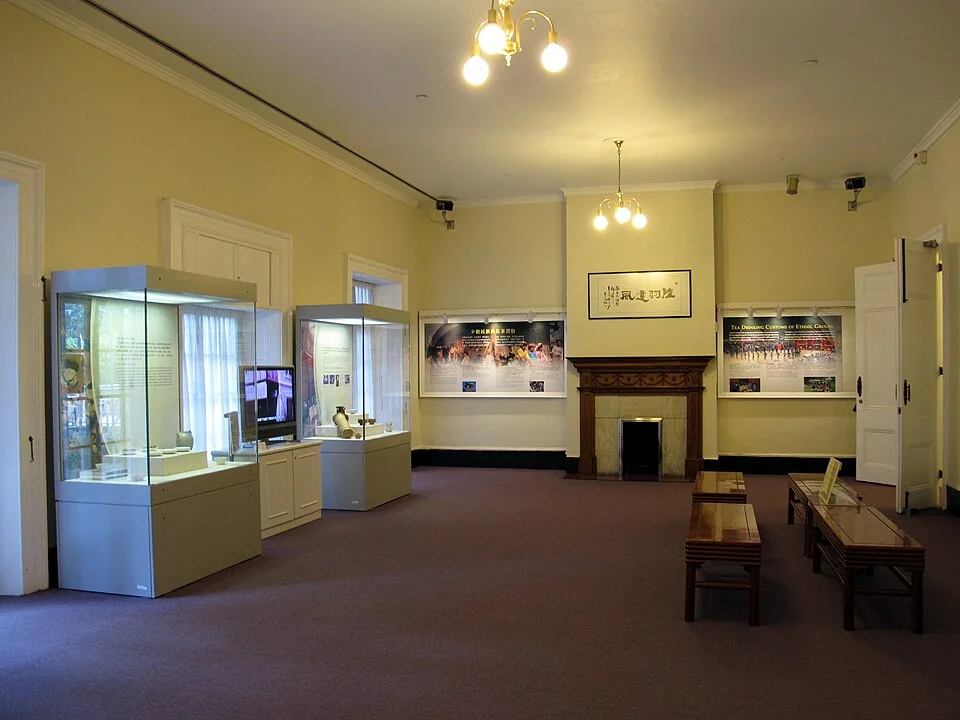
The official museum history dates its establishment to 1984. Its founding collection came from Dr K.S. Lo’s 1981 donation of about 600 ceramic and purple-clay tea vessels and related objects. Flagstaff House was built between 1844 and 1846, formerly housed the Commander of the British Forces and became a declared monument in 1989. Look at the relationship between rooms, windows and display cases before examining the pots: a historic residence and a specialist collection share this setting.
Distinguish Flagstaff House from the K.S. Lo Gallery. The permanent-exhibition page announces the latter’s exhibition-area closure from 27 October 2026 to March 2027. Do not make its ceramics and seals essential stops during that period. Main-building exhibitions have their own notices and daily access arrangements. Allow roughly 60–90 minutes for a selective visit, followed by a short park walk; this is our planning suggestion, not an official tour duration.
First look at function: how would it be lifted, poured and set down?
The ground-floor permanent exhibition, “Let’s Talk about Tea through the Ages”, follows Chinese tea-drinking history through different kinds of vessels. Resist calling every unfamiliar shape a teapot. Bowls, cups, pots and other implements have different roles, so begin with the object label. Tea ware records ways of preparing and sharing a drink, as well as colour and visual taste.
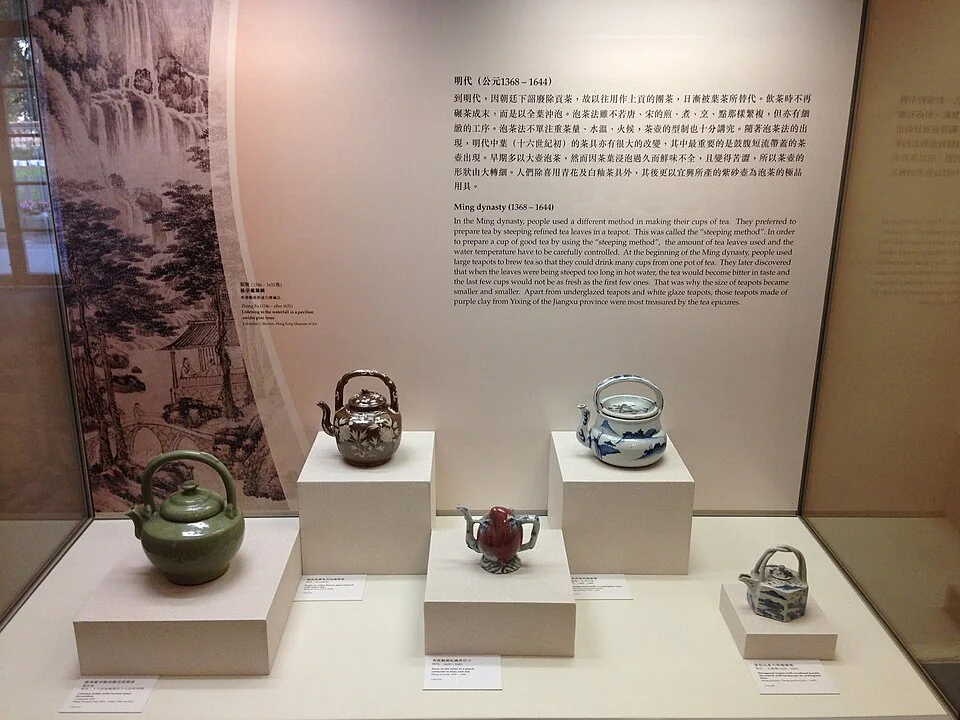
Choose two pots with clearly different silhouettes. Find the spout, handle and lid with your eyes. An overhead handle and a side handle suggest different ways of holding a vessel; height, the opening and the position of the body turn a general impression of beauty into specific questions. Observe through the case rather than touching or attempting to test an object.
In the 2010 reference photograph below, one pot has a sweeping overhead handle; the other combines a low body with a side handle. Describe that difference before reading about the maker, period and technique. The photograph is useful for practising observation, but does not establish that either pot is currently on display.
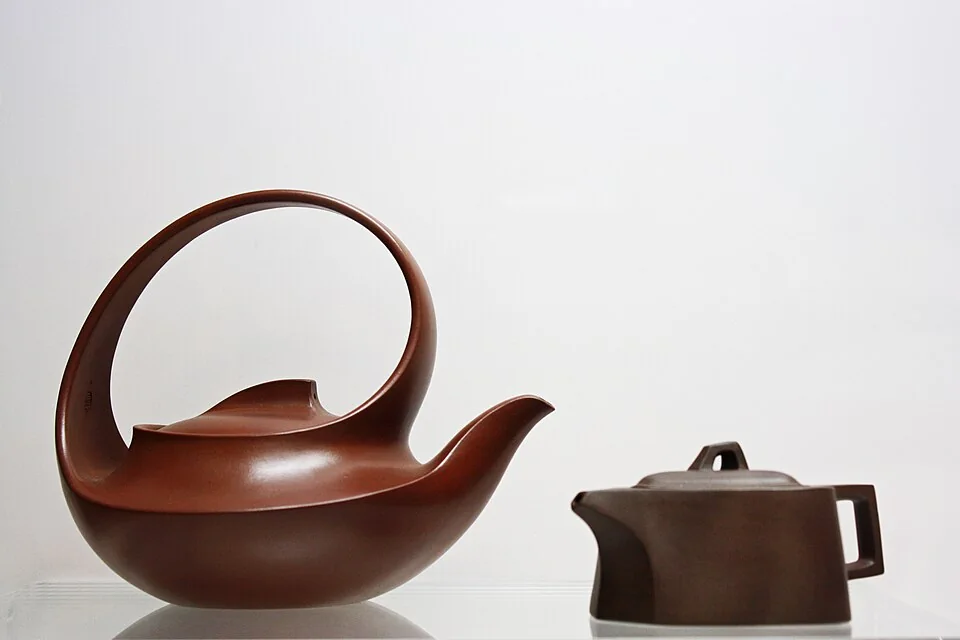
With a child, one question is enough: which handle is easier to spot, or which lid seems to continue the outline of the body? Listen to the description before introducing terminology. Comparing visible features can be enjoyable without turning the visit into a test of dates or requiring every gallery to be completed.
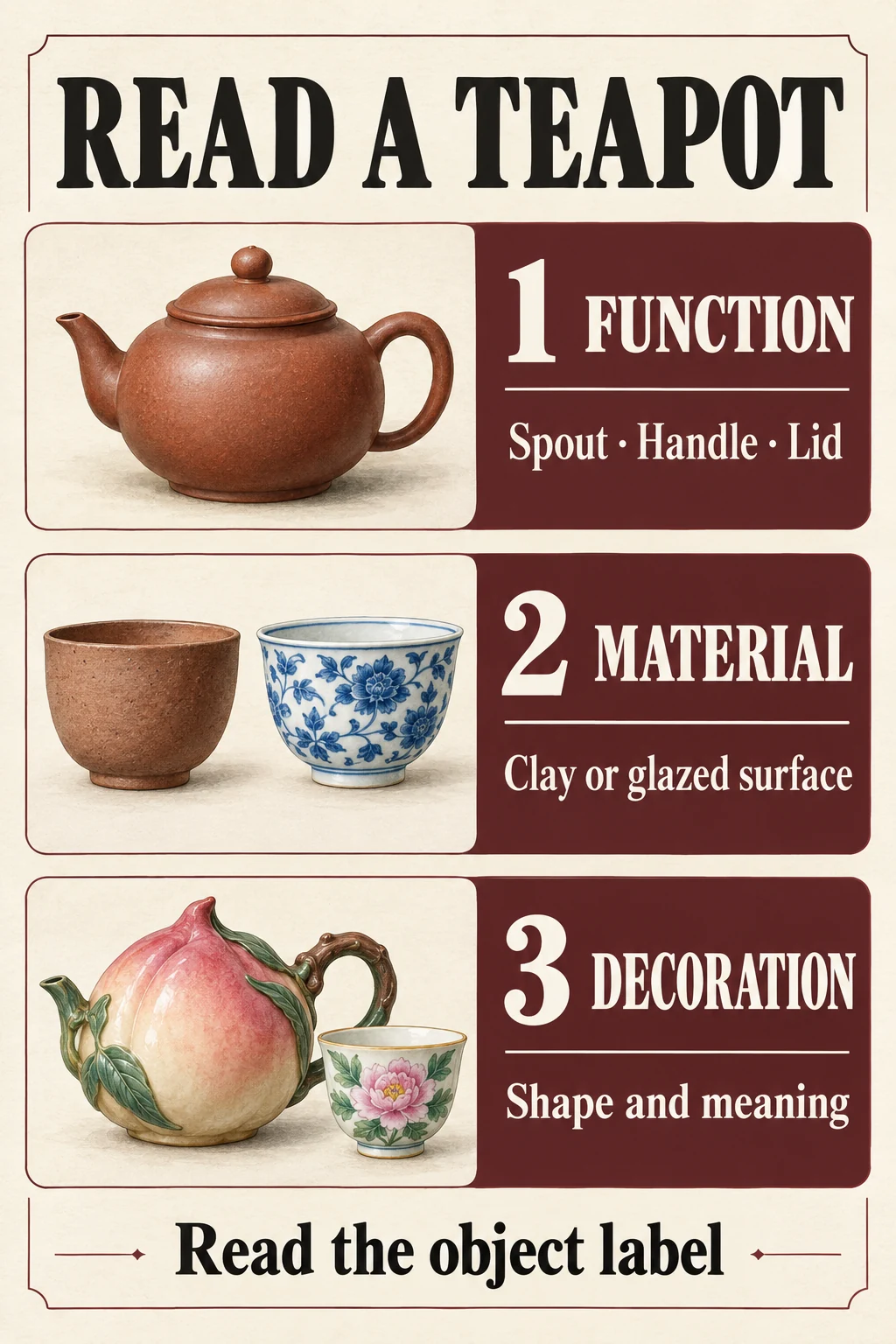
Then look at material, without identifying it by colour alone
The online K.S. Lo collection includes purple-clay vessels, glazed ceramics and decorated cups and pots. It is a collection resource, not a list of everything in today’s cases. Inside the museum, select a relatively plain surface and another with glaze or painted decoration. Notice how the light behaves around the rim and across the body.
Does the surface appear fine or granular? Is the reflection sharp or soft? Is decoration painted, incised, applied or formed by the body’s own contours? These are ways to look closely, not an authentication method. A brown colour alone cannot identify a clay; a photograph cannot establish value, authenticity or brewing performance. Use the exhibit label for the material and technique, and leave unsupported conclusions open.
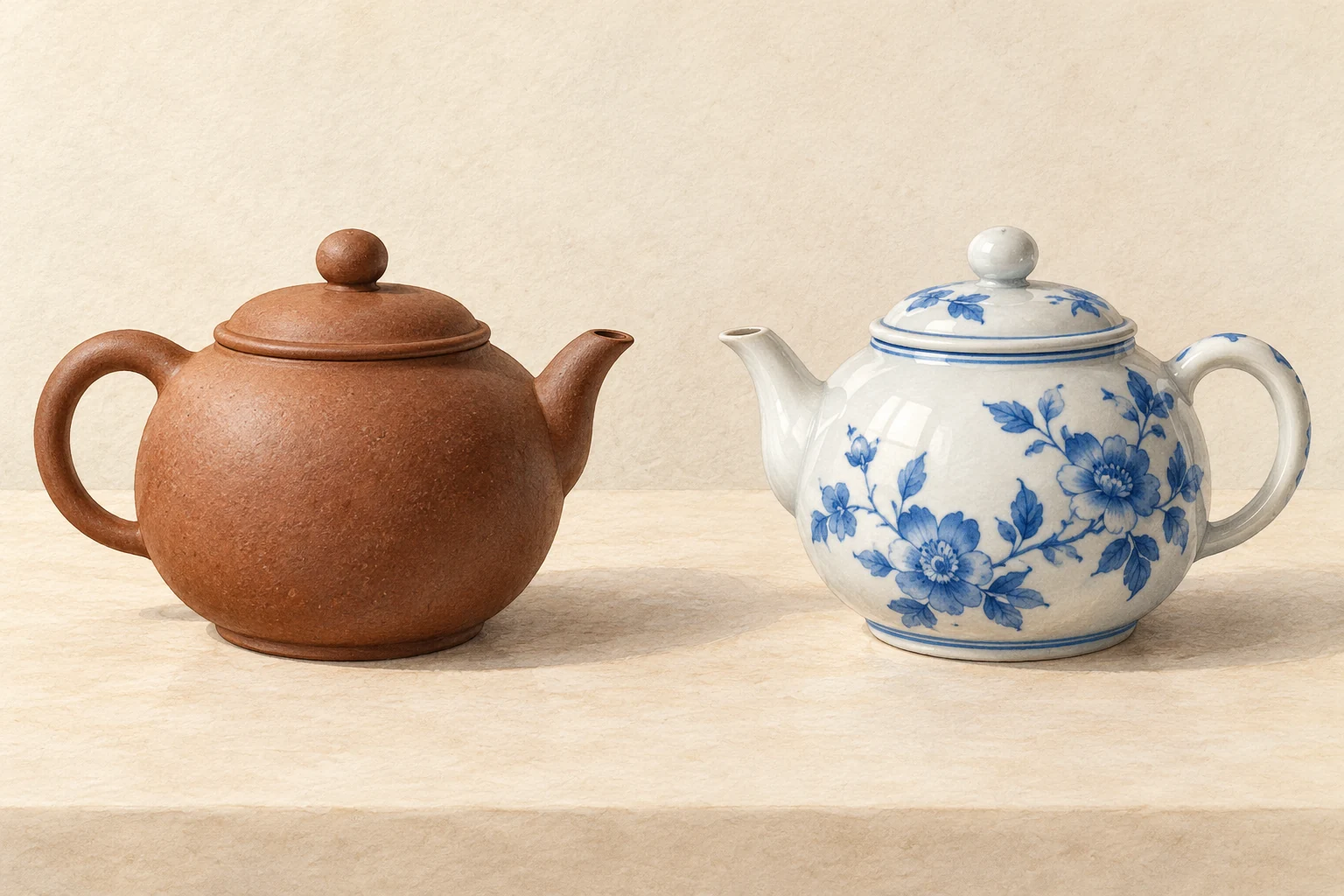
The illustration below places an unglazed-looking surface beside white glaze and blue decoration to show a comparison. The vessels are conceptual, not identified collection pieces. Their juxtaposition does not mean they share a period, technique or use. Spending a little longer on one pair often leaves a clearer memory than photographing an entire row of cases.
Finally ask what a flower or peach shape contributes
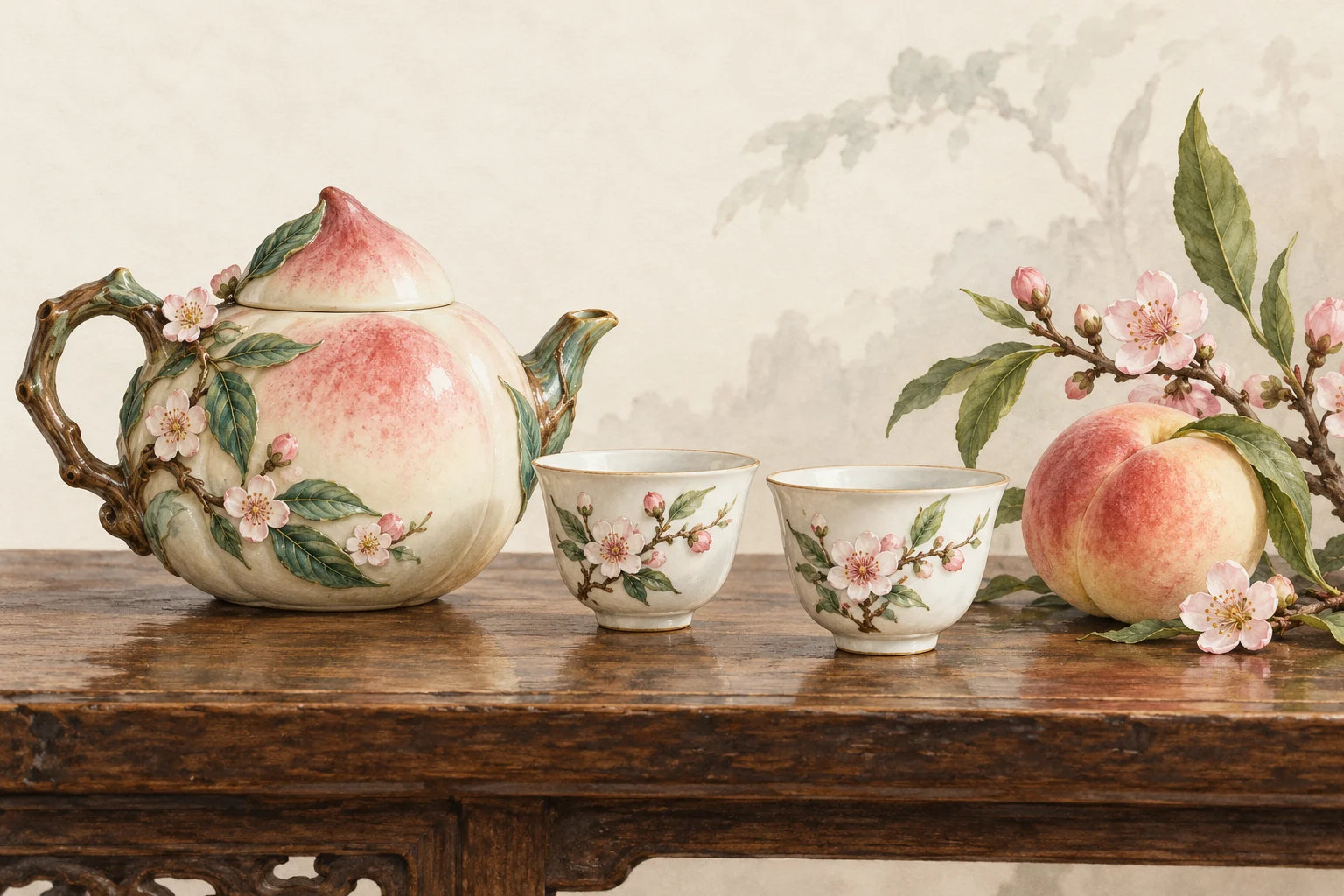
Decoration can connect a vessel with seasons, good wishes and social exchange. HK01’s 2024 museum-anniversary feature discussed pots with birthday and auspicious meanings, alongside cups decorated with flowers associated with the months. This historical account offers a way into the subject; its anniversary programme is not a timetable for 2026.
Try two stages when looking at a floral cup or a form borrowed from nature. First describe what is visible: where a flower sits, how a stem wraps around the cup, or how a vessel borrows the outline of a fruit. Then read the label for the particular symbolism, inscription or historical context. Different flowers need not carry the same meaning, and a visitor’s personal association is not automatically the maker’s intention.
The museum currently lists “Shape of Tea”, which began on 26 November 2025. Wood and bamboo artists revisit tea’s forms through the collection and the everyday aesthetics of the Song dynasty. It occupies Galleries 5–8 on the first floor and the ground-floor activity room in Flagstaff House. After traditional objects, take one question into these contemporary works: how can changing a material or form change the way tea is experienced? The page checked for this guide gives no closing date, so recheck the exhibition and gallery arrangements before travelling.
Organise the visit around a few questions
| Part of the visit | Our suggested focus | What you can leave out |
|---|---|---|
| On arrival | Confirm the day’s exhibitions, floors and photography rules | Photographing every case immediately |
| Ground-floor permanent display | Compare function and surfaces in two or three objects | Memorising a complete sequence of dynasties |
| Optional special exhibition | Explore tea and contemporary making if interested and comfortable | Assuming an activity room means a drop-in workshop |
| Before leaving | Note one favourite object and one question | Making the K.S. Lo exhibition area essential during renovation |
With only half an hour, concentrate on a small part of the ground-floor display. If someone requires step-free access, ask the museum about the main building before setting out. Its FAQ lists a ground-floor accessible washroom, supporting material for the main building’s first-floor displays and a lift in the K.S. Lo Gallery. The lift in one building is not evidence that every floor of the other can be reached without steps; renovation arrangements also matter.
Check hours, approach and photography before departure
The official FAQ lists free admission and normal hours of 10:00–18:00, with Tuesday closure except on public holidays. Christmas Eve and Chinese New Year’s Eve close at 17:00; the first two days of Chinese New Year are closed. Weather, works and programmes can affect arrangements. Free museum admission does not mean every activity needs no registration.
Admiralty is the suggested MTR approach. The museum gives approximately ten minutes on foot from Exit C1, following signs for the park and museum. This estimate does not include finding an exit within the station, waiting for a lift or taking a break. Check the appropriate station route separately when using a wheelchair or pushchair. Do not direct an ordinary vehicle into the park: permitted drop-off arrangements and the remaining walk need their own planning.
Photography without flash or a tripod is permitted in most galleries, subject to signs and staff guidance. Do not press a camera against glass to reduce reflections or block someone reading a label. For tea afterwards or a workshop, consult the relevant current opening or booking information separately. A free museum visit does not reserve a tea table or a place in a class.
Your pre-journey checklist
- Save 10 Cotton Tree Drive inside Hong Kong Park, rather than the art museum in Tsim Sha Tsui.
- Check Tuesday and holiday arrangements; leave the K.S. Lo exhibition area out from 27 October 2026 to March 2027.
- Compare function, material and decoration in a few objects; an online collection is not today’s display list.
- Confirm photography, accessible floors and activity registration with the museum.
Sources & further reading
This article draws on the media coverage and public information below. Event and transport arrangements can change; check the latest details before travelling.
- Museum of Tea Ware: address and visiting informationhk.art.museum (Opens in a new tab)
- Hong Kong Museum of Art: museum historyhk.art.museum (Opens in a new tab)
- Museum of Tea Ware: hours, transport, access and photographyhk.art.museum (Opens in a new tab)
- Museum of Tea Ware: permanent displays and K.S. Lo Gallery renovationhk.art.museum (Opens in a new tab)
- Museum of Tea Ware: Shape of Tea exhibitionhk.art.museum (Opens in a new tab)
- Hong Kong Museum of Art: online K.S. Lo collectionhk.art.museum (Opens in a new tab)
- HK01: 2024 museum anniversary feature, historical contexthk01.com (Opens in a new tab)
- Time Out: Hong Kong tea-culture ideas, 2018 backgroundtimeout.hk (Opens in a new tab)
Make it your journey
Give the museum a complete short visit, then add the park or a nearby meal. For another day’s heritage and harbour exploration, see our Central, harbour and West Kowloon itinerary; the two different rhythms need not be squeezed into one morning.