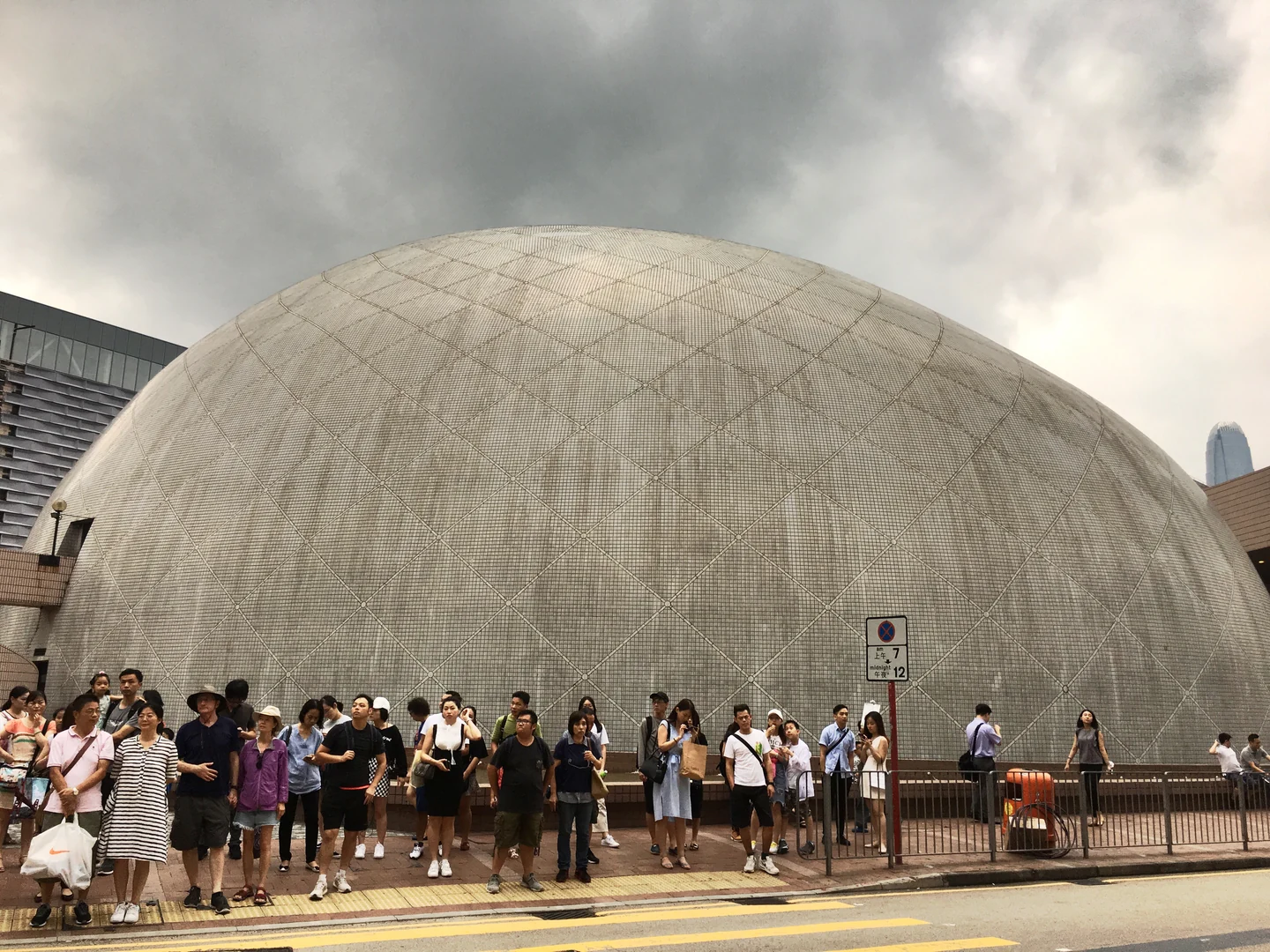
Hong Kong Space Museum offers two quite different experiences: exhibition halls where you explore at your own pace, and a Space Theatre with scheduled screenings. For a first visit, choose a scientific question that interests you before deciding whether to add a dome show. We suggest roughly one and a half to two hours for the galleries, or around three hours with a show, waiting and a break. The admissions are separate. Free Wednesday access to the galleries does not make the theatre free.
Choose the galleries or book a show first?
If your party wants to try things, stop and discuss them, make the permanent galleries the main attraction. The ground-floor Hall of the Cosmos moves from the Solar System to stars, the Milky Way and more distant galaxies. Upstairs, the Hall of Space Exploration considers how people leave Earth, live in space and use instruments to investigate distant worlds. The museum currently lists about a hundred exhibits, roughly half interactive. You need not press every button to have a worthwhile visit. Permanent exhibition overview
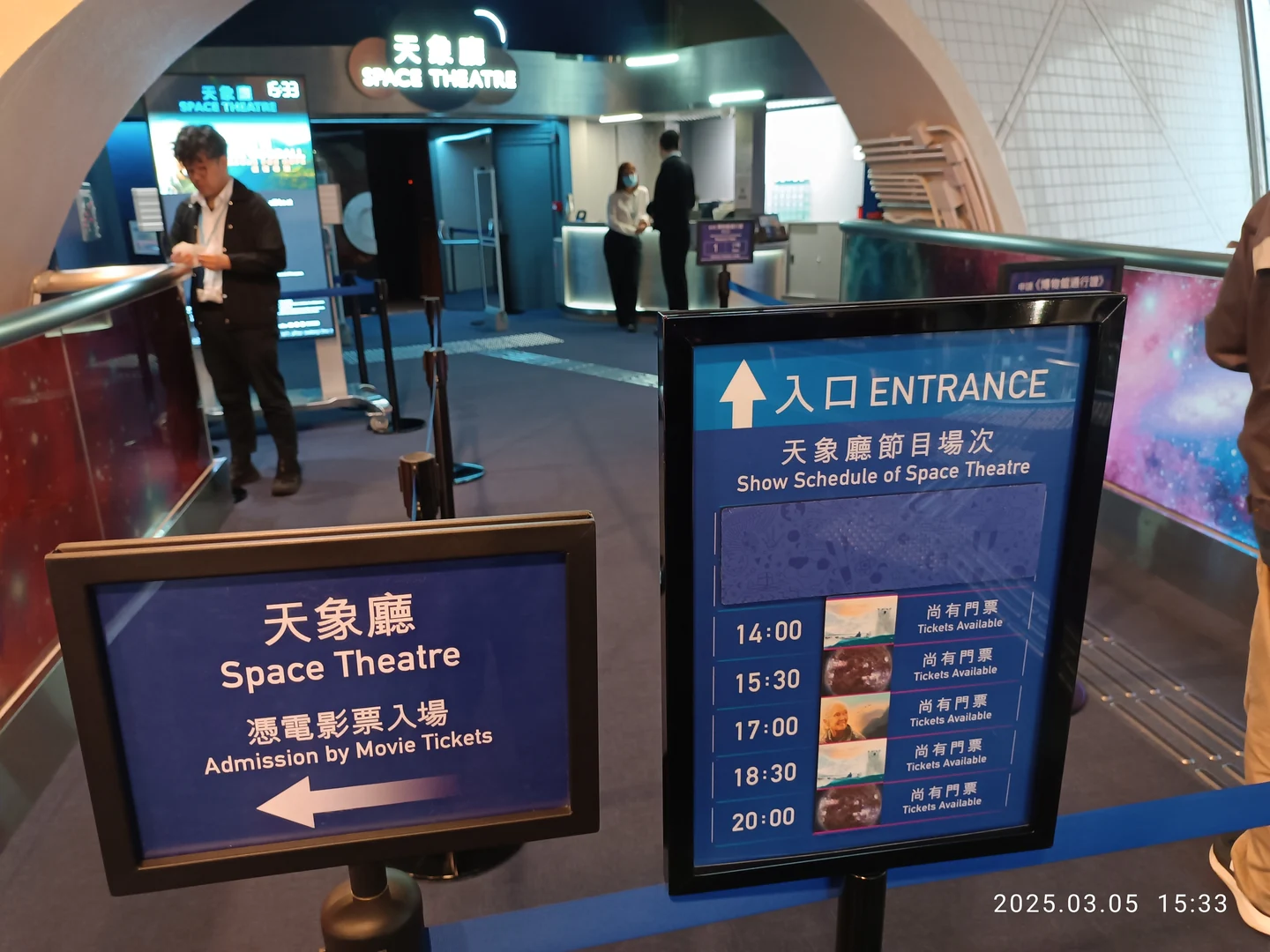
The Space Theatre suits visitors who want to sit through a complete programme. Check its subject, running time, language and screening time, then place your gallery visit around it. If anyone is under three, rule out the theatre first: its age restriction differs from gallery admission. Someone uncomfortable with darkness, strong visual motion or prolonged sitting can simply choose the exhibitions. Visiting the dome-shaped building does not oblige you to buy both types of ticket.
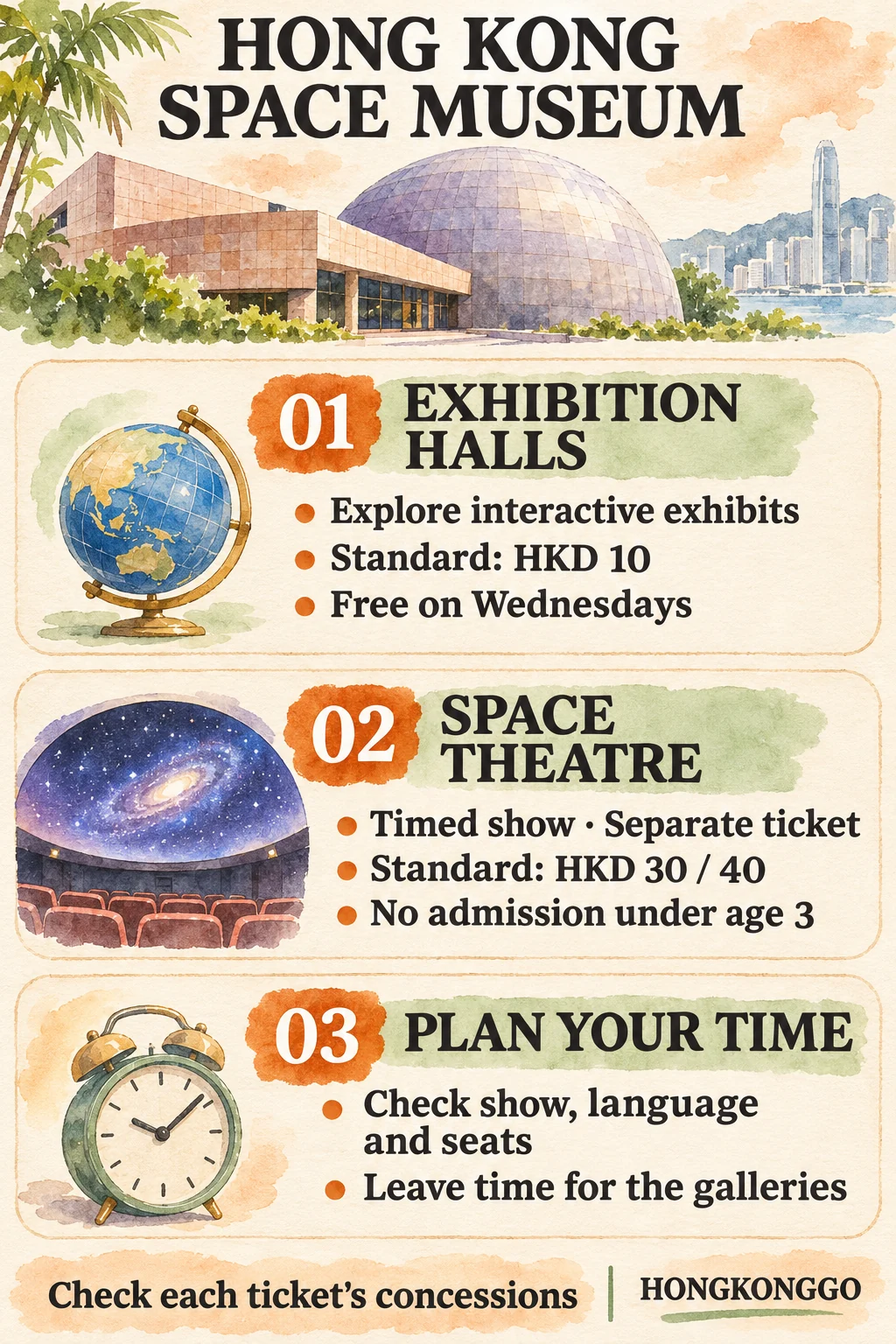
| Choice | Arrangements checked on 21 November 2026 | Planning point |
|---|---|---|
| Exhibition halls | Standard HKD10; concession HKD5; free on Wednesdays | Full-time students and valid Museum Pass holders enter free; bring proof |
| Space Theatre | Standard front stalls HKD30, other stalls HKD40; concessions HKD15 and HKD20 respectively | Buy a separate ticket for a specified screening; no admission under three |
| Galleries only | Our suggestion: one and a half to two hours | Explore a few exhibits carefully, allowing for queues and rest |
| Galleries plus a show | Our suggestion: around three hours | Work around the actual screening booked and allow for entry and waiting |
Gallery concessions cover people with disabilities and one accompanying carer, and people aged sixty or over. Children under four enter the galleries free when accompanied by an adult with a ticket. Theatre concessions also cover full-time students, but a student's theatre ticket is discounted rather than free. Do not transfer an entitlement from one admission category to the other. Check the museum's ticketing information and availability for your visit.
In the Hall of the Cosmos, ask what a model changes
Downstairs, try three questions at an interactive exhibit: what can I see, what can I control, and why does the result change? At the aurora exhibit described by the museum, visitors adjust solar-wind intensity and observe changes around a model Earth in a vacuum. Watch once, then vary one condition rather than moving controls rapidly. The equipment demonstrates a relationship; the light and apparatus do not reproduce the universe's full scale or every part of the real process.
Another approach is to move outward in scale. Locate Earth in the Solar System section, then follow the account of stars and the Milky Way. Ask whether the object being discussed is a planet, a star or a system containing many stars. A child can follow this distinction without memorising every name, and it prevents the universe becoming one undifferentiated picture of a starry sky. The museum also describes a dry-ice demonstration of comet jets. Whether it is operating and how visitors participate depend on the instructions and staff arrangements on the day.
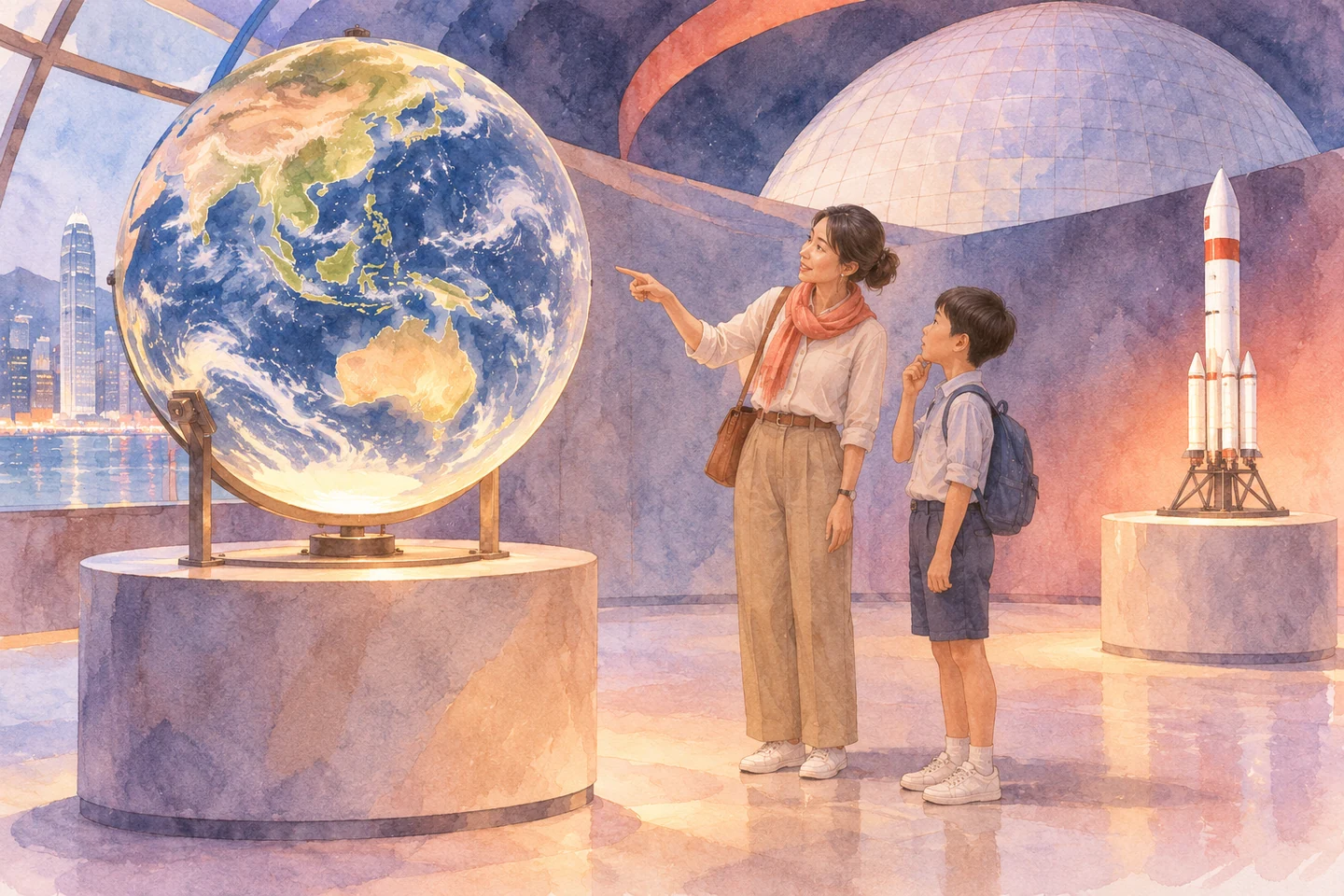
Agree that each companion will pick one exhibit and explain it in their own words before leaving. If the result remains puzzling, return to the explanation and identify whether the device represents a motion, an environment or a way of observing something. Taking one good question away can be more useful than hurrying between installations to complete the room.
Upstairs, separate simulation from spaceflight
In the Hall of Space Exploration, change the question to what happens to familiar activities away from Earth. The museum's Disorientation exhibit presents an upside-down virtual space station, while Weightlessness uses an astronaut model in free fall to explain the phenomenon. A confusing visual impression does not mean your own body has escaped Earth's gravity. Discussing that difference connects an entertaining experience with the underlying science.
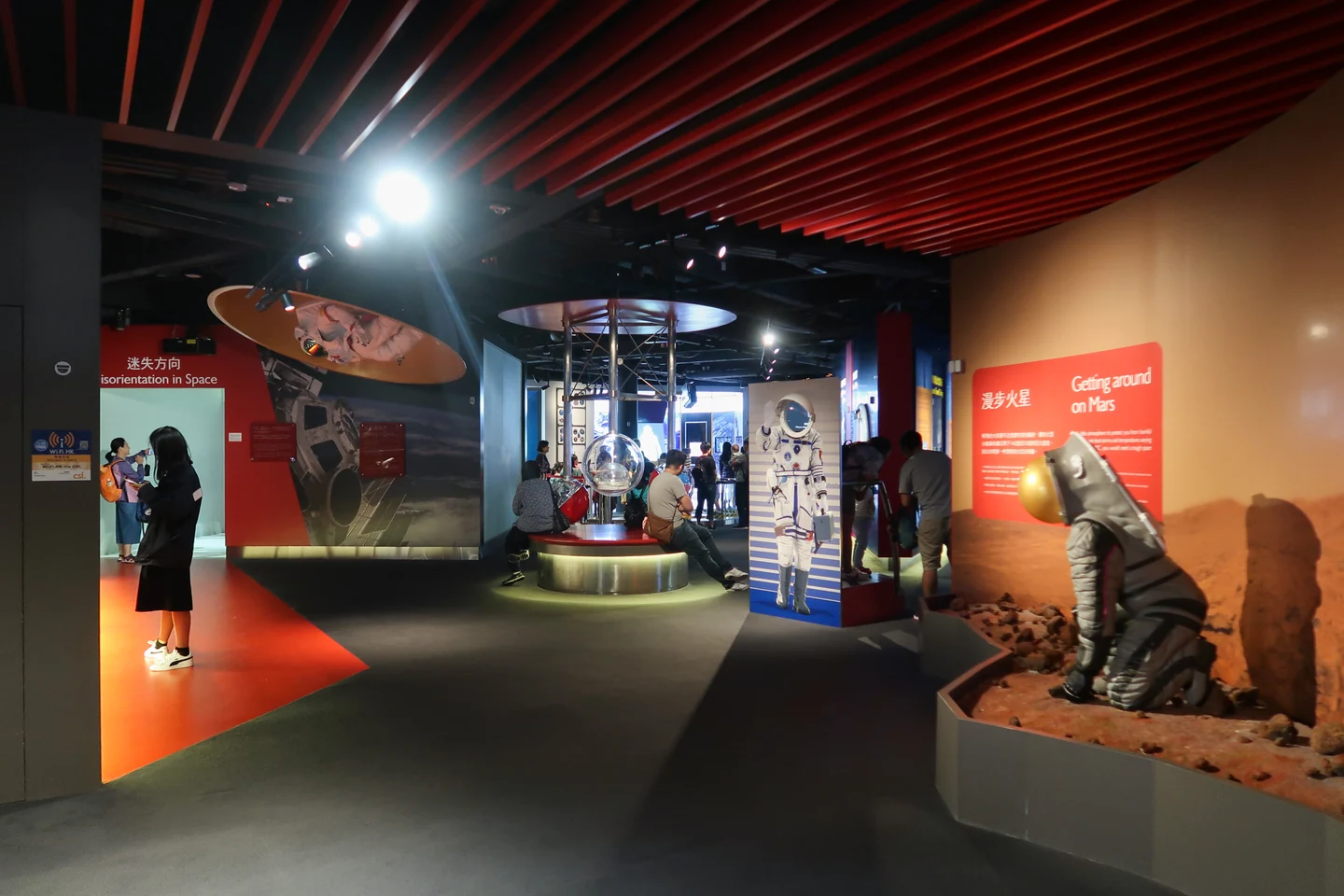
Next, choose an instrument or vehicle to study. The museum lists a full-scale Zhurong Mars rover model, a James Webb Space Telescope model, and Moon and Mars virtual-reality exhibits using data from Chang'e-4 and Tianwen-1. A rover raises questions about moving across a surface; a telescope prompts questions about receiving information from far away. Rather than remembering every name, compare travelling over a place with observing it from a distance. They answer different kinds of question.
If a popular interactive exhibit has a queue, look at nearby models and explanations before deciding whether to return. This guide does not promise access to a particular simulator. Check individual maintenance notices, age or height requirements and staff instructions at the venue.
Choose a dome show by subject before running time
On 21 November 2026 the museum lists three general programmes. The 3D dome film Explore 3D concerns astronomical exploration and the development of science. It runs for twenty-eight minutes and is scheduled from 15 October 2026 to 14 July 2027. The dome film Wild Asia: Life at Extremes focuses on animals in different Asian environments, runs for forty-three minutes, and is scheduled from 16 September 2026 to 14 June 2027. The sky show Shenzhou 13 – Space Travel uses footage taken by astronauts during the Shenzhou-13 mission; its twenty-eight-minute programme runs from 15 May 2026 to 14 February 2027. Official programmes and timetable
For a continuation of the galleries' astronomy questions, start with the astronomy or spaceflight subject. Choose the Asian wildlife film if your companions prefer a nature documentary. The venue's name does not mean every dome film is exclusively about planets. A programme's overall run also does not mean it screens at every time on every day: check tickets for the actual date.
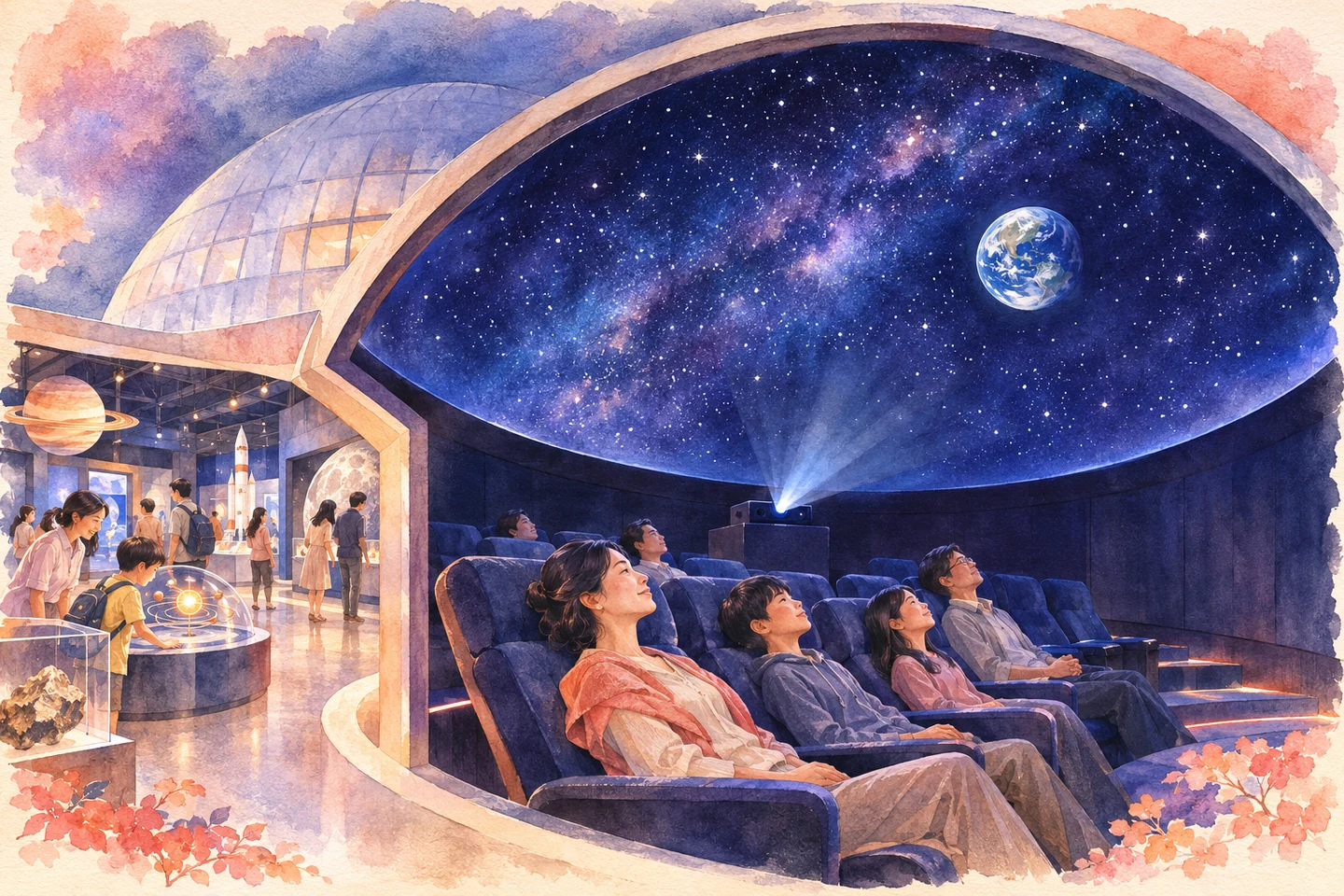
An asterisk in the museum timetable marks an English screening; the other listed screenings are Cantonese. Its headphone system also offers languages including Cantonese, Putonghua and English. Confirm the language arrangements of the particular programme and screening before purchasing, especially for companions who listen only in English or Putonghua. Returning to a related exhibit afterwards can help connect an impressive image with an idea, without squeezing both experiences into the same hour.
Match opening, ticket sales and your arrival
Normal museum hours are 13:00–21:00 on Mondays and Wednesdays to Fridays, and 10:00–21:00 on Saturdays, Sundays and public holidays. It closes on Tuesdays except public holidays, and on the first two days of Chinese New Year. Christmas Eve and Chinese New Year's Eve have an earlier 17:00 closure. Museum opening information
The box office follows a slightly different timetable. On an ordinary Monday or Wednesday to Friday it starts selling tickets at noon, but the galleries do not open until 13:00. The museum offers a week's advance sales, with the online system updating at 10:00 each morning. Earlier ticket sales do not give earlier gallery access. Save your ticket and screening details before travelling, and allow time to find the entrance, collect tickets if needed and pass admission checks.
The address is 10 Salisbury Road, Tsim Sha Tsui. Search for Hong Kong Space Museum on your map rather than going to Hong Kong Science Museum, which is also in Tsim Sha Tsui. Eating and drinking are restricted to the foyer, and large bags are awkward around exhibits. Arrange a meal before or after the visit. The museum lists lifts, an accessible toilet and wheelchair positions in the theatre; contact staff ahead for a particular access requirement. Facilities and visiting rules
Your pre-journey checklist
- Decide whether to visit the galleries alone or add a separately ticketed show; Wednesday gallery admission does not include the theatre.
- Check ages and each admission category's concessions, and carry valid evidence.
- Choose two or three exhibits and distinguish the model, the observed result and the real phenomenon.
- Check programme dates, language, ticket availability and opening time, allowing for rest and waiting.
- Contact the museum in advance about wheelchair positions or other specific assistance.
Sources & further reading
This article draws on the media coverage and public information below. Event and transport arrangements can change; check the latest details before travelling.
- Space Museum: permanent exhibitionshk.space.museum (Opens in a new tab)
- Space Museum: admission and facilitieshk.space.museum (Opens in a new tab)
- Space Museum: programmes and schedulehk.space.museum (Opens in a new tab)
- Space Museum: opening hourshk.space.museum (Opens in a new tab)
- HK01: family museum ideashk01.com (Opens in a new tab)
Make it your journey
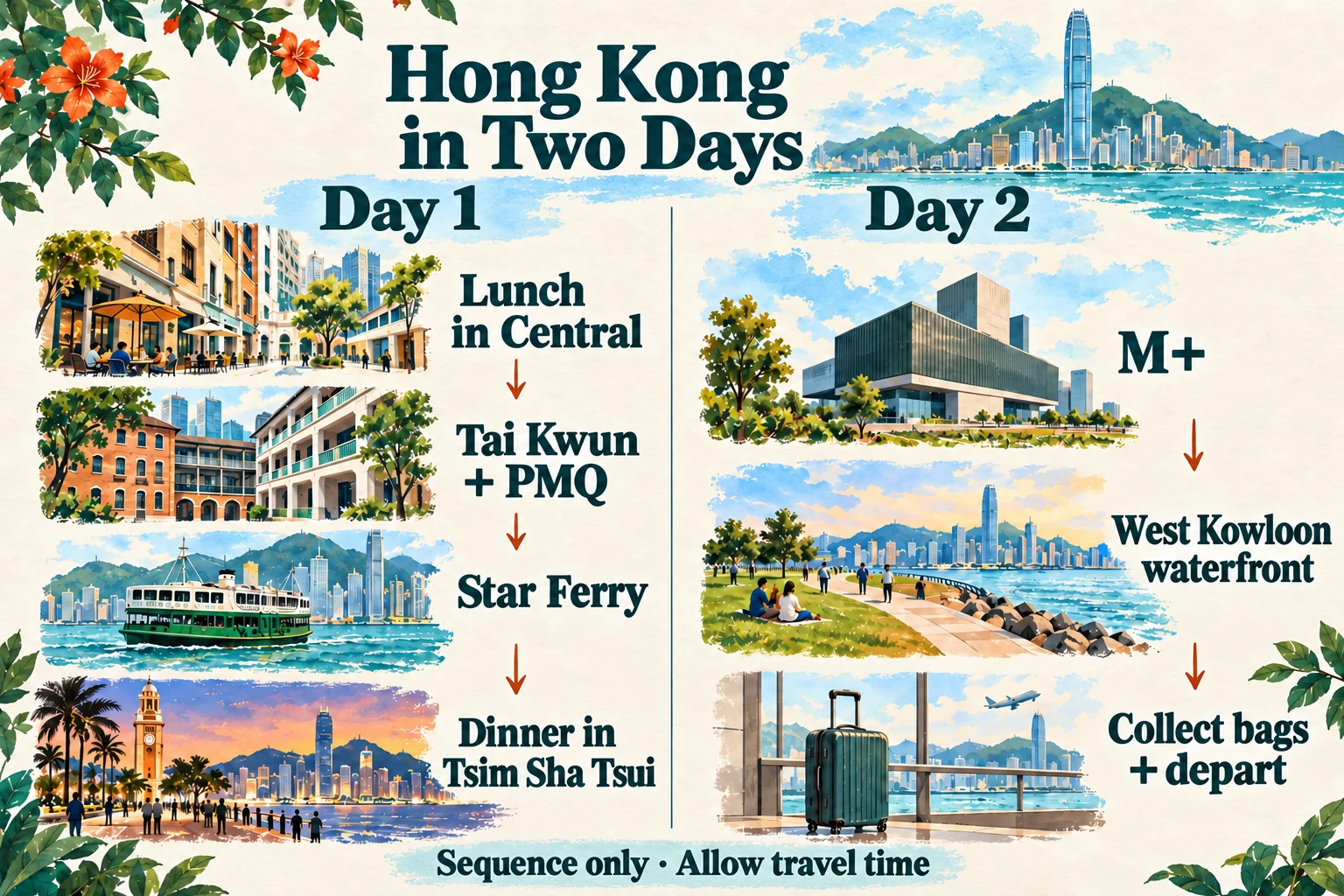
For a separate part of your stay around the harbour and cultural venues, see our two-day Central, harbour and West Kowloon itinerary. Substitute the Space Museum for another indoor visit instead of adding another stop to an already full day.