Visit City Gallery with a question about how Hong Kong works. Start at the scale of everyday life on the first floor, then widen the view to transport, land and regional planning on the second. Around 90 minutes is a useful self-guided allowance suggested here, not a guaranteed official tour duration. Checked on 13 November 2026: phased refurbishment is under way. Old entrance photographs and exhibition images do not establish which doors, floors or interactive displays are available today.
Decide which Hong Kong you want to understand
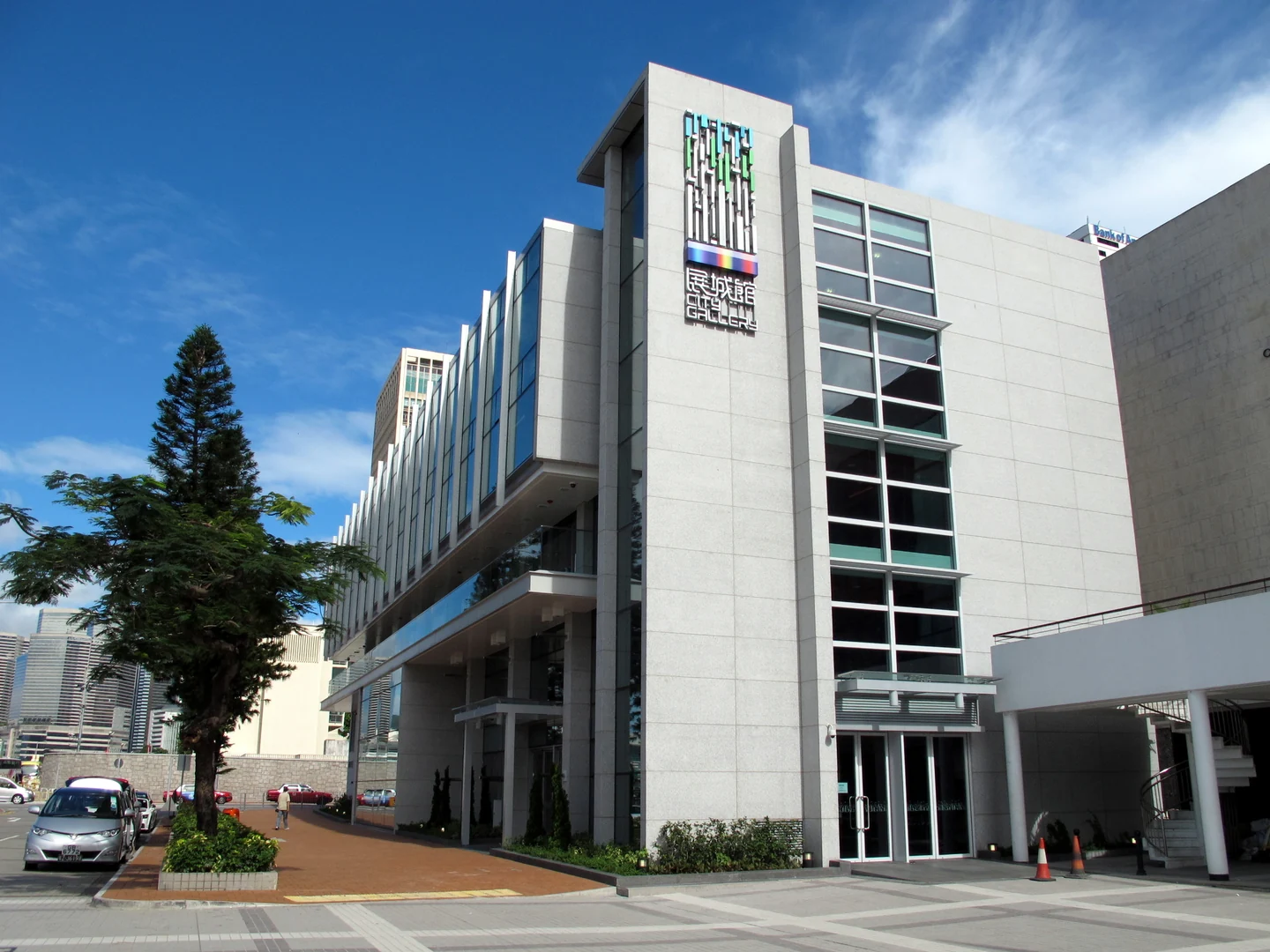
Managed by the Planning Department, City Gallery stands at 3 Edinburgh Place, Central, beside City Hall's Low Block. Its subject is planning and infrastructure: why dense housing needs connections, how parks and waterfronts fit into everyday routines, and how a diagram describes a future that may not yet exist. The official introduction explains its role in presenting planning and encouraging discussion about the city's future.
For someone who enjoys maps, buildings and asking why, this adds a layer easily missed on a sightseeing trip. After looking at towers, consider how people move between them. After riding the railway, ask why transport features so prominently in plans for a new district. School-age children can choose a practical question, such as how many roads someone would cross between home and a park, without having to memorise development names.
If you mainly want original artworks, historical objects or play equipment that needs little explanation, another venue may suit you better. Interactive exhibits here support a planning story. Treating the gallery as an indoor playground, or squeezing it between appointments simply because admission is free, can miss its purpose.
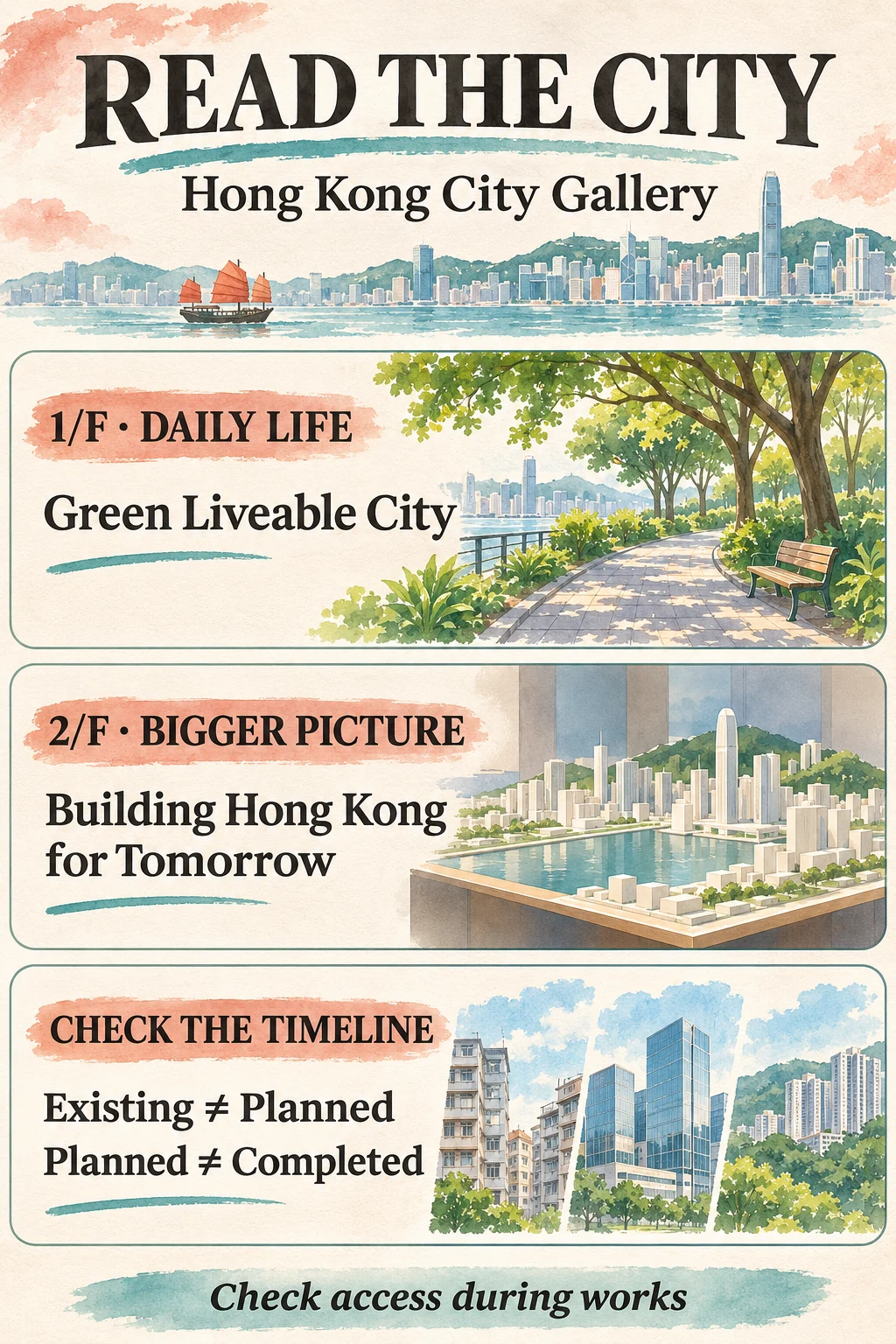
During works, check the entrance before the exhibitions
The current opening announcement schedules phased works from 27 July 2026 to early February 2027. The entire ground floor, third-floor corridor exhibition area and part of the fourth floor are subject to phased closure. Work areas are cordoned off and intermittent noise is possible. The end date is the announced schedule, not a reopening guarantee from this guide.
The main entrance is temporarily closed. Use the side entrance facing City Hall, with reception temporarily near its staircase; other floors are reached using the side entrance lift or stairs. Ask which areas are open when you arrive, then decide your route. An exhibit appearing in an older photograph is not permission to go beyond a barrier to find it.
During works, tours primarily cover Green Liveable City on 1/F and Building Hong Kong for Tomorrow on 2/F. If anyone uses a wheelchair or pushchair, or is sensitive to noise, call +852 3102 1242 beforehand about the current approach, lift and necessary facilities. A normal facilities list or old floor plan cannot settle construction-period access. Do not rely on ground-floor lockers or fourth-floor baby-care facilities without checking their availability.
First floor: turn an ordinary outing into a planning question
A practical starting point for Green Liveable City is: if you lived among these buildings, how would you get to school, buy food or take a break? Pick something relevant to you and look for the exhibition's response. This is a suggested way to read the displays, not an official test or prescribed route.
Break the word green into observations. Is there shade or somewhere to sit? Does a walking connection lead somewhere people actually need to go? Can an older person, child or someone carrying shopping use it comfortably? This makes greenery more than an attractive colour on a model. Bring your own journey from the station into the discussion: which section felt comfortable, where did you detour, and what would change in rain?
With children, ask them to describe a relationship before supplying terminology. Instead of asking which tower is tallest, ask where someone living there would catch a train or bus. Skip an apparatus that does not make sense to you; leaving with one question worth discussing is more useful than remembering how many buttons you pressed.
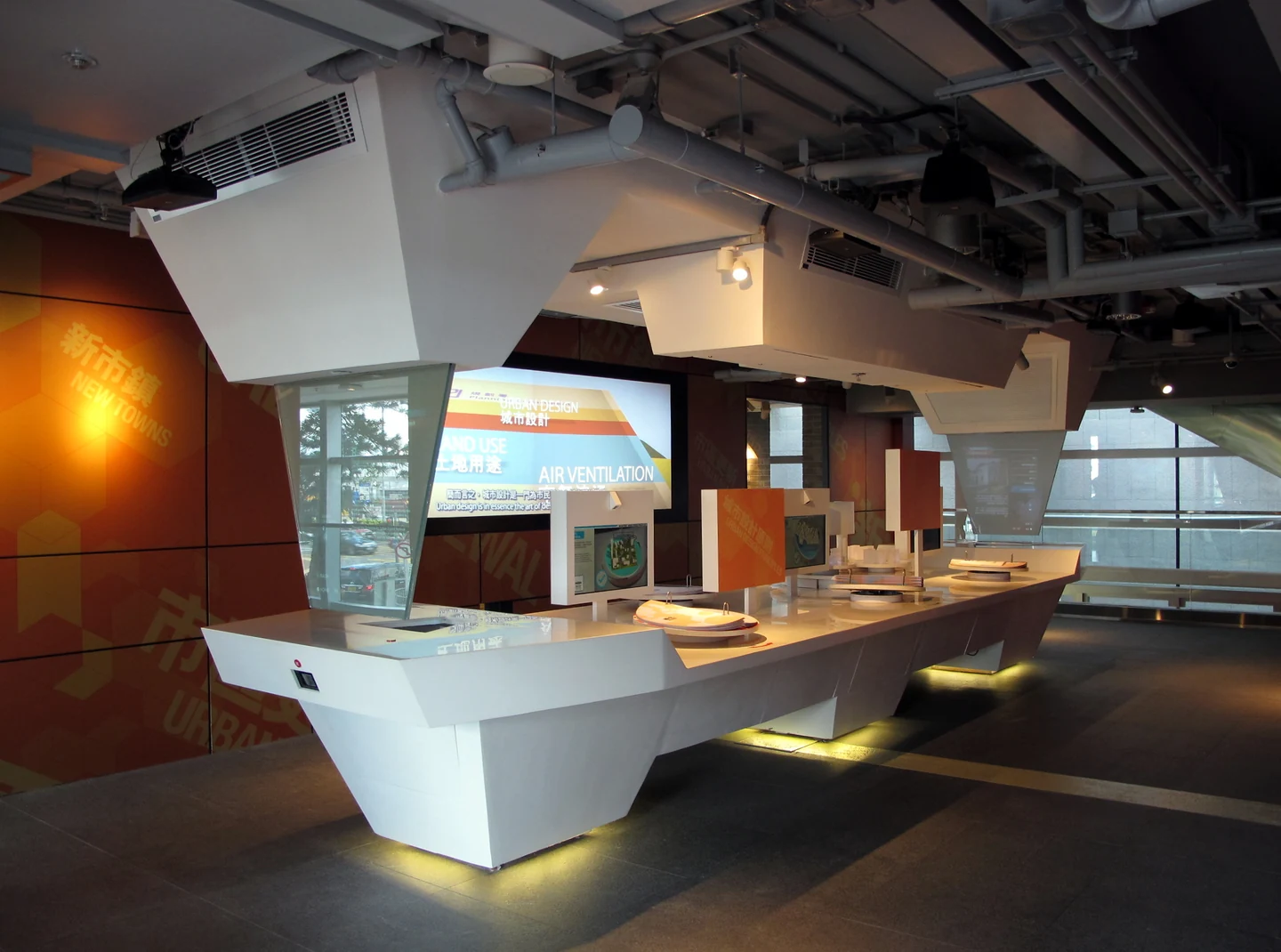
This 2013 photograph records an earlier Living Environment display. It illustrates how the gallery once represented everyday space; it does not show the present first-floor layout or establish that those installations remain available. Distinguishing an archive image from a current notice is itself a useful habit in a changing city gallery.
Second floor: zoom out from the street to the region
When Building Hong Kong for Tomorrow reopened following refurbishment in 2024, the official introduction described macro planning, major development areas, and transport and infrastructure experiences, including terrain models and multimedia. The government account of the exhibition provides background to these themes. Whether a particular device is running on your visit is a separate, on-site question.
At a large model, locate hills, water and existing urban areas first, then look for connections. Do not begin by chasing every illuminated point. Choose somewhere you know as an anchor and compare its position with another area: across the harbour, along a hillside, or nearer the boundary? This makes regional scale distinct from the experience of walking one street.
Next, read a project description and ask three things. What need is it intended to meet? What transport or public facilities would support it? Does the image describe an existing condition, a proposal or a future impression? A model makes relationships visible without necessarily telling you how much construction has happened in the real world.
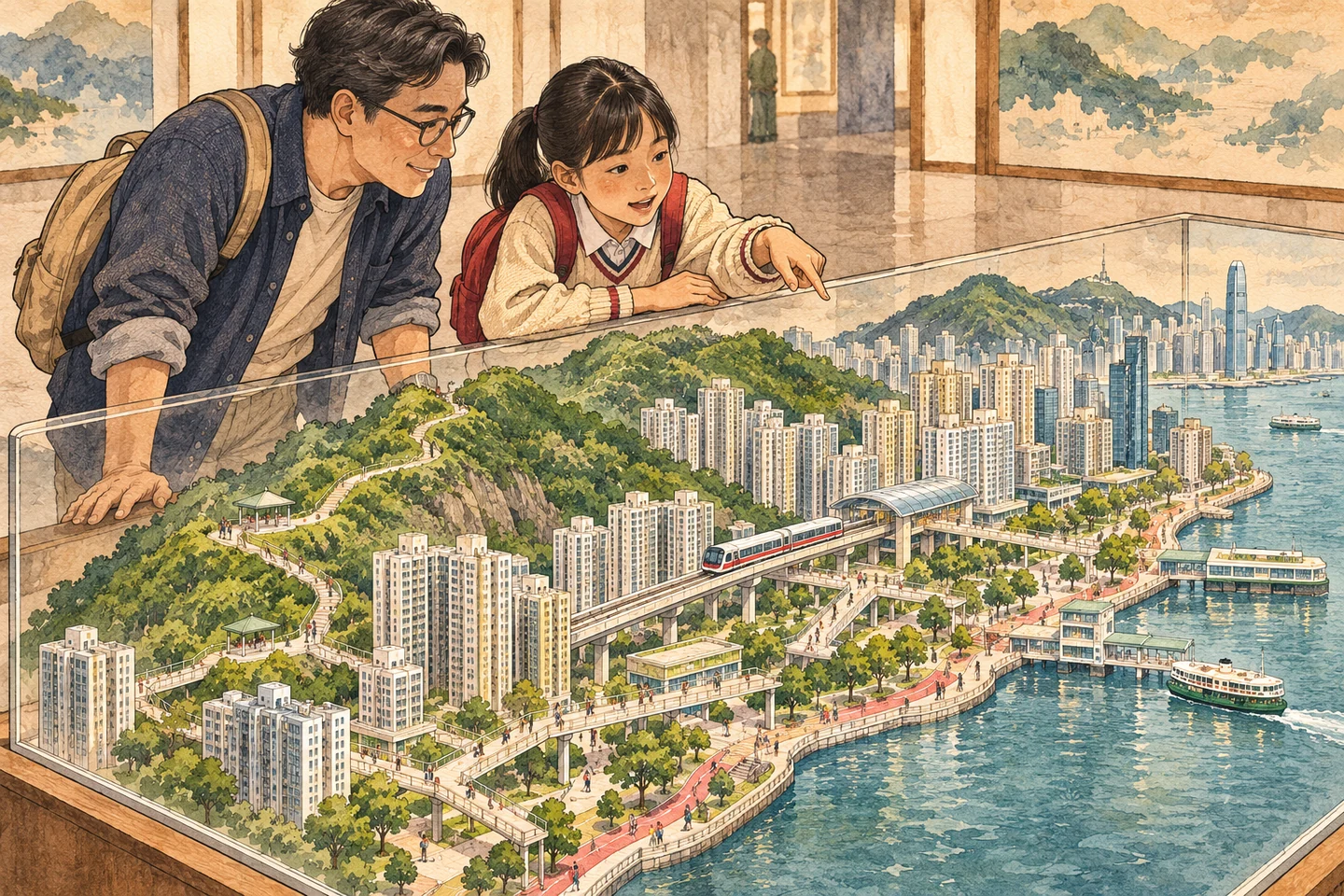
Families can divide the task: one person looks at homes, another at transport and another at places to rest. Discuss what would be missing without each. No specialist knowledge is required, and this need not become a contest over who remembers more numbers. Follow equipment instructions and keep hands out of models or displays that are not intended to be touched.
A proposal on display is not automatically somewhere you can visit
The Northern Metropolis photograph reproduced here records a 2024 display. Its boundaries, names and lines are not a 2026 navigation aid or construction progress chart. A proposed railway, land development or waterfront project appearing in the gallery does not establish that it is operating, complete or open to visitors.
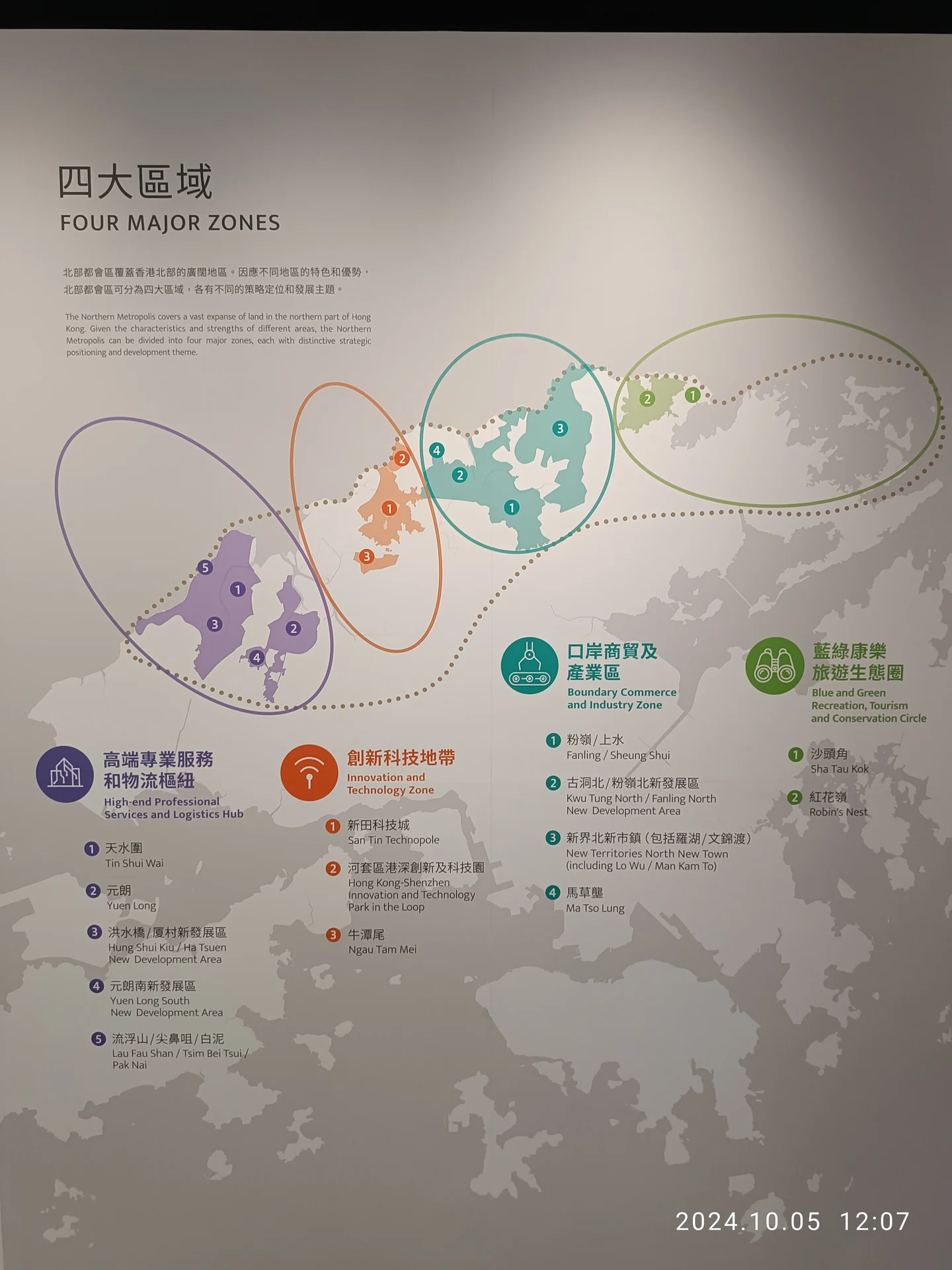
Divide your notes into three categories: geographical relationships you can identify, planning directions the exhibition presents, and current conditions that require another source. A detailed presentation makes a project worth understanding; approval, construction progress and a usable opening date are different questions. Before adding somewhere to an itinerary, consult the responsible department or operator's present access information rather than navigating from a model.
Archive photographs also encourage you to look for dates on display material. An artist's impression, historical photograph and present-day status report each have a purpose; none is a complete account by itself. Being able to explain a trade-off, such as the link between transport connections and everyday convenience, is a worthwhile outcome even if you do not remember every future landmark.
How to use 90 minutes, and when to shorten the visit
This is a suggested self-guided budget, excluding travel from your hotel or station. Reduce the number of things you inspect if queues, construction diversions or temporary closures intervene. Do not borrow time from an essential onward connection.
| Part of the visit | Suggested time | One useful task |
|---|---|---|
| Side-entrance reception | About 10 minutes | Confirm today's open areas and facilities |
| First-floor everyday scale | About 25 minutes | Connect one liveability question to your own outing |
| Second-floor city scale | About 35 minutes | Read a model and distinguish existing from planned |
| Revisit and reflect | About 20 minutes | Answer a question and decide whether to stay longer |
With only 45 minutes, choose one exhibition. If planning interests you, stay longer, but do not treat every floor as a completion target. Anyone needing a completely quiet environment may prefer to return after the works. Group tours also require arrangements: the normal application window is at least 14 days and up to three months ahead, generally for groups of 15–20. During refurbishment, ask about capacity and coverage before building a programme around one. See the official visit and tour information.
Admission, hours and one observation to take outside
Admission is free. Normal hours are 10:00–18:00 Monday to Thursday, and 10:00–19:00 Friday to Sunday and public holidays. Tuesdays are closed except public holidays; the first two days of Lunar New Year are also closed. Read the Tuesday exception alongside the Monday-to-Thursday hours. Separate bad-weather arrangements apply, so check both opening information and current notices before setting off.
The gallery lists Central Station Exit K, Hong Kong Station Exit A and Admiralty Station Exit B among the MTR approaches. Choose what fits your starting point, use current navigation for 3 Edinburgh Place and follow the works signs to the side entrance. These are not statements that the gallery is immediately outside the station, or that every approach avoids steps. If arranging a transfer, explain the entrance change and walking needs, and confirm a legal place to set down or collect.
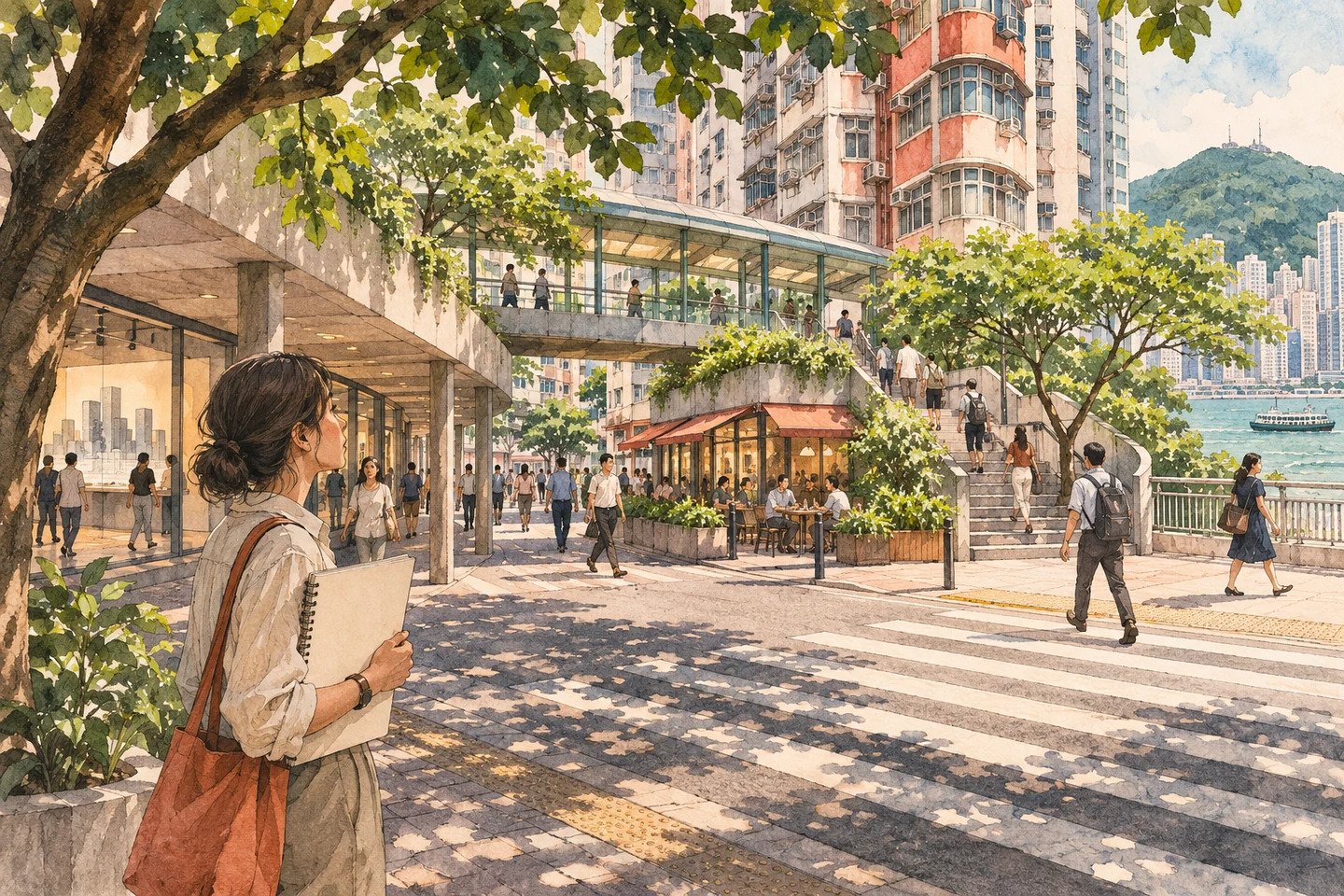
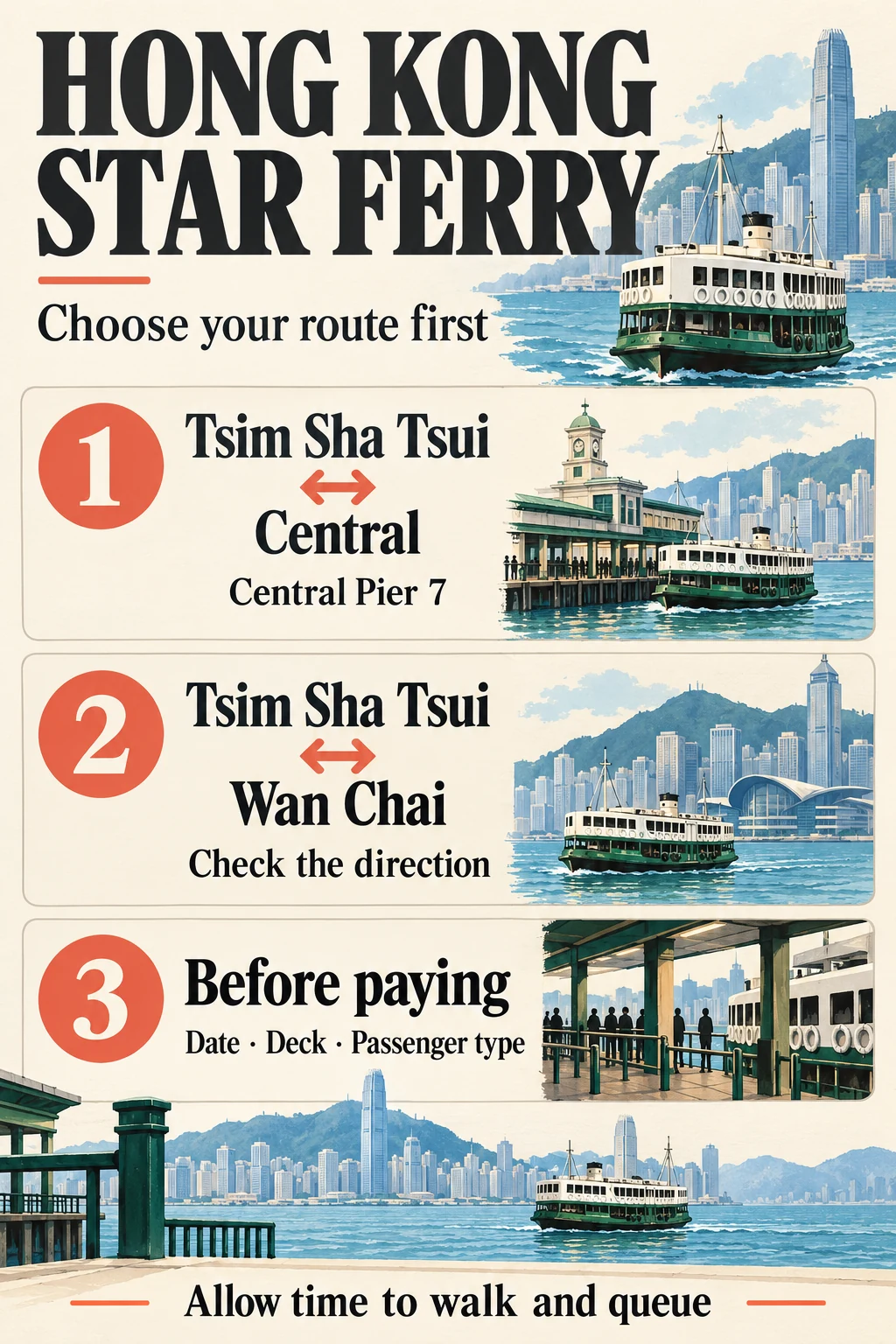
Afterwards, if the weather permits, make one short observation in a nearby public space: a shaded path, a crossing or somewhere to sit. Consider how it changes the large-scale city you have just studied. This is an optional exercise, not a fixed walking route. If crossing the harbour afterwards, consult the Central and Wan Chai Star Ferry guide and allow separately for leaving the exhibition, walking to the pier and waiting for a boat.
Your pre-journey checklist
- Check phased-works notices, the City Hall-facing side entrance and that day's available areas.
- Remember Tuesday and Lunar New Year closures and the public-holiday exception.
- Give each of the two main floors one question rather than trying every device.
- Distinguish existing, planned and completed; check navigation and current project access separately.
- Confirm wheelchair access, baby-care facilities, storage or group tours with the gallery when needed.
Sources & further reading
This article draws on the media coverage and public information below. Event and transport arrangements can change; check the latest details before travelling.
- City Gallery: About the gallerycitygallery.gov.hk (Opens in a new tab)
- City Gallery: Notice on phased works and accesscitygallery.gov.hk (Opens in a new tab)
- Government news: The second-floor exhibition in 2024news.gov.hk (Opens in a new tab)
- City Gallery: Planning a visit and tourscitygallery.gov.hk (Opens in a new tab)
Make it your journey
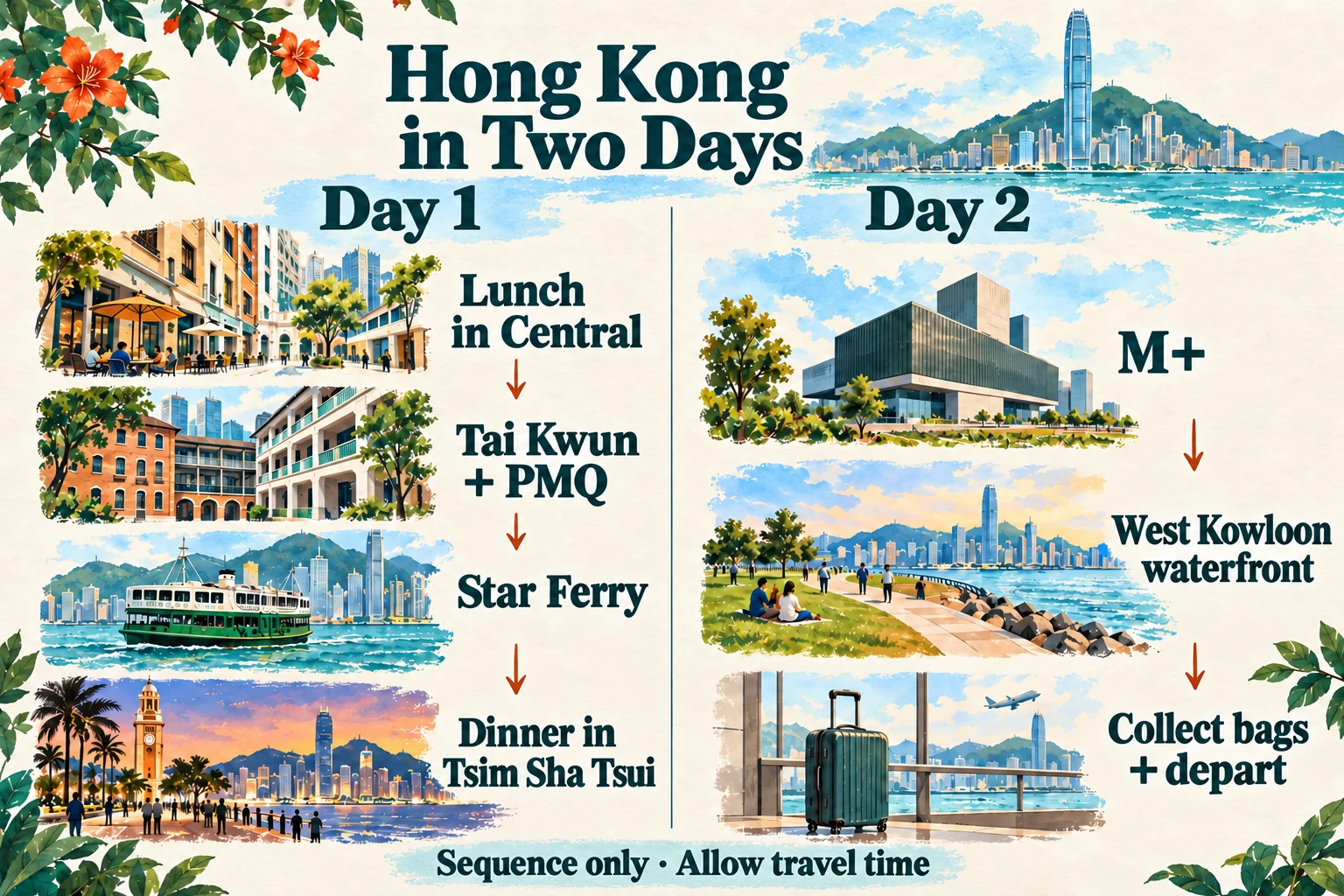
Give City Gallery an unhurried Central slot. Bring a question inside and take an answer back to the street. If using the Central, harbour and West Kowloon two-day plan, replace another venue with this one rather than continually adding stops.