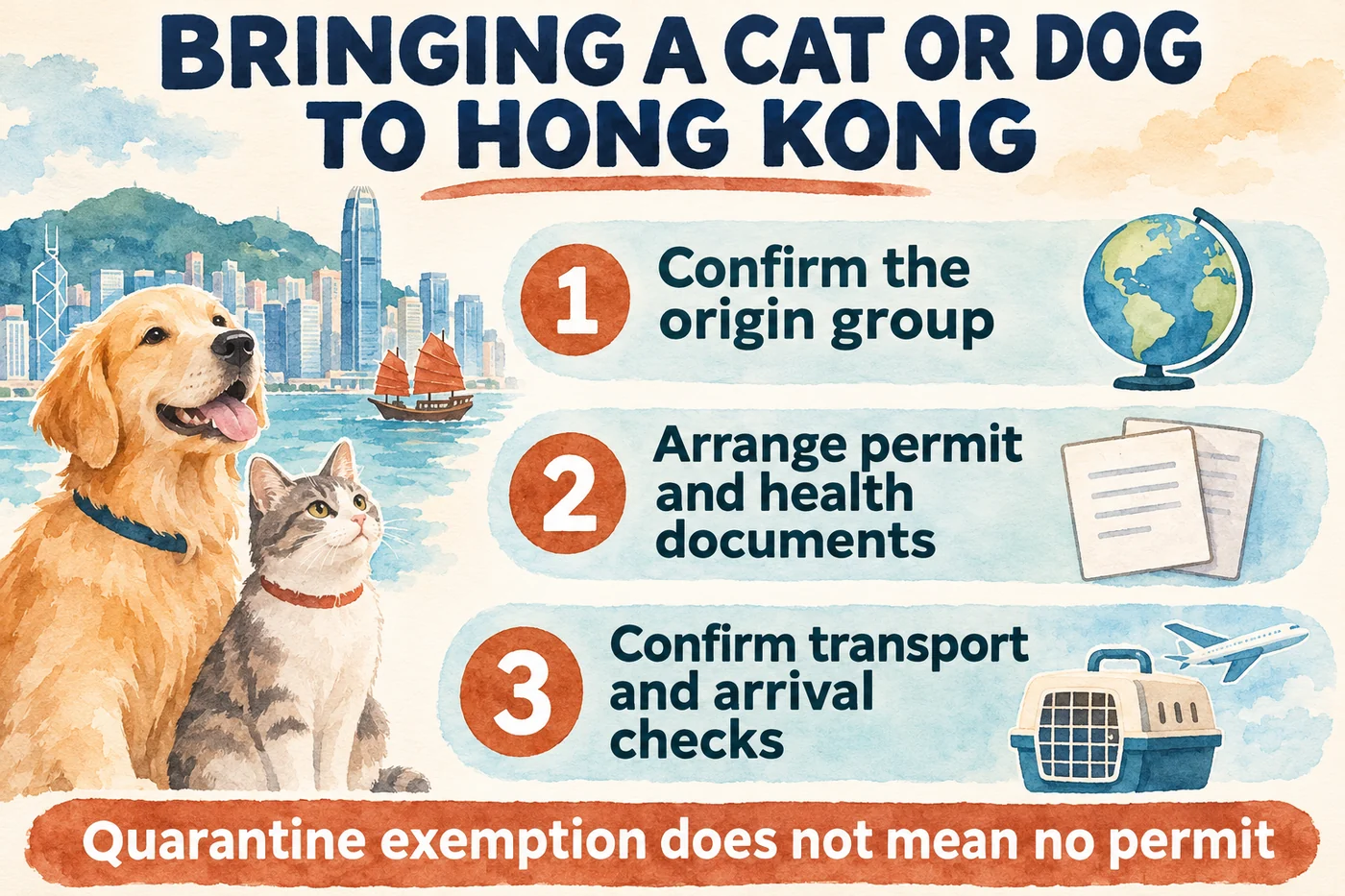
Before booking pet-friendly accommodation in Hong Kong, establish your cat or dog's origin group, import permission and transport arrangements. A traveller's immigration eligibility and an animal's import procedure are separate. Being allowed into Hong Kong yourself does not mean your pet can cross with you or be released immediately on arrival.
Start with the animal's origin, not your passport
This guide explains planning for privately kept cats and dogs, using an air arrival from a Group II origin as the main example and distinguishing Mainland arrangements. It does not cover commercial trading, other species or every transit scenario. AFCD pages were checked on 13 November 2026; the conditions issued with the permit and the authority's advice govern individual cases.
The AFCD dogs and cats import overview assigns countries and places to groups. These examples are not the full lists. If the animal has moved between countries, transited elsewhere or has an uncertain history, explain this to AFCD rather than classifying it solely by the departure city of its last flight.
| Origin group | Selected examples in the official lists | Planning implication |
|---|---|---|
| Group I | Japan, United Kingdom, Australia, New Zealand | Follow that group's process; a permit is still needed |
| Group II | Canada, Singapore, continental USA | Quarantine exemption depends on full compliance |
| Group IIIA | Chinese Mainland, Macao, Malaysia, Thailand | Different conditions; do not copy the Group II process |
| Group IIIB | Countries and places outside those groups | Check the relevant rules, not human visa status or airline acceptance |
Lists can change. The Mainland joined Group IIIA on 3 June 2025; this is not a new rule introduced when this article was published. A September 2025 HK01 report covered relaxed Mainland arrangements. “Relaxed” should not be read as quarantine-free or suitable for a last-minute crossing with a pet.
Check breed restrictions early too. AFCD identifies prohibited fighting-dog breeds and their crosses, while Bengal cats have generation and documentary requirements. If ancestry or breed is unclear, resolve that with AFCD before paying non-refundable freight charges. An airline accepting a booking does not replace Hong Kong import permission.
A Group II example: permit, fees and validity
If your animal qualifies under a Group II origin and will arrive by air, read the Group II import page . It specifies forms AF240 and UN110 and the applicant's identification. Applications can follow the published in-person, postal or Trade Single Window arrangements; overseas applicants may arrange a Hong Kong agent.
At verification, that page listed HKD432 for the first animal and HKD102 for each additional animal on the same permit in a single shipment. That is a permit fee, not a total including air freight, veterinary work, documentation, terminal handling or quarantine. Do not apply that fee indiscriminately to every origin group.
The permit described on the Group II page is valid for six months and one consignment only. It is not a six-month multiple-entry pass. AFCD says final travel arrangements should be made after a permit is granted. Veterinary preparation, health conditions, original-document delivery and freight booking each take time; an administrative processing period alone cannot establish that an animal can travel next week.
Have the vet check the current permit requirements
The Group II page links permit terms DC-02v05, the sample animal health certificate VC-DC2 and airline certificate PC101. Give those links and the issued permit to the responsible veterinarian and carrier. Check identification details, required health records, certification and transport conditions against the actual documents. Documents dispatched with the permit take precedence over an old online vaccination checklist.
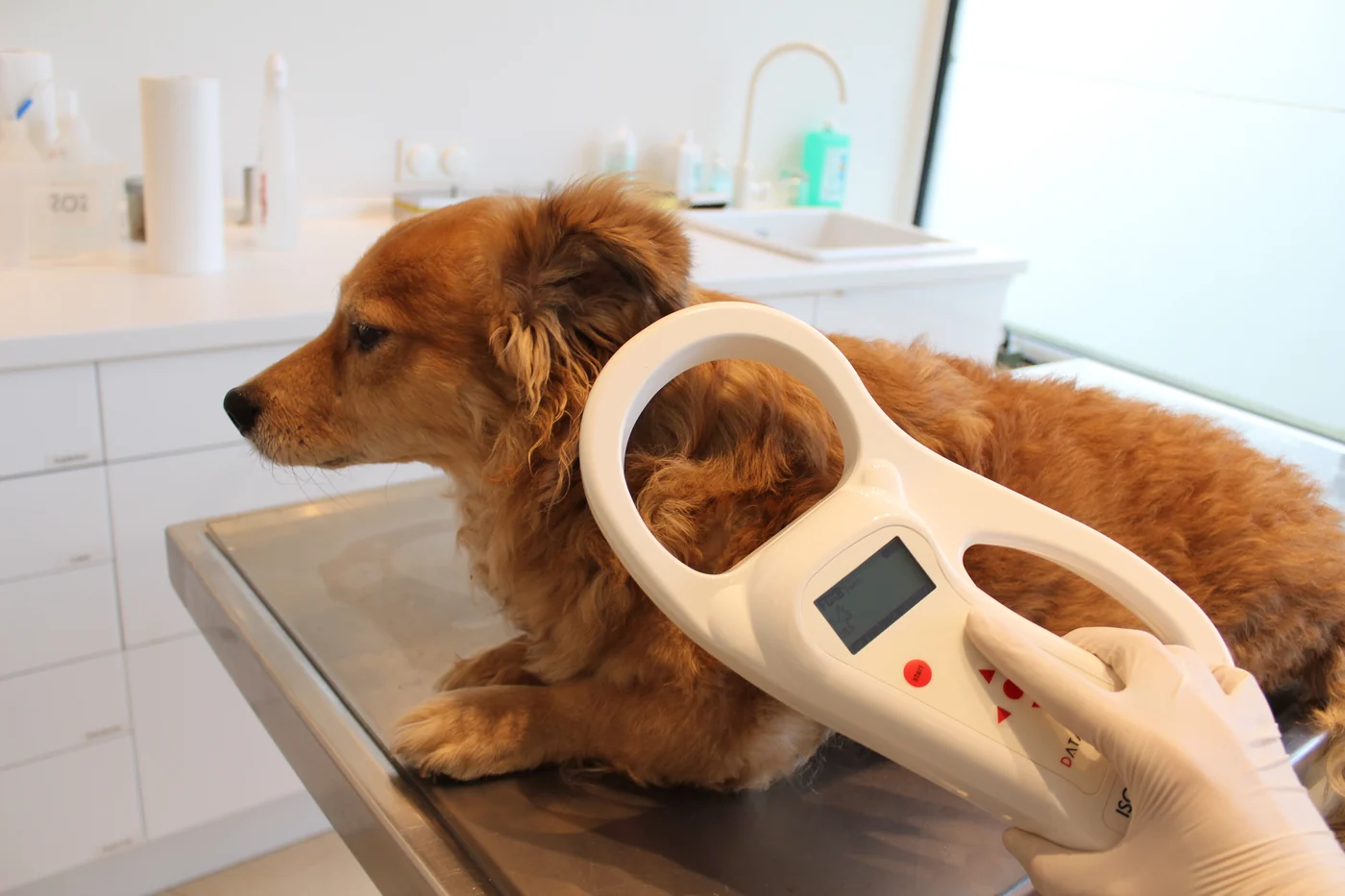
A useful preparation sheet records whether the animal identification number matches across documents, who completes or signs each form, which originals travel with the animal and which the collector carries, and whether the airline has confirmed its documentary requirements. This is an organisational aid, not a substitute for satisfying the permit conditions. Resolve specific questions with AFCD or the veterinarian before departure rather than trying to repair missing paperwork at the airport.
Quarantine exemption is conditional. Group II animals must meet the full permit conditions; missing documentation or other circumstances can lead to quarantine or return and additional costs. Do not promise your companions an immediate transfer to the hotel solely because an origin appears in Group II.
Ordinary pets arriving by air travel as manifested cargo
AFCD's import and export FAQ says cats and dogs imported by air must travel as manifested cargo, rather than excess baggage or ordinary cabin baggage. Disability Assistance Dogs have separate arrangements and advance approval requirements. Ordinary pets and emotional-support animals cannot simply use that exception.
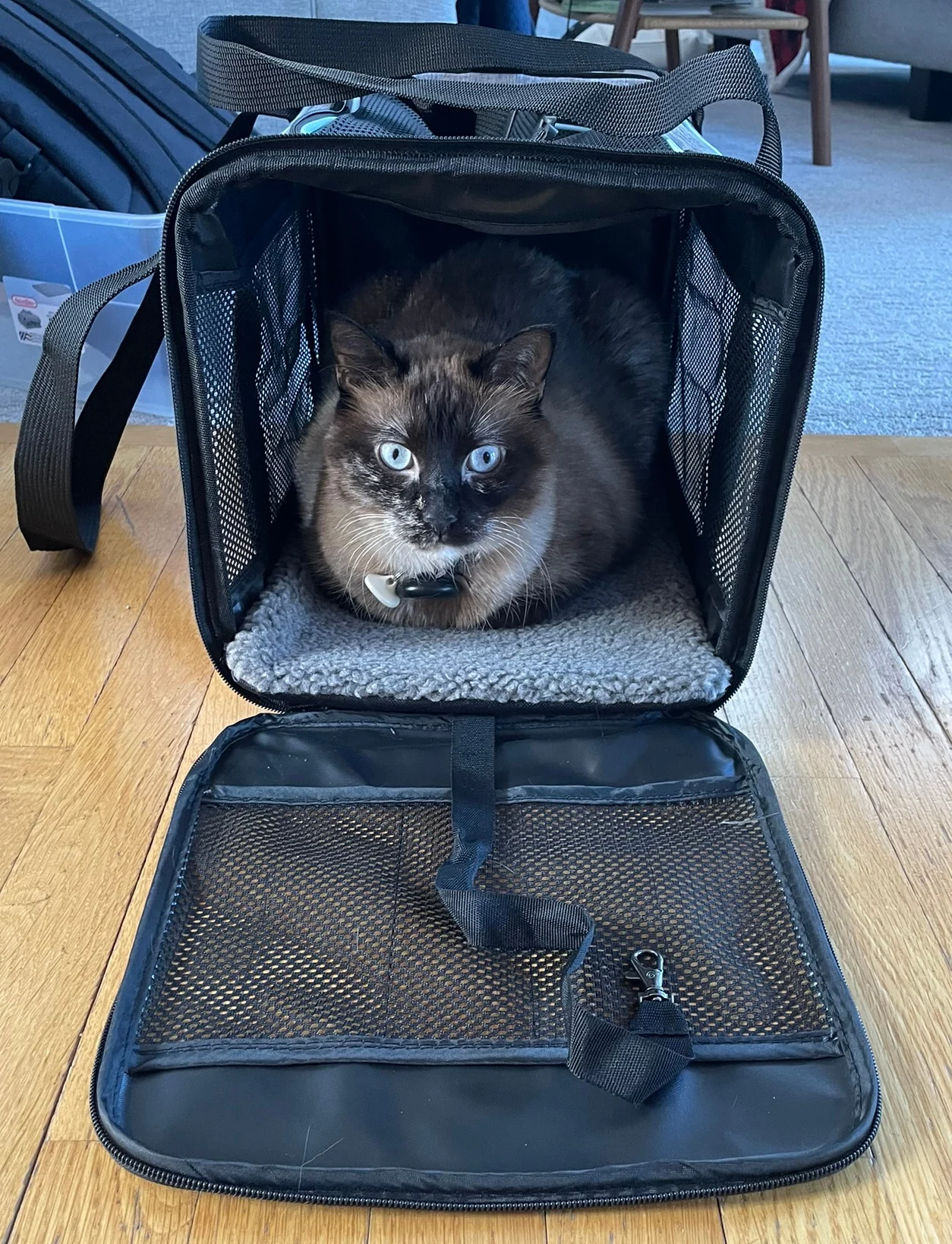
When asking an airline or freight agent for a quotation, specify a cat or dog being imported into Hong Kong. Confirm the freight booking, transport container, paperwork and handling terminal. Asking whether you can “add a pet to my ticket” is insufficient. The soft-sided carrier pictured here illustrates an everyday carrier; it is not an example of an approved container for air import into Hong Kong.
Mainland origins: separate quarantine and land-arrival rules
The AFCD Mainland-specific page states that the arrival quarantine period can be reduced from 120 to 30 days when all relevant import requirements are met. Thirty days is still quarantine. It does not support a two- or three-day holiday with immediate access to your pet.
That page requires the animal health certificate agreed with China's General Administration of Customs, issued by a government veterinary officer, and refers to rabies antibody testing at recognised laboratories. The application must specify the entry control point. For a land arrival, the animal must reach the specified Hong Kong control point between 9am and 5pm. Entry may be through a land control point or Hong Kong airport, but that does not establish permission for any crossing, at any time, in any private car. Confirm the relevant permit, quarantine and transport arrangements first.
Macao is also in Group IIIA, but its paperwork should not simply be copied from the Mainland-specific page. Consult the rules and permit terms for the actual origin. Human border-crossing guidance and animal import requirements must be handled separately.
Airport collection starts with the correct cargo terminal
The AFCD airport animal-collection procedure involves the relevant cargo terminal and departmental checks. Ask the carrier for the flight, air waybill number and handling terminal. HACTL, AAT or CPSL may handle the shipment; do not assume every animal goes to a single counter in the passenger arrivals hall.
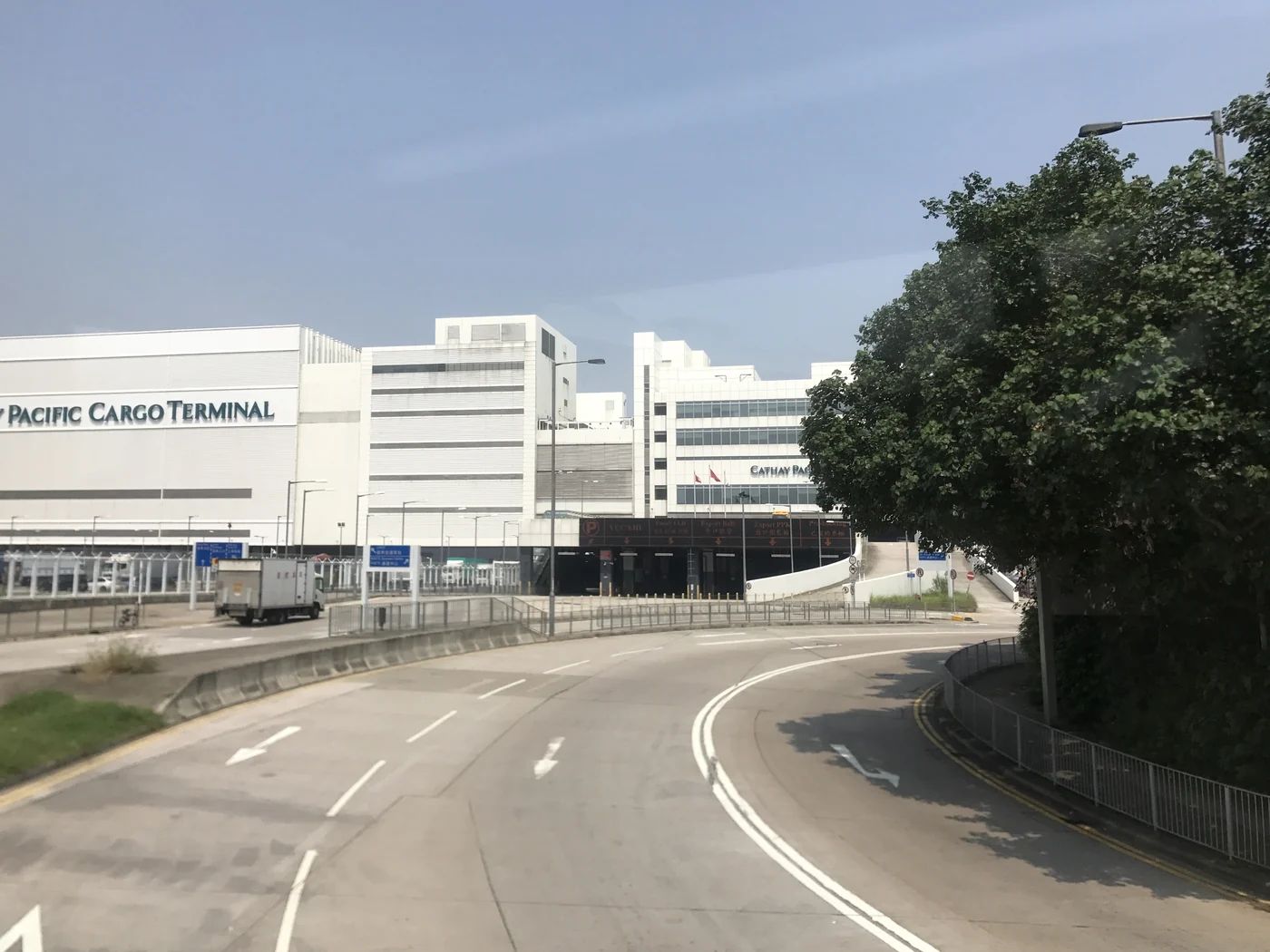
Prepare the original import permit, air waybill details, identification and required health documents. Obtain the release paperwork as instructed by the airline or agent, then follow the terminal procedure for presenting the animal to AFCD. Release depends on the conditions being satisfied; animals requiring quarantine have further arrangements.
For an appointed collector, the official instructions require an agent aged at least 18, their identification, a copy of the permit holder's identification, the original permit and authorisation form PC111, together with the required documents. The relevant AFCD airport offices operate around the clock. That does not remove airline release, terminal or quarantine procedures, and animals should not be left unnecessarily until the following day.
Do not arrange a car to depart immediately from the passenger terminal until you know the handling terminal and release arrangements. Tell the vehicle provider the animal species, container dimensions and actual collection point, and confirm acceptance. An ordinary chauffeur enquiry with this website does not mean pet-import agency or quarantine services have been arranged.
Leaving Hong Kong and returning needs another plan
The Group II page specifically reminds owners that animals returning after leaving Hong Kong remain subject to import requirements and need advance permission. A short trip to Macao or the Mainland does not automatically preserve the previous entry arrangement. The next destination also has its own animal-entry rules.
Divide the preparation between AFCD for import conditions, the veterinarian and carrier for documentation and transport, and the ground-transfer provider for travel after release. For the human travellers, see the separate Hong Kong and Macao entry and re-entry guide . For ground-transfer enquiries, use the contact page and describe the animal and container before making arrangements.
Your pre-journey checklist
- Confirm the animal's origin group and permit conditions.
- Check documents and transport with the vet and carrier.
- Arrange ground travel for the actual terminal and release plan.
Sources & further reading
This article draws on the media coverage and public information below. Event and transport arrangements can change; check the latest details before travelling.
- AFCD: dog and cat import groups and restrictionsafcd.gov.hk (Opens in a new tab)
- AFCD: Group II dog and cat import procedureafcd.gov.hk (Opens in a new tab)
- AFCD: animal import and export FAQafcd.gov.hk (Opens in a new tab)
- AFCD: collecting animals at Hong Kong International Airportafcd.gov.hk (Opens in a new tab)
- AFCD: Mainland dog and cat quarantine and entry arrangementsafcd.gov.hk (Opens in a new tab)
- HK01: 2025 Mainland pet-quarantine changeshk01.com (Opens in a new tab)
Make it your journey
Describe your party, exact locations and special requirements so customer service can confirm arrangements.