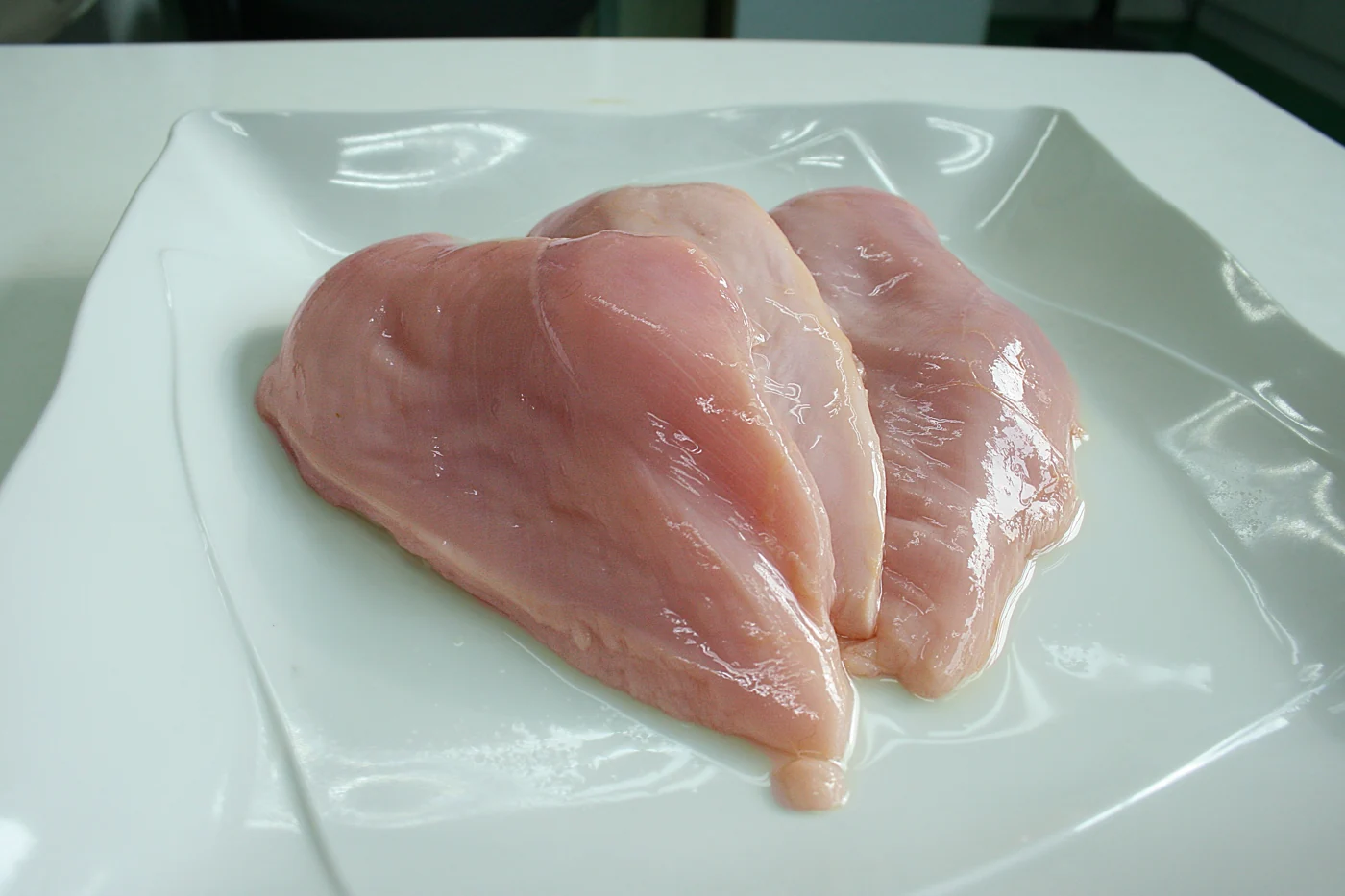
Before bringing meat, poultry or eggs into Hong Kong, distinguish an import licence, a health certificate and written permission. They are not interchangeable documents. Frozen or chilled meat and poultry carried in personal baggage solely for your own use, in an amount not exceeding 15 kg, may qualify for an import-licence exemption, but a recognised valid official certificate is still required. Vacuum packaging, briefly blanching the food or intending to eat it yourself does not automatically remove the requirements for raw or undercooked products.
Identify the food before asking how much you can bring
Record the product name, animal species, place of origin, cooking status, packaging and weight. “Can I bring food gifts?” is too broad a question: raw chicken, fully cooked meat and eggs can involve different rules even when they fit into the same shopping bag. This guide concerns personal baggage entering Hong Kong. It is not an instruction manual for commercial imports, postal purchases or entry into Macau or Mainland China.
An HK01 report from October 2026 highlights recurring misunderstandings about vacuum packaging and blanching. The CFS government announcement issued on the same day confirms that relevant foods which are not thoroughly cooked remain regulated, regardless of the boundary control point used. This was an enforcement reminder about existing requirements, not evidence that a new ban had just begun.
What exactly does the 15 kg exemption cover?
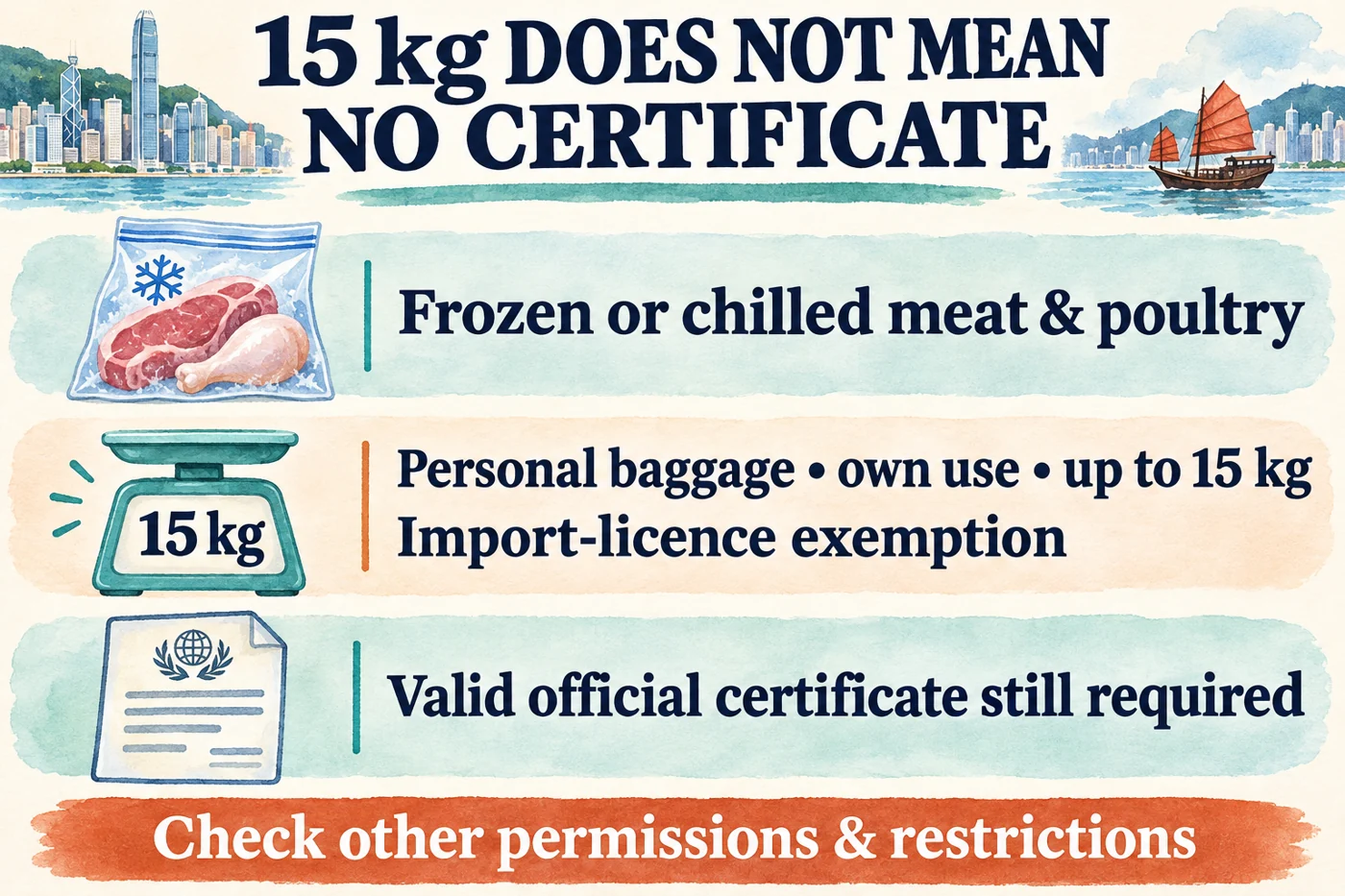
Paragraph 8 of the CFS import-licence guide sets out the exemption for imports in personal baggage, solely for personal use, in an amount not exceeding 15 kilograms. The condition remains that the meat or poultry is accompanied by a valid official certificate recognised by the Director of Food and Environmental Hygiene. The guide is about frozen or chilled meat and poultry, not a universal duty-free allowance for every type of food.
The “Frozen or Chilled Meat and Poultry” section of Customs’ controlled-imports page also separates the licence exemption from the certificate requirement and mentions personal consumption or gifts. If your actual purpose is giving the food to someone else, describe it as a gift when enquiring rather than calling it your own consumption. Either way, a small quantity does not mean the required certificate can be omitted.
Consider a traveller carrying two kilograms of uncooked chilled chicken to eat personally. Being under 15 kg does not establish that no paperwork is needed. Nor does exceeding 15 kg turn the issue into a simple excess-baggage fee payable on arrival. Confirm the applicable permission and document arrangements with the authority first. If you cannot satisfy them, do not travel with that consignment.
Match certificates and permission to the particular category
Customs’ “Game, Meat, Poultry and Eggs” section states that prior FEHD permission is required for game, meat and poultry, except for the specified case of meat and poultry accompanied by a valid health certificate from a recognised issuing entity at the place of origin. Eggs require a health certificate and/or written permission from an FEHD health officer. It would be misleading to shorten these distinctions to “choose any one document for any food.”
The CFS imported-food control page additionally states that game or eggs require prior permission, and meat, poultry or eggs must come from recognised sources. Ask CFS to identify the document combination for your product, origin and route. A shop assistant saying that something can be carried is not official confirmation. Unloading during transhipment elsewhere can introduce additional certification requirements; the final departure city alone may not describe the complete journey.
For regulated foods carried from the Mainland, the 10 October 2026 government announcement specifically requires a health certificate issued by Mainland Customs to accompany the goods. A supermarket receipt, an origin label on a vacuum bag, an inspection sticker or a screenshot of a seller’s chat is not that document requirement itself. Ask which issuing entity provides the certificate and which goods it covers, rather than judging a document only by whether it has a stamp.
Fully cooked, partly cooked and eggs are different cases
In its passenger-clearance FAQ, Customs says foods such as fully cooked meat in personal baggage, in reasonable quantities for personal consumption, are generally not subject to control. Those qualifications matter. They should not become “all cooked food is allowed in any quantity for any purpose.” Where a species or source is subject to another control, check that separately.
| Situation | What the official guidance establishes | What to do before departure |
|---|---|---|
| Raw or only blanched meat and poultry | These remain regulated; vacuum or foil packaging does not change that. | Confirm certificates and permission. A cooked-looking surface is not proof of thorough cooking. |
| Fully cooked meat | Customs gives a general explanation for reasonable quantities in personal baggage for personal consumption. | Confirm that cooking, purpose and quantity match that explanation; do not extend it to commercial imports or another destination. |
| An egg or its edible part | Fully cooked eggs, or eggs constituting an ingredient of a compounded food, are excluded from the Regulations’ egg scope. | Retain product information. An uncooked egg cannot simply use the fully cooked exception. |
| Unclear ingredients or processing | A retail product name does not settle its legal classification. | Send complete labels, ingredients and processing information to CFS rather than inventing an exemption. |

The egg exclusion comes from Customs’ controlled-imports explanation. It does not exempt every other ingredient in the same compounded product from all controls. Meat or another regulated ingredient still needs its own assessment. This guide does not pronounce a packet admissible just because it is sold as meatballs, dumplings or vacuum-packed cooked food. If thorough cooking cannot be established, opening the package at the border or promising to cook it later is not a substitute for the necessary advance arrangements.
Arrange documents before travel: the red channel does not issue missing approval
CFS notes that issuing entities generally provide health certificates to food traders for business purposes. Individuals wanting a certificate should enquire with the relevant entity at the place of origin about whether arrangements exist for issuing one to an individual. Do not assume the seller or border office can produce the correct paperwork immediately after purchase. If departure is close and documents are unresolved, cancel the plan to carry that food or choose a different gift whose position has been checked.

Customs’ FAQ makes clear that declaring controlled goods in the red channel still requires the relevant valid licence or permit. Without it, a traveller may face prosecution and the goods may be seized. Declaration does not automatically legalise the import. If you enter the green channel and then realise you have something to declare, leave for the red channel and/or seek help from a Customs officer immediately, rather than continuing because your companions are waiting.
Give the authority enough information to identify the consignment
A practical enquiry can follow this sequence: “On [date], I plan to enter Hong Kong from [actual origin and departure place] via [route]. My personal baggage would contain [product, animal species, quantity and weight], for [my consumption or a gift]. Its processing state is [uncooked, fully cooked or uncertain]. I attach labels, ingredients and existing paperwork. Please confirm the import licence, health certificate and prior written permission requirements.”
The CFS control page lists the Food Import and Export Section at +852 2867 5577 and fsc@fehd.gov.hk. The import-licence guide separately lists +852 2156 3012 for its responsible licensing office. Choose the contact relevant to the question; these are enquiry channels, not a promise of immediate approval. Keep the response, and enquire again if the product, origin, quantity or route changes.
Transport presents a separate issue. The government notice warns that unsuitable temperatures or unhygienic packaging can increase food-safety risks. Having the right documents does not demonstrate that food has been stored appropriately throughout a trip. An ordinary passenger vehicle, suitcase or hotel room should not be assumed to provide suitable cold-chain conditions. Your driver is not the authority that decides whether the food is admissible.
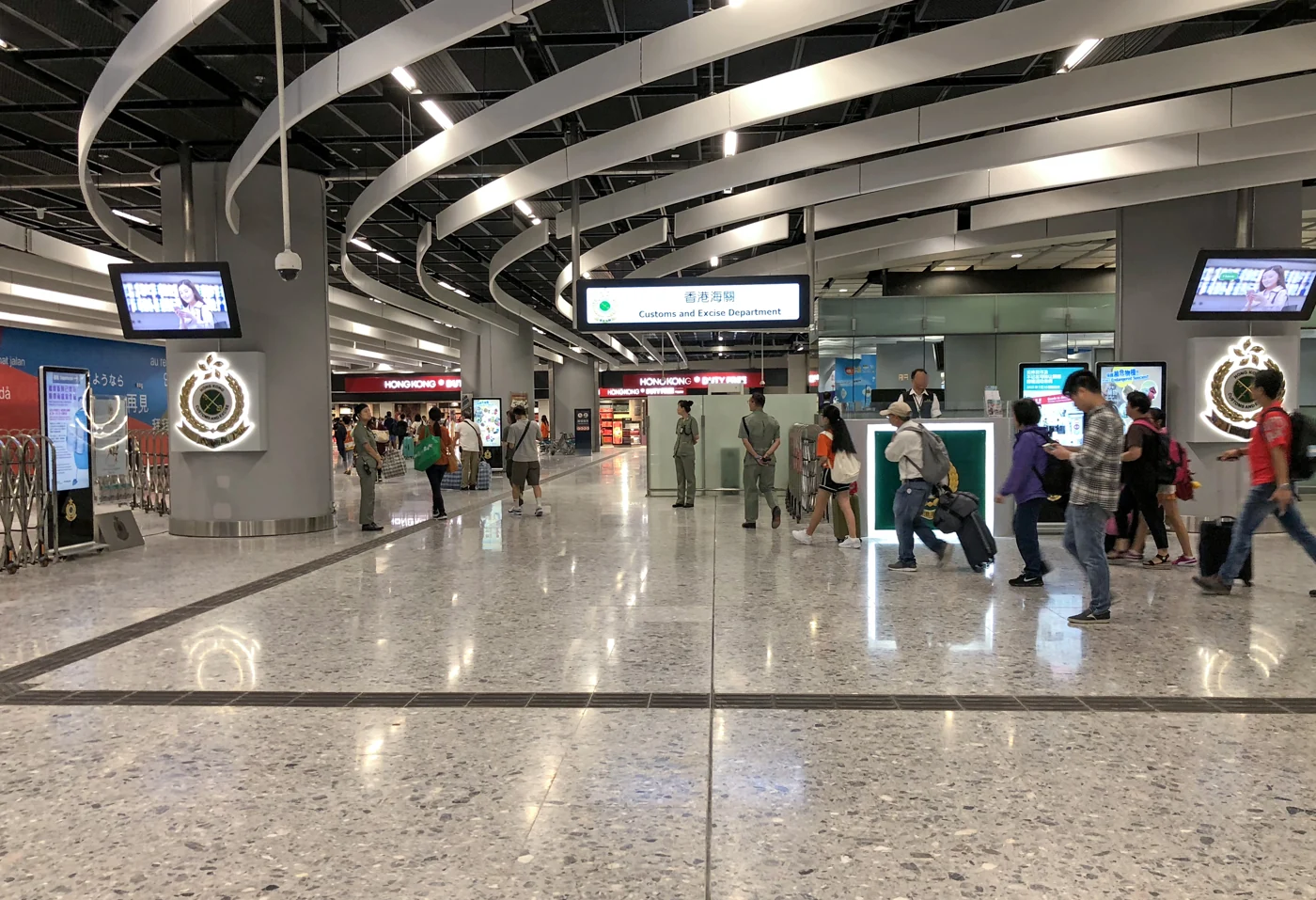
The reference image shows a Hong Kong Customs area at West Kowloon station in 2018, facing towards the Mainland. It illustrates the institution’s setting, not the route to follow when entering Hong Kong today. If you also carry plants or medicines, read the separate plants, seeds and soil guide and personal-medicine requirements. Do not transfer a food weight threshold or exception to unrelated items.
Your pre-journey checklist
- Record the food category, origin, cooking status, weight, purpose and actual route.
- Check import-licence exemptions separately from health certificates and written permission.
- Do not treat 15 kg, vacuum packaging, blanching or personal use as a blanket exemption.
- Confirm the precise scope of fully cooked food and egg exceptions, checking other ingredients independently.
- Obtain necessary documents before departure; declaration cannot replace permission, and unresolved food should not travel.
Sources & further reading
This article draws on the media coverage and public information below. Event and transport arrangements can change; check the latest details before travelling.
- Hong Kong Government: undercooked food import reminder, 10 October 2026info.gov.hk (Opens in a new tab)
- CFS: import-licence guide for frozen or chilled meat and poultrycfs.gov.hk (Opens in a new tab)
- Hong Kong Customs: controlled imports and egg exceptionscustoms.gov.hk (Opens in a new tab)
- Hong Kong Customs: passenger clearance, cooked food and red/green channel FAQscustoms.gov.hk (Opens in a new tab)
- CFS: imported-food control and enquiriescfs.gov.hk (Opens in a new tab)
- HK01: undercooked meat, vacuum packaging and border enforcement, October 2026hk01.com (Opens in a new tab)
Make it your journey
Use the quote form to discuss passengers, ordinary luggage and the cross-border route. Confirm food admissibility and transport conditions with the authorities and carrier first. A passenger-transfer booking includes neither food-import approval nor a cold-chain transport commitment.