When entering with cash and qualifying bearer negotiable instruments, Hong Kong's threshold is a total value above HKD120,000; Macao's is MOP120,000 or more. The currencies and boundary are different, and neither figure is simply a maximum you may legally carry. Add up what you actually possess, then follow the rule for the direction of travel. An online QR code still requires completion of the procedure with Customs in person.
Separate a declaration threshold from a spending budget or carrying limit
Card purchases, bank-account balances and proof of sufficient travel funds for immigration are different questions. This guide addresses cash and qualifying instruments carried by travellers or in their accompanying belongings. It does not cover cargo, post, corporate funding arrangements or mainland China's rules. Both Customs authorities explain that the system monitors cross-border cash movements; it is not exchange control prohibiting lawful funds from entering or leaving.
These systems have existed for years. HK01 reported on Hong Kong's system in 2018 and Macao's in 2017. A news article's updated timestamp does not turn the measure into a new 2026 policy, and an initial grace period described in old reporting is not a current exemption. The guidance below was checked on 21 October 2026 against the two authorities' dedicated pages and complete FAQs.
Two figures of 120,000: the currency and the equality sign matter
| Direction of travel | Threshold and required action |
|---|---|
| Arrival in Hong Kong through a specified control point | If the aggregate value of cash and qualifying instruments is more than HKD120,000, declare through the red channel |
| Departure from Hong Kong, or arrival other than through a specified control point | When required by Customs, truthfully disclose whether you possess a large quantity of these items; make a declaration if you do |
| Entry into Macao | If the aggregate value is MOP120,000 or more, proactively declare, complete the declaration form and use the red channel |
| Departure from Macao | Declare truthfully when questioned by Customs |
These distinctions come from Hong Kong's currency and bearer negotiable instruments page and Macao's cash declaration page. For this cash threshold alone, exactly HKD120,000 is not “more than” Hong Kong's figure, while exactly MOP120,000 reaches Macao's threshold. This comparison does not remove obligations to cooperate with checks or declare other regulated goods.
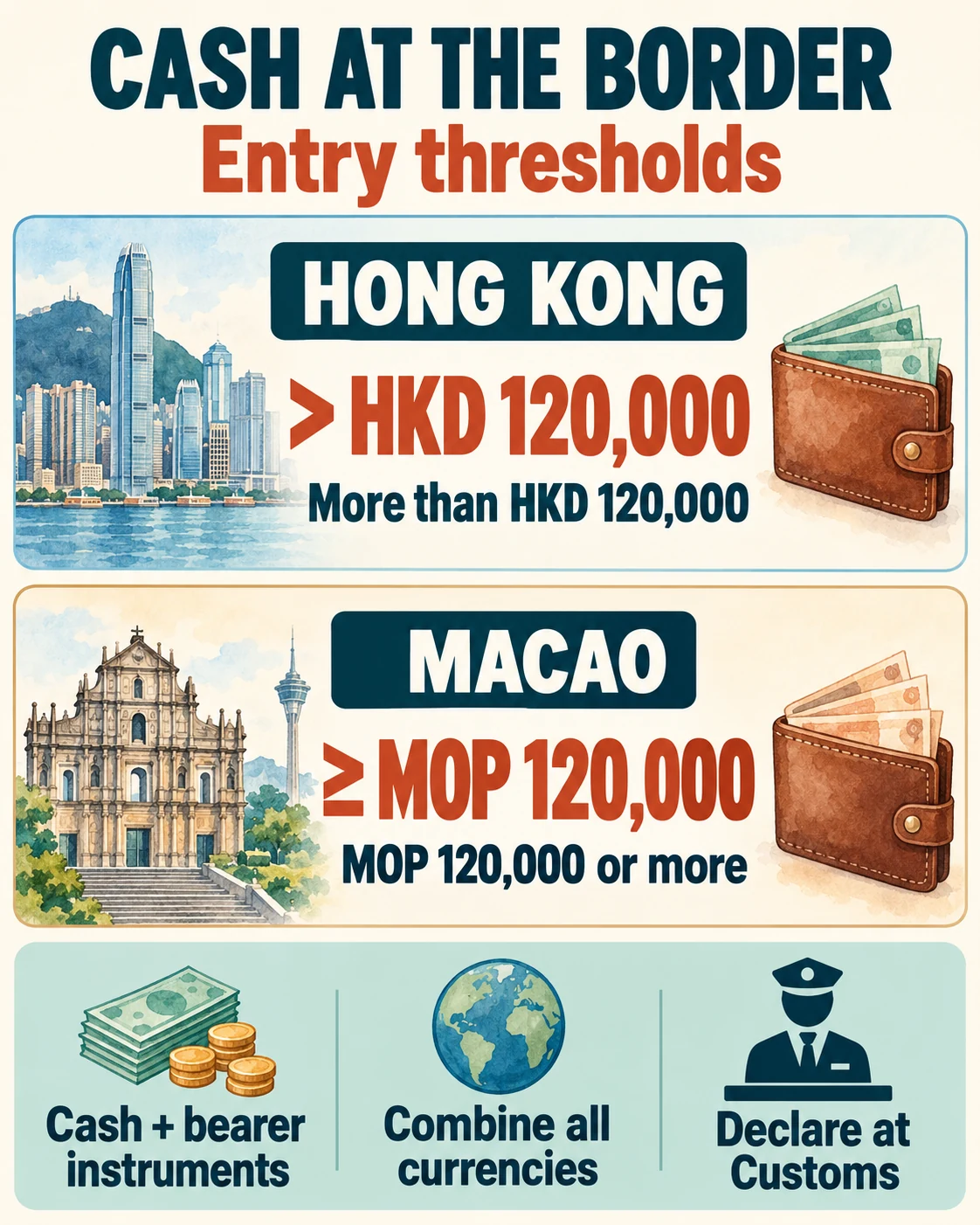
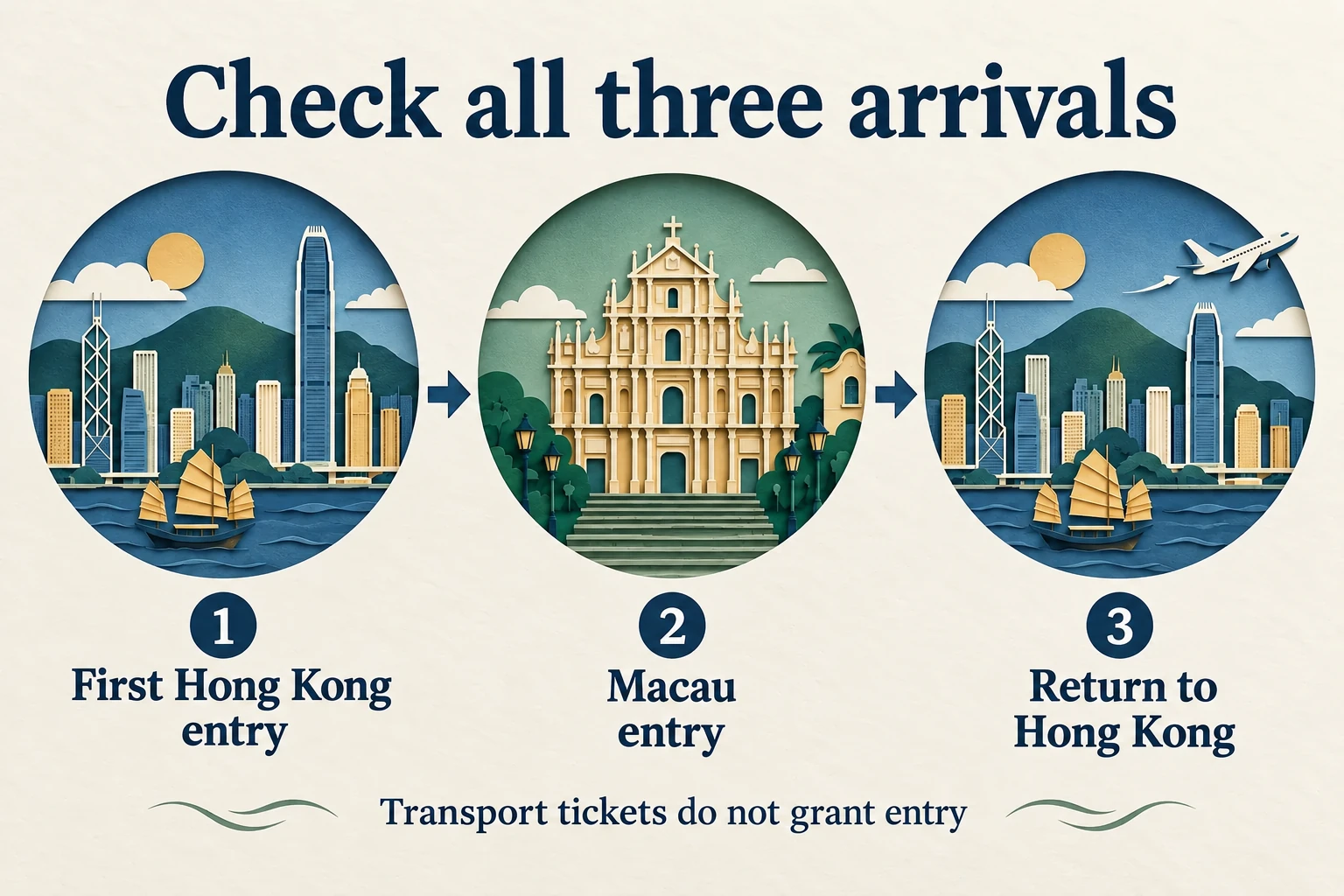
Do not treat Hong Kong dollars and patacas as interchangeable numbers. Hong Kong dollars carried into Macao must be converted under Macao's applicable exchange rule before assessing the threshold. On a Hong Kong–Macao journey, check Hong Kong departure and Macao arrival separately. The return trip reverses those directions; one declaration does not cover the whole round trip.
What to count: currencies, instruments and more than one bag
Cash includes banknotes and coins that are legal tender in Hong Kong, Macao or elsewhere. Qualifying negotiable instruments also count. Hong Kong Customs gives examples including travellers' cheques, bearer cheques, promissory notes, bearer bonds and money orders. However, coverage depends on their form: for example bearer form, unrestricted endorsement, entitlement transferred by delivery, or a signed instrument with the payee's name omitted. The word “cheque” alone does not determine the answer.
Macao's FAQs likewise describe bearer or unrestrictedly endorsed instruments, rights transferable by delivery alone and signed incomplete instruments without a named payee. If uncertain, explain the type, payee and transfer terms accurately to Customs. Avoid posting complete identity, account or instrument numbers in public chats. Check the Hong Kong FAQs and Macao FAQs for the detailed definitions.
Hong Kong's concept of possession extends beyond cash in a pocket. It includes accompanied baggage, personal belongings on the cross-boundary conveyance and the traveller's checked baggage; checked baggage may count even when it is not on the same conveyance. Check your coat, wallet, cabin bag and checked suitcase together. A bag being temporarily out of reach is not a reason to exclude it from the assessment.

Do not simply assign a cash value to jewellery, gold bars or casino chips and add it to the same declaration. Hong Kong's FAQs explain that diamonds, gold and chips are not themselves currency or bearer negotiable instruments, but a gold coin that is legal tender must be considered according to that status. Macao's cash declaration regime excludes gold, precious metals, gems and casino chips, while reminding travellers that other foreign-trade rules still apply. Being outside this cash regime does not mean every quantity and purpose is free of other formalities.
Convert foreign currencies using the correct rule
Hong Kong travellers use the opening indicative counter selling exchange rates published by the Hong Kong Association of Banks for the day of arrival or departure. If that day's rates have not been published, including when you cross before publication, use the most recently published preceding rates as specified. For a currency without a corresponding published rate, Customs sets out a conversion method using the effective United Nations rate. An app's mid-market quote, your earlier purchase price or a charter website's currency conversion is not a substitute.
Convert the currencies under the applicable rule into Hong Kong dollars to assess the combined threshold. On the declaration itself, state the original currencies and amounts: actual US dollars, for example, are listed in US dollars rather than rewriting every amount as Hong Kong dollars. Near the threshold, with an uncertain rate or an unclear instrument value, prepare a list and ask Customs before proceeding through the relevant channel.
Macao uses the exchange rates published by the Monetary Authority of Macao for that day. Its FAQs specifically say that travellers can ask Customs officers about the applicable rate. Do not use one unverified conversion table for both places. This guide deliberately gives no fixed “US dollar allowance” that would change with exchange rates.
Travelling with family or carrying money for someone else
Hong Kong's current FAQs require each person to declare or disclose the large quantity of items in their possession. An accompanying adult who knows that a traveller under 16 possesses a large quantity must declare or disclose it on that person's behalf. Carrying money for someone else is not an exemption: when the conditions are met, declare it and provide the owner's information on the form. “It is not my money” does not replace an accurate account of what you possess.
Macao's assessment also concerns the total each person actually carries. Where a minor or an incapacitated person has the obligation, their legal representative, such as a parent or guardian, declares on their behalf. Macao's FAQ does not express that rule as Hong Kong's “under 16” condition. Do not merge the two into a single assumed family age limit.
For a family group, record honestly who carries which items, who owns them and whether someone must declare for another person. Multiplying 120,000 by the group size does not create a shared allowance. Nor should an old media example be treated as permission to average holdings among family members. Ask Customs to resolve complicated facts; splitting, hiding or misdescribing ownership to avoid declaration is not recommended here.
Online preparation does not finish the in-person process
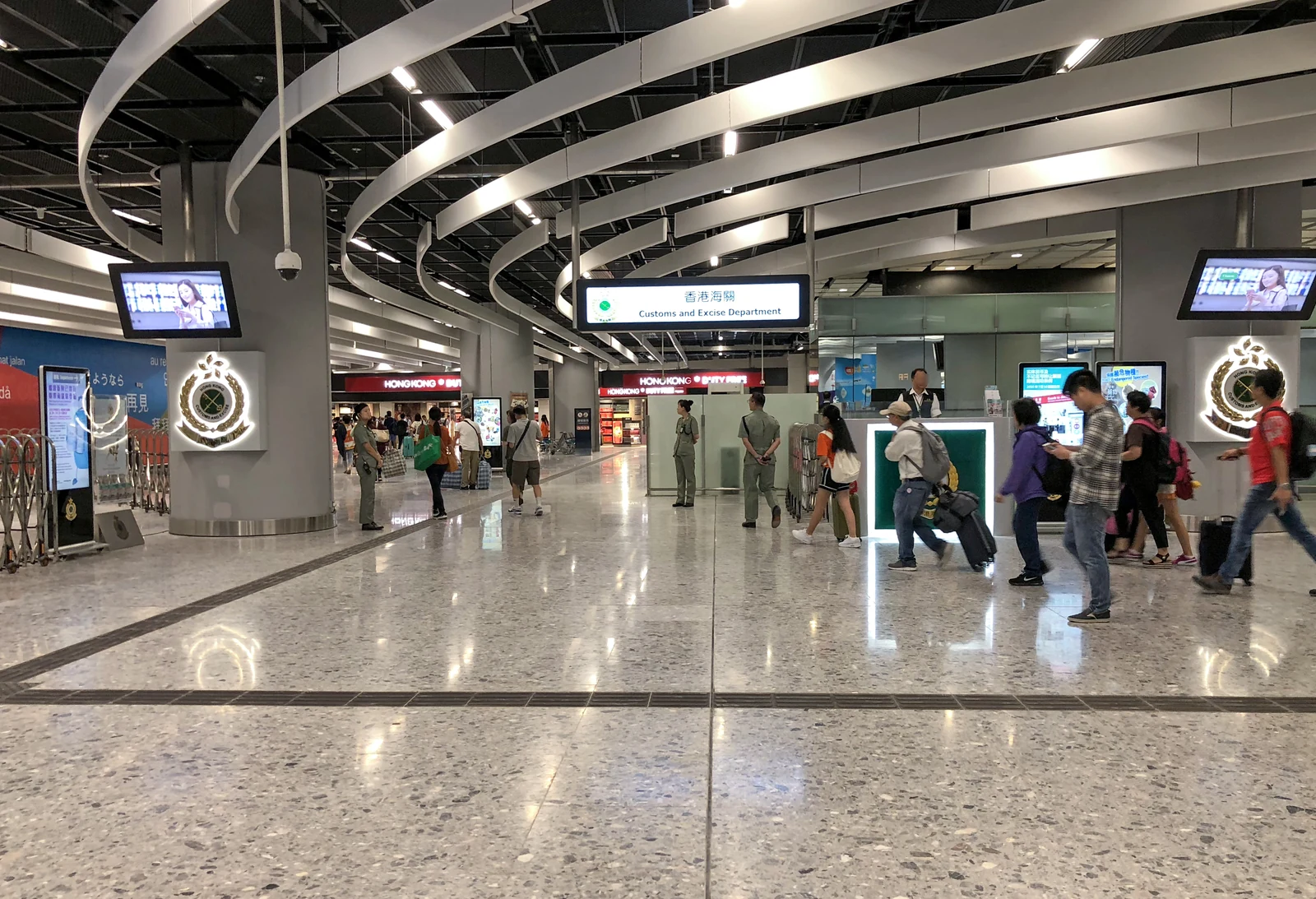
Hong Kong's official page links to the passenger electronic form, which allows advance completion and generation of a QR code. Present it to Customs on arrival, or use the paper form. For drivers or passengers in cross-boundary private or hired vehicles who need to declare, the official FAQ says to submit the paper form or show the QR code to officers when the vehicle passes the Customs kiosk. Not entering a passenger hall does not remove the obligation.
Macao's official cash declaration entry point provides the online service. After creating the QR code, present that code, the application number or the identification-document number at the Customs station and follow officers' instructions. The page does not automatically save the QR code and details to your phone; save them as directed. If both the code and application number are lost, the FAQ says the identification-document number can be used to retrieve the information.

Once Macao's online details have been confirmed, they cannot be edited directly online. You can submit again to generate a new QR code, or explain the correction to an officer at the station and seek assistance. Prepared electronic details do not bypass physical verification; officers may check or count the items. Allow time for this without turning an old news report's “a few minutes” into a guaranteed pickup or sailing connection.
Transit and repeat entry require the actual conditions to be met
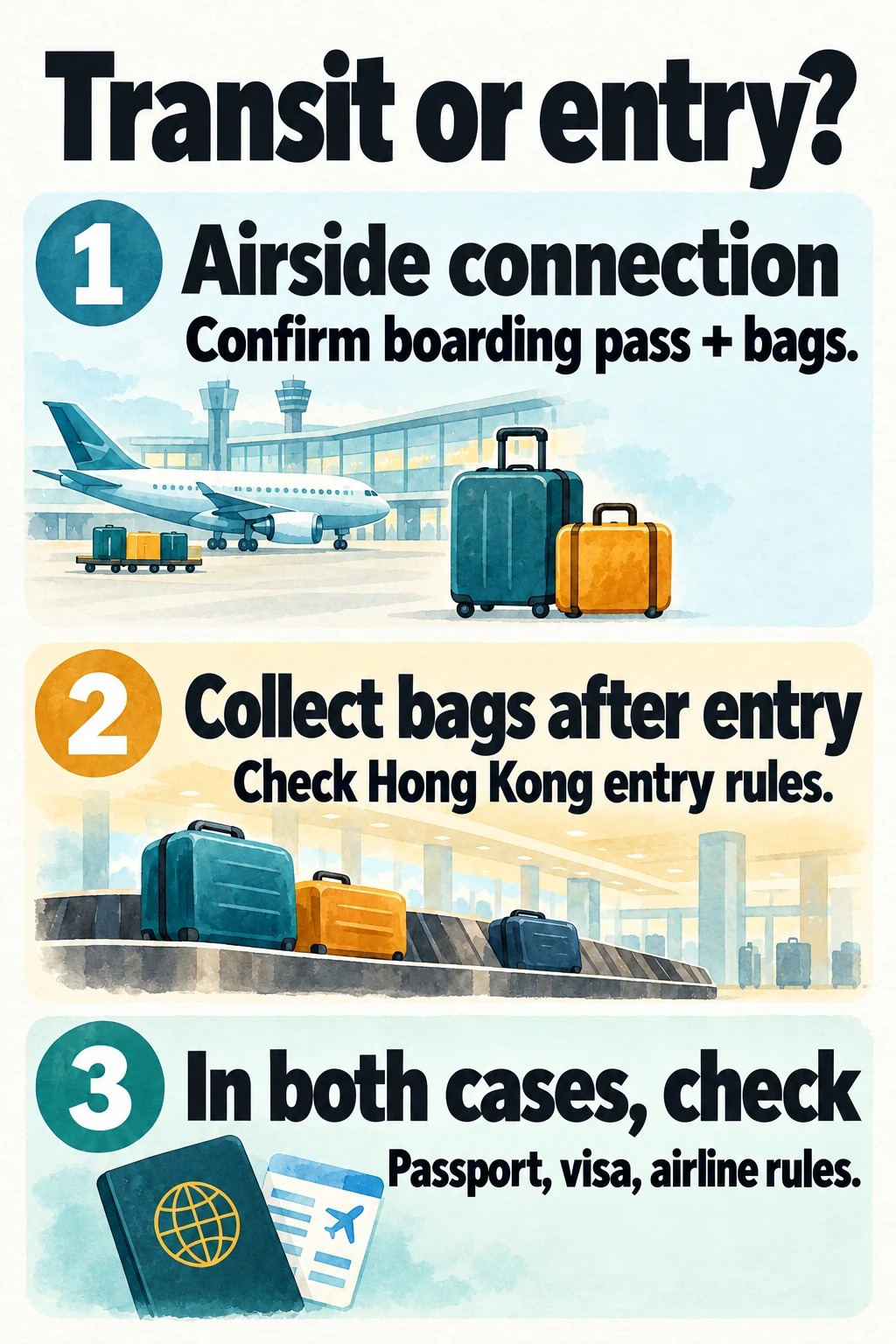
Hong Kong's exception is for transit passengers who arrive at Hong Kong airport from outside Hong Kong and do not pass through immigration control at a specified control point during their stay. Macao's FAQ describes travellers making a brief stop en route to another destination without completing any entry or exit record. Not having to fill in a paper arrival form does not make someone who has completed immigration an exempt transit traveller. Those conditions must actually apply. A ticket saying “via Hong Kong”, or a plan to leave Macao the same day, does not automatically establish an exception.
If you enter the city for a night, collect baggage before continuing to Macao, or complete Macao immigration and go sightseeing, assess the actual arrival and departure directions instead of applying an airside-transit rule. Immigration eligibility and Customs declarations are separate: a cash-declaration QR code grants no visa or permission to stay.
Before leaving your accommodation, organise the items, amounts, ownership details and applicable exchange-rate basis. Provide personal information only through official channels. If unsure which channel to use or how to complete the form, explain the situation to an officer first. Silence or choosing green is not a default confirmation that all is well. Non-declaration or inaccurate information can lead to penalties; accurate disclosure and cooperation are central to moving lawful funds correctly.
Your pre-journey checklist
- Hong Kong's threshold is strictly above HKD120,000; Macao's includes MOP120,000 itself.
- Count all currencies, qualifying instruments and relevant baggage, not just one wallet.
- Use each jurisdiction's applicable exchange rule and record original amounts and ownership honestly.
- Check each place's separate rules for declaring on behalf of minors.
- Open electronic services from official pages, save the details and still complete the process with Customs.
- Check every arrival and departure in a round trip, and consult the rules of other jurisdictions separately.
Sources & further reading
This article draws on the media coverage and public information below. Event and transport arrangements can change; check the latest details before travelling.
- Hong Kong Customs: currency and bearer negotiable instrumentscustoms.gov.hk (Opens in a new tab)
- Hong Kong Customs: full currency and bearer-instrument FAQscustoms.gov.hk (Opens in a new tab)
- Macao Customs: cash and bearer-instrument declarationscustoms.gov.mo (Opens in a new tab)
- Macao Customs: complete cash-declaration FAQscustoms.gov.mo (Opens in a new tab)
- HK01: 2018 reporting on Hong Kong cash declarationshk01.com (Opens in a new tab)
- HK01: 2017 reporting on Macao cash declarationshk01.com (Opens in a new tab)
Make it your journey
Cash declarations and travel documents require separate preparation. For repeat-entry eligibility, read the Hong Kong and Macao entry and re-entry checklist. For tobacco, alcohol or other smoking products, use the separate Hong Kong traveller Customs guide.