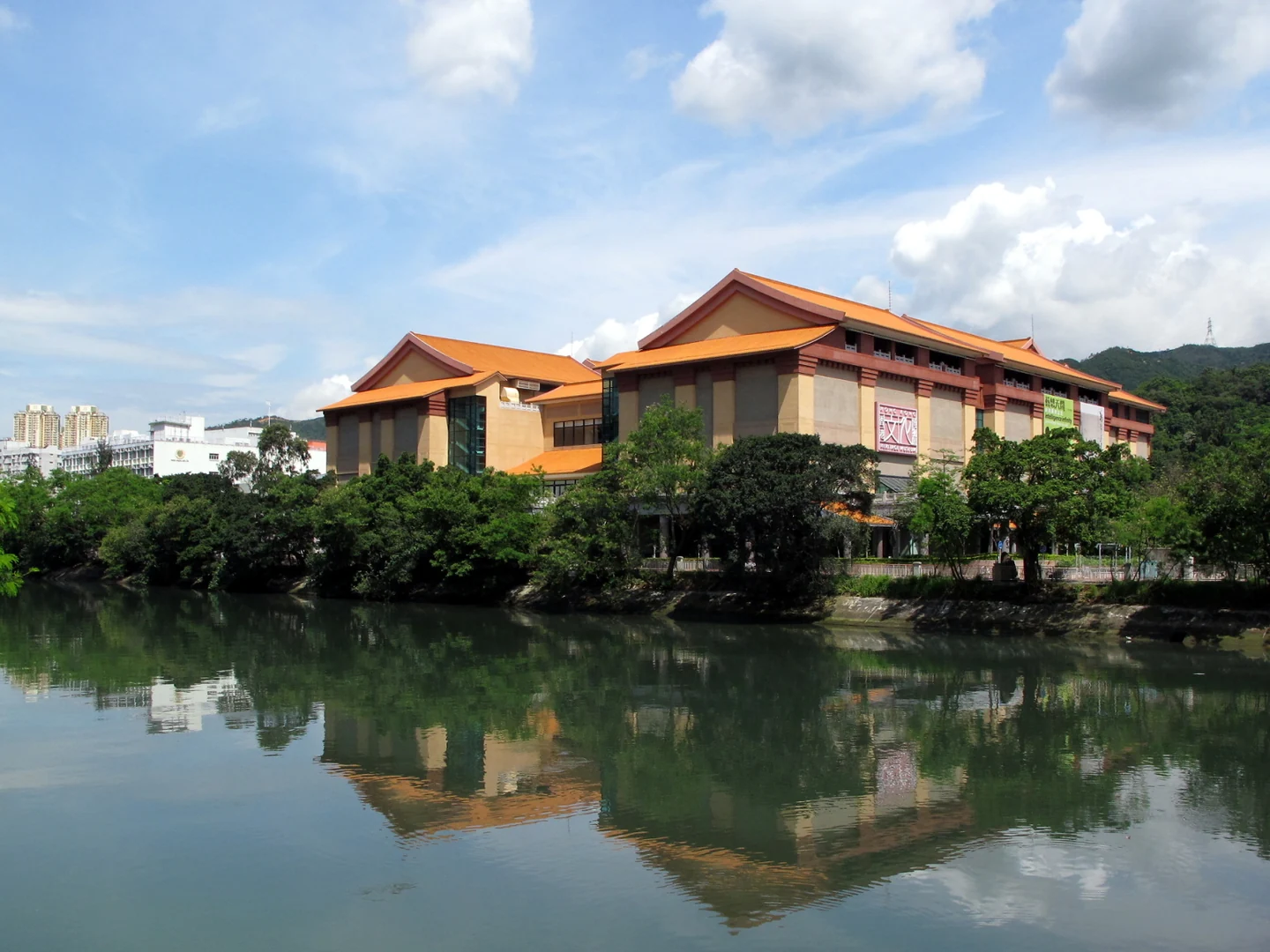
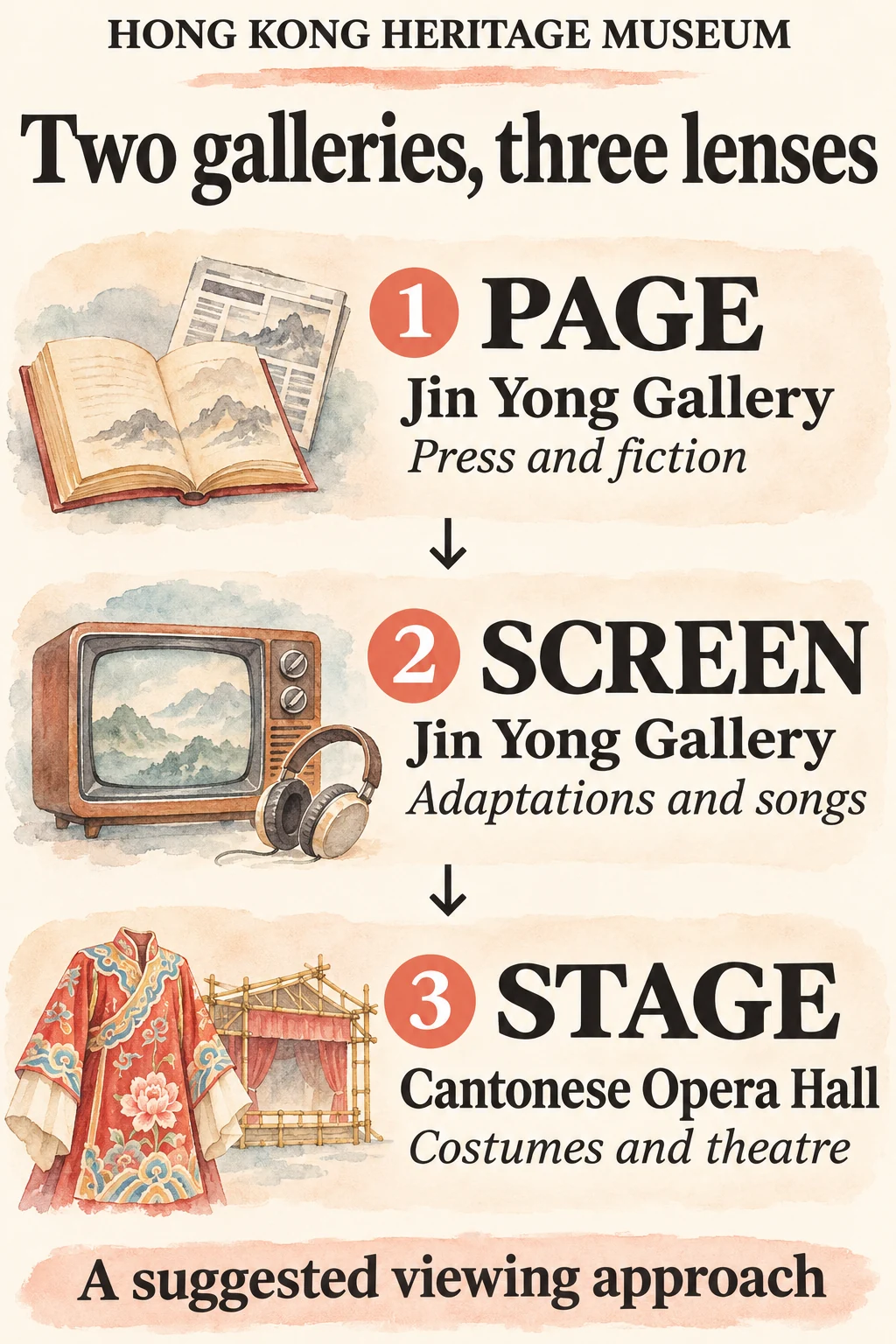
For a first visit to Hong Kong Heritage Museum, start with the Jin Yong Gallery on the ground floor, then the Cantonese Opera Heritage Hall on the first floor. Both permanent exhibitions are free. Allow roughly two to three hours to follow stories from newspapers and books to screen and stage. That is a suggested visiting budget, not a museum rule, and you do not need prior knowledge of martial-arts fiction or Cantonese opera.
Find the right museum, then choose two lines of enquiry
Hong Kong Heritage Museum is at 1 Man Lam Road in Sha Tin. It is a different institution from Hong Kong Palace Museum in West Kowloon. The museum describes the walk from Che Kung Temple MTR Station Exit A as about six minutes. That estimate covers the station-to-museum walk, not your train journey from a hotel, waits at crossings or rest stops.
There is no need to turn every gallery into a compulsory stop. At Jin Yong Gallery, ask how a story was written and how different media carried it to audiences. At the opera hall, ask how performers use costumes, objects and a performance space to create a character. These questions connect the two galleries without requiring you to memorise every name, novel or role type. Check the day's gallery signs before following a list of objects in an older guide.
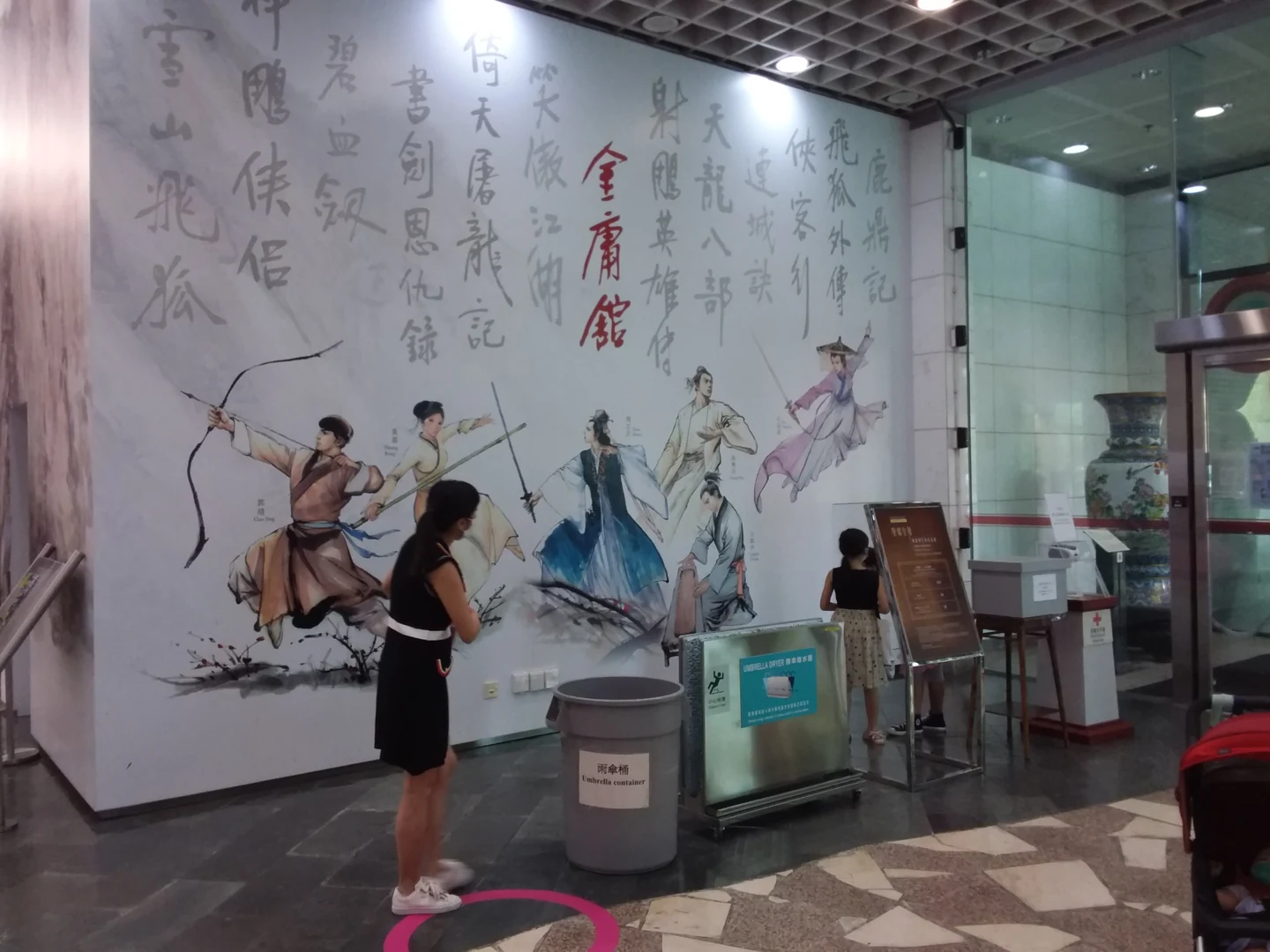
At Jin Yong Gallery, begin with the difference between a serial and a book
The museum records that Louis Cha published his first martial-arts novel, The Book and the Sword, in the New Evening Post in 1955 under the pen name Jin Yong. He completed his last, The Deer and the Cauldron, in 1972, having written fifteen novels. More than 300 exhibits introduce his early career, creative process and influence on popular culture.
Read this as a history of making and circulating stories, rather than a test of publication dates. Choose one newspaper or serial-related item, then a bound edition. Compare page layout, divisions, cover design and how a reader would handle each format. A serial asks readers to wait for another instalment; a complete book lets them set their own pace. Revision manuscripts listed by the museum add another question: why might publication be a stage in writing rather than its final point? The actual objects on view remain subject to gallery labels and current arrangements.
HK01's 2017 opening report discussed the preservation of manuscripts and preparation of the exhibition. It offers a useful historical perspective: surviving material has a story of collection and preservation of its own. It does not establish that a particular manuscript described in 2017 is still displayed in the same place. Use the museum's current information to understand the permanent exhibition, and the labels to identify today's objects.
Move to screen and sound: what changes when the medium changes?
The gallery includes interactive material involving film and television excerpts and theme songs. If someone in your group knows an adaptation, choose just one familiar story to compare. If nobody does, examine how a cover presents a character, how an image suggests a relationship and how sound creates a mood. Recognising an actor is not an entry requirement for the exhibition.
The museum's current highlights include different forms of Demi-Gods and Semi-Devils material, television special issues and theme-song records. They do different jobs. A revised manuscript preserves changes to words; a special issue shows how a production was presented to its audience; a record lets a story circulate through listening. Holding those distinctions in mind is more rewarding than photographing every case without pausing.
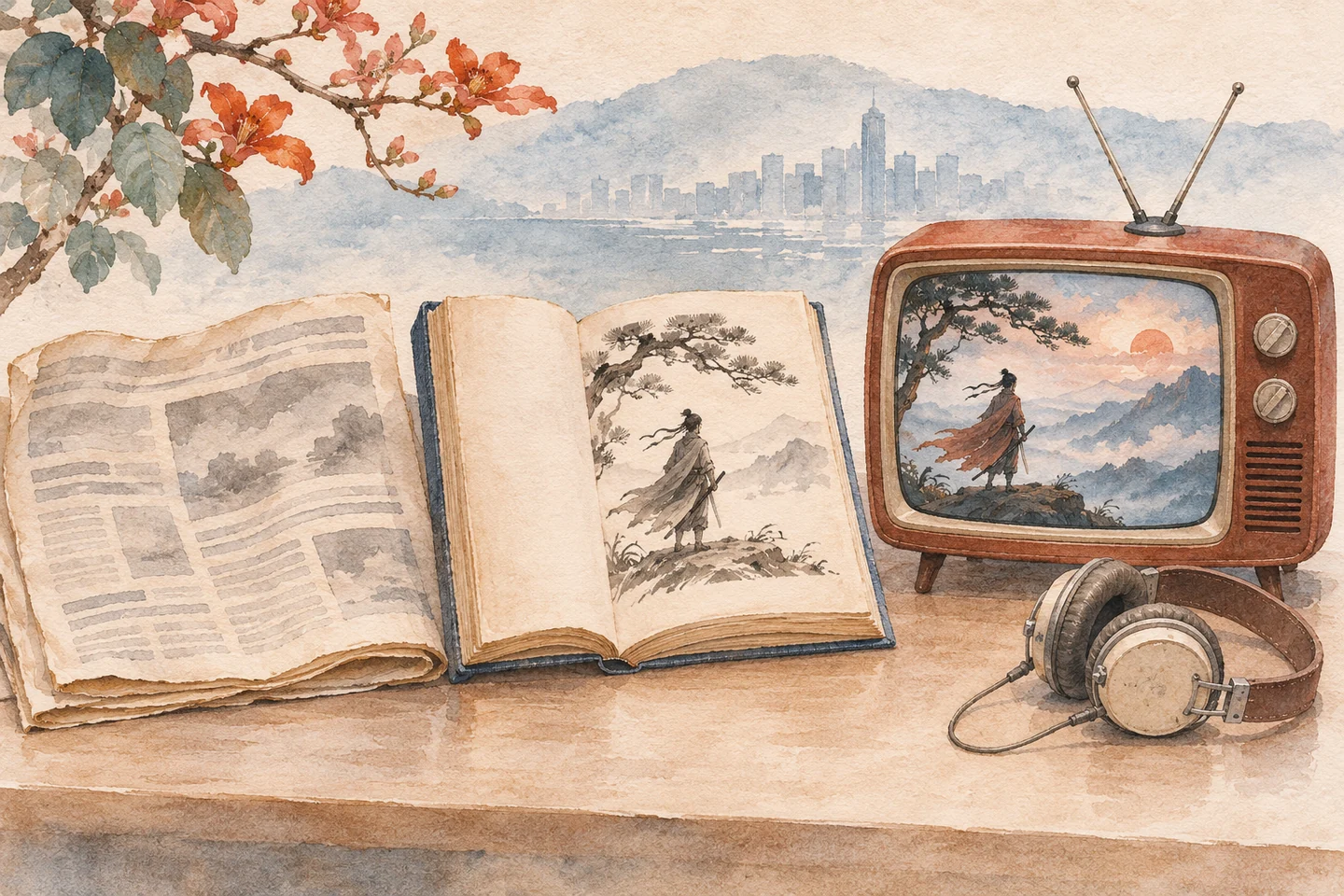
Device availability, waiting and playback depend on the day. Interactive excerpts are not a promise of a fixed screening session or a complete film. The illustration below compares media conceptually; its invented character and objects do not reproduce a museum display.
At the opera hall, look at the theatre before the costume
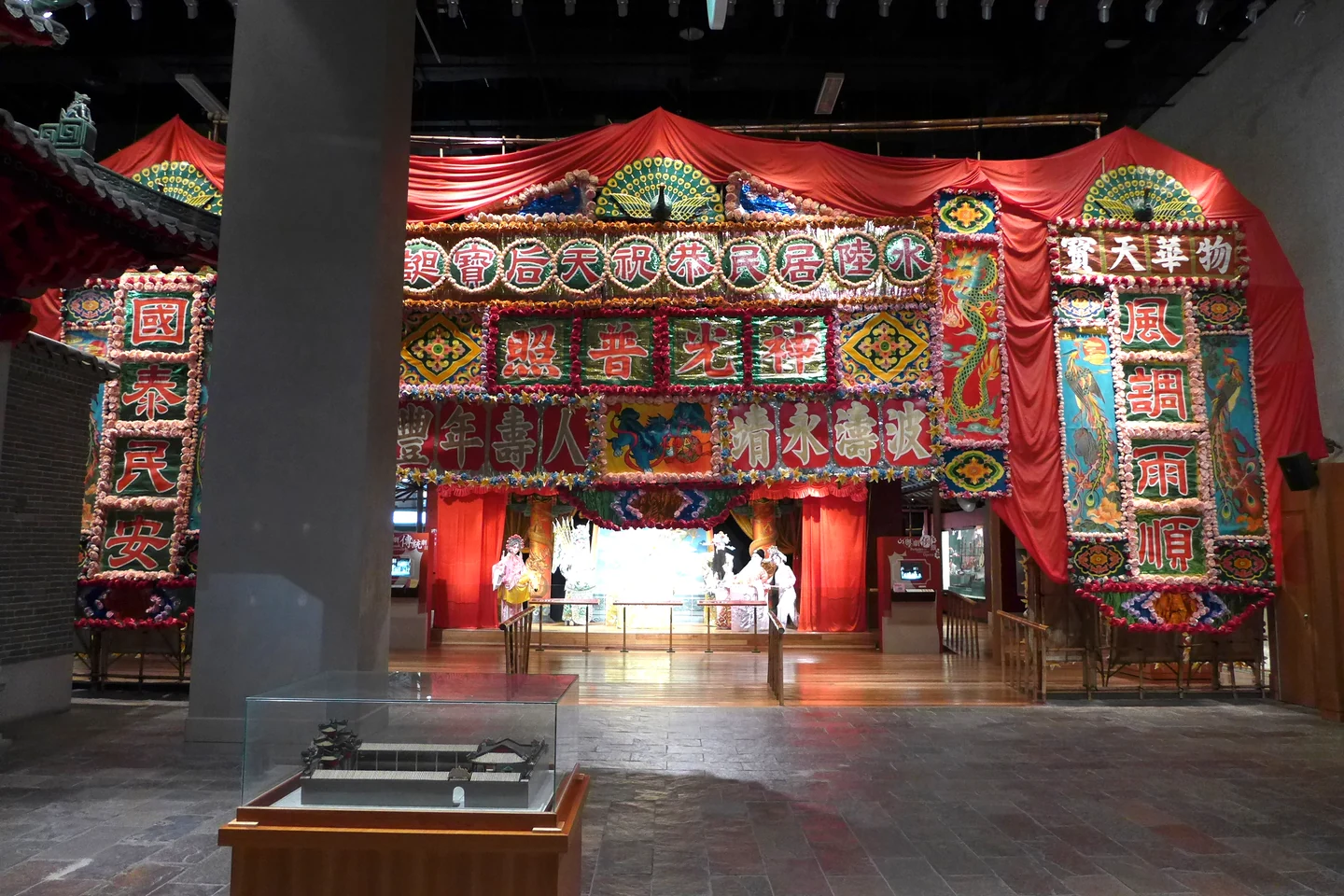
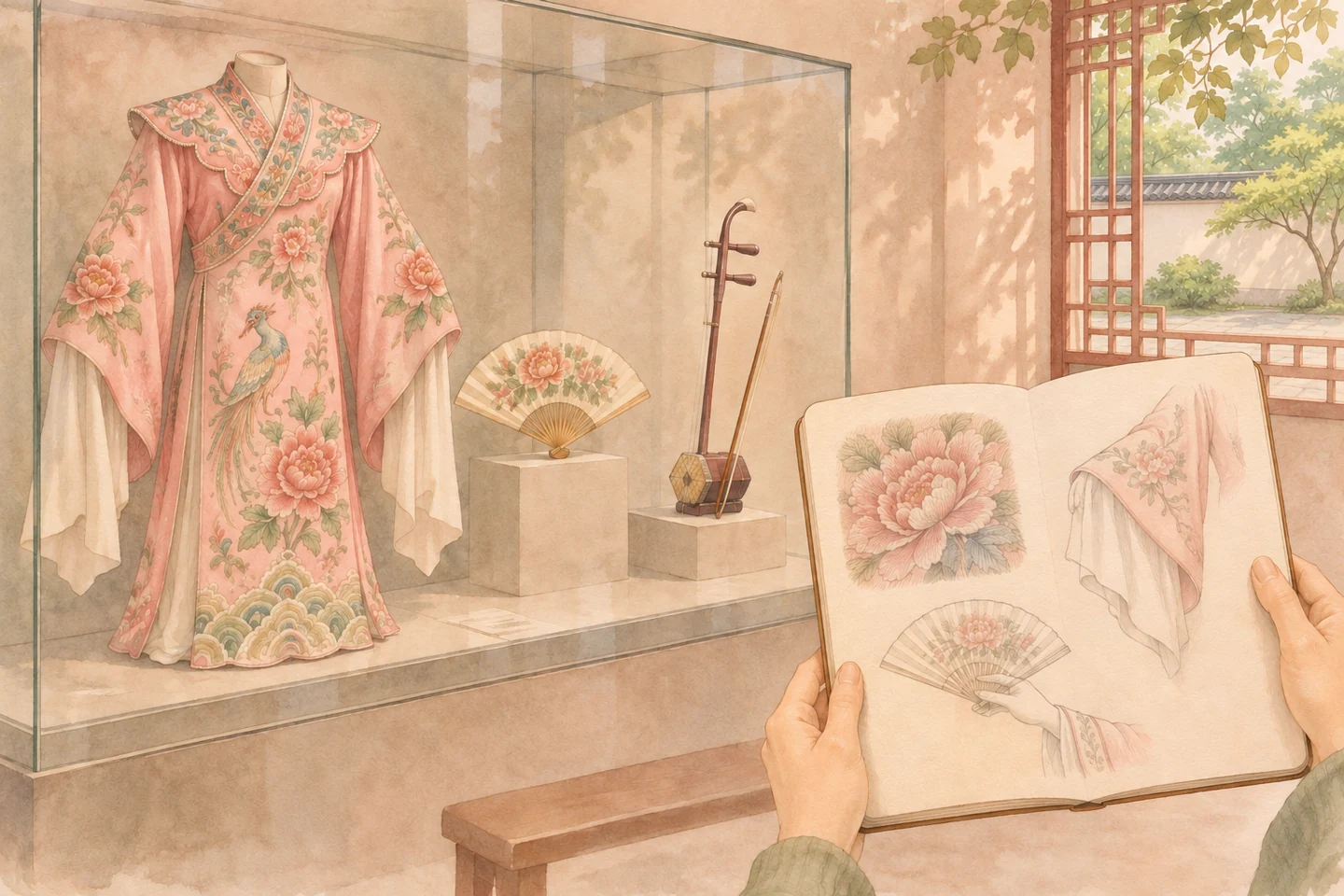
The Cantonese Opera Heritage Hall is on the first floor. Its official introduction highlights artefacts associated with earlier performers, a reconstructed bamboo-shed theatre and multimedia material explaining the history and characteristics of Cantonese opera. Begin at a distance, considering the relationship between stage and audience. Then approach the cases to examine fabric, decoration and accessories.
Ask two practical questions: which silhouettes and colours remain conspicuous from farther away, and which details only become visible close up? These are ways to look, not a universal code assigning a character's identity to every colour or pattern. To identify a costume's performer, production or role, read that object's label rather than guessing from its appearance.
Postbills, contracts and photographs are worth comparing with clothing. A costume helps explain how a stage image is constructed; a paper document may provide a different clue about a performance, collaboration or circulation. The reconstructed theatre is an exhibition feature. Its presence does not mean there is a live opera performance every day.
Leave time for Leung Sing Por across stage, film and television
When checked on 3 November 2026, the official gallery page described the Artist's Corner display on Leung Sing Por, “The King of Comic Roles”, including costumes, postbills and photographs. It traces a career spanning stage, film and television. This connects naturally with the earlier gallery's question about how audiences encounter a cultural figure through different media.
Visitors unfamiliar with opera terminology can each choose an object and describe what they can actually see: the shape of clothing, the placement of an accessory or the hierarchy of words on a poster. Then read the label to test that observation. With children, finding one detail at a time can prompt a better conversation than insisting on reading every panel. This is a suggested family viewing exercise, not a museum-led course or workshop.
How to divide two to three hours, or simplify a one-hour visit
This self-guided time budget includes breaks and moving between galleries. It excludes travel to Sha Tin and does not guarantee immediate access to every interactive feature on a busy day.
| Part of the visit | Suggested time | Keep the focus on |
|---|---|---|
| Arrival, signs and choosing priorities | 10–15 minutes | Gallery access and the day's notices |
| Jin Yong Gallery | 45–60 minutes | One set of written material and one adaptation medium |
| Rest and changing galleries | 15–25 minutes | Adjusting to energy rather than filling every gallery |
| Cantonese Opera Heritage Hall | 45–60 minutes | Theatre, costume and one group of performer-related objects |
With only one hour, choose one gallery properly and leave the other for another visit. Readers and screen enthusiasts may prefer Jin Yong Gallery; visitors drawn to clothes, theatre and performance may prefer the opera hall. Before adding a special exhibition, check its subject, charge and the time actually left. Its tickets or sessions are not automatically included in arrangements for these two permanent displays.
Check hours, photography rules and the pick-up point before travelling
The published opening hours are 10:00–18:00 on Monday and Wednesday to Friday, and 10:00–19:00 on Saturdays, Sundays and public holidays. The museum closes on Tuesdays except public holidays, and on the first two days of the Lunar New Year. It closes at 17:00 on Christmas Eve and Lunar New Year's Eve. Recheck official notices for exceptional arrangements before travelling.
These two permanent exhibitions are free; some special exhibitions may charge separately. The museum's FAQs generally permit photography subject to individual gallery rules. Flash or lighting equipment, tripods and selfie sticks are not allowed inside galleries. If a particular object creates uncertainty, ask staff rather than treating another visitor's photograph as permission.
The museum's public car park has been closed since 1 August 2025 for Trunk Road T4 works. Drivers and passengers arranging a transfer should not use parking spaces visible in old photographs as evidence of current availability. Confirm the actual parking or pick-up location and the walking distance separately. Visitors needing specific wheelchair access, group arrangements or assistance should also check with the museum, rather than assuming that every route is suitable simply because the visit is indoors.
Your pre-journey checklist
- Confirm the destination is Hong Kong Heritage Museum in Sha Tin, not Hong Kong Palace Museum in West Kowloon.
- Check closure days, special exhibitions and gallery notices on the day of travel.
- Allow for the walk from Che Kung Temple Station and calculate hotel-to-Sha Tin travel separately.
- Do not rely on the closed public car park; confirm your pick-up point.
- Choose one group of written material, one screen or sound connection and one stage object.
- Read photography notices and leave flash, tripods and selfie sticks unused in galleries.
Sources & further reading
This article draws on the media coverage and public information below. Event and transport arrangements can change; check the latest details before travelling.
- Hong Kong Heritage Museum: Jin Yong Galleryheritagemuseum.gov.hk (Opens in a new tab)
- Hong Kong Heritage Museum: Cantonese Opera Heritage Hallheritagemuseum.gov.hk (Opens in a new tab)
- Museum FAQs: hours, photography and parkingheritagemuseum.gov.hk (Opens in a new tab)
- Museum opening hours and locationheritagemuseum.gov.hk (Opens in a new tab)
- Museum current exhibitionsheritagemuseum.gov.hk (Opens in a new tab)
- HK01: gallery opening and manuscript preservation (2017 report)hk01.com (Opens in a new tab)
Make it your journey
To connect a Sha Tin museum visit with a hotel, airport or another district, use our contact page to share the date, starting point, group size and time you want inside. Confirm transfers around actual opening and pick-up conditions; the museum visit need not become a race to finish every gallery.