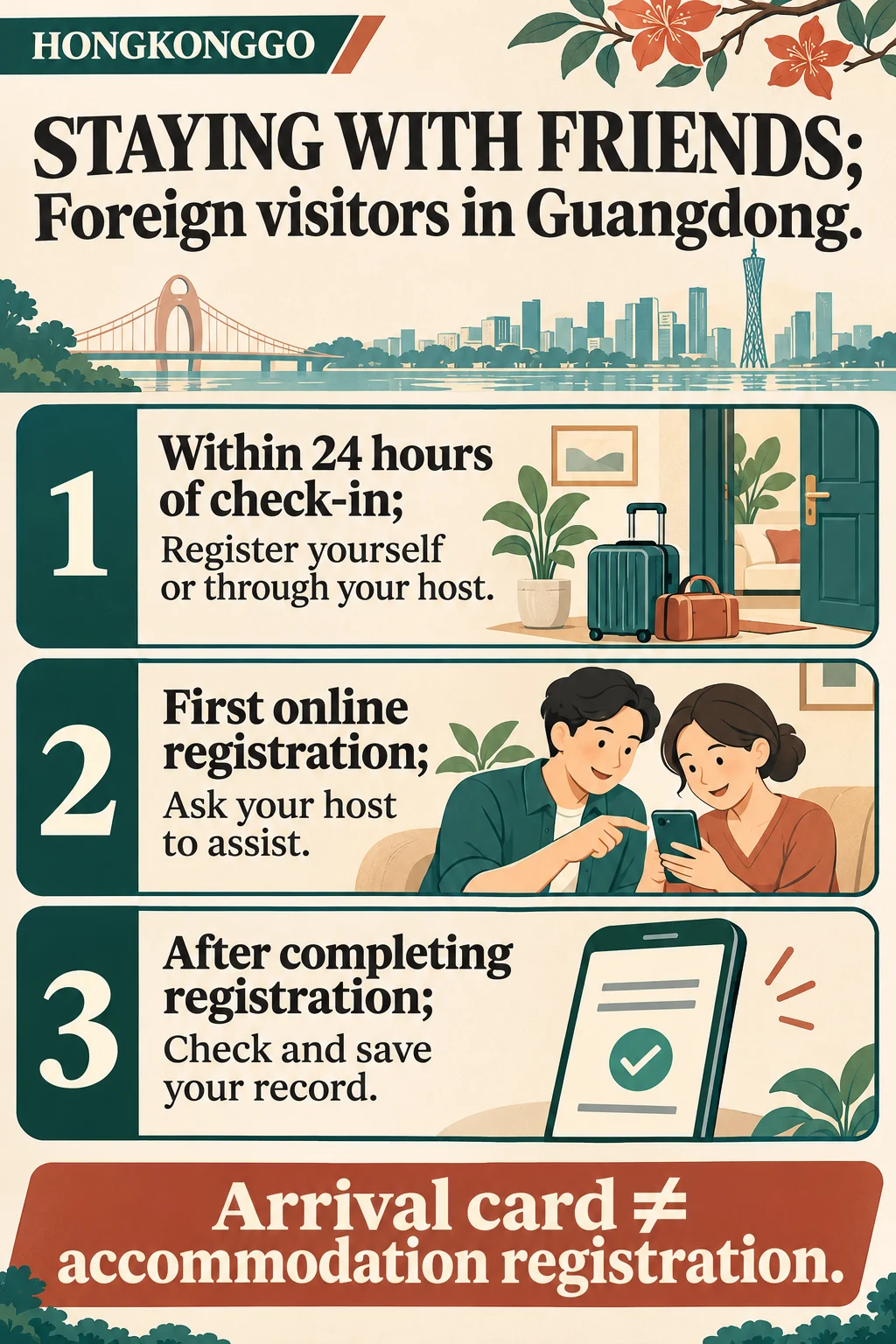
If you travel from Hong Kong to Guangdong on a foreign passport and stay with friends or relatives, the address on your arrival card is not accommodation registration. For a stay outside a hotel, you or your host must register with the public security authorities at the place of residence within 24 hours of check-in. The National Immigration Administration (NIA) extended its online service nationwide on 21 September 2026; in-person channels remain available. For a first online registration, arrange help from the host who knows the address.
Entering China and registering your stay are separate steps
This guide is for foreign-passport travellers who have checked their mainland entry eligibility separately and plan to stay in a private home in Guangdong. Hotels and ordinary residences involve different responsibilities. Mainland accommodation registration is also separate from Hong Kong or Macao immigration procedures.
The NIA nationwide announcement restates Article 39 of the Exit and Entry Administration Law: hotels register foreign guests and report the information to the local public security authorities; outside hotels, the guest or host must register within 24 hours of check-in. The online channel is the new convenience. It did not introduce the underlying 24-hour obligation or abolish registration.
| Plan | What to confirm |
|---|---|
| A car from Hong Kong to a Shenzhen hotel | Cooperate with the hotel’s registration. A room reservation alone is not completed check-in. |
| A train from Hong Kong to Guangzhou, staying with a friend | Agree with the host how to complete non-hotel registration within 24 hours of check-in. |
| A hotel first, then a relative’s home | The hotel’s record does not replace registration at the new accommodation. |
| The friend’s address is already on the arrival card | Arrival information and accommodation registration are separate processes. |
A short visit, visa-free entry or an invitation from relatives is not, by itself, a registration exemption. For the entry form, see our China Arrival Card guide; its field-by-field instructions are not repeated here.
Count 24 hours from check-in, not the next working day
The Chinese official wording is “within 24 hours after moving in”. If you arrive and begin your stay at a friend’s home at 20:00 on Friday, plan to complete registration within the following 24 hours rather than waiting until Monday. This illustrates the published deadline; it does not create any additional grace period.
Before leaving Hong Kong, ask the host to confirm the complete address and when they can help. After arrival, check the actual check-in date, time and residence. Tell the host if a delayed flight, border crossing or change of plans alters your accommodation. Vehicle arrival, departure from Hong Kong and moving into the home are different events.
For online difficulties, NIA provides the 12367 hotline and local public security assistance. Start early rather than treating an inaccessible website as a suspension of the deadline. This guide does not promise that every local police station handles registration around the clock; check the actual location.
The online service is nationwide, including Guangdong
Some older explanations still list a seven-province pilot in Hebei, Liaoning, Zhejiang, Hubei, Guangxi, Chongqing and Sichuan. That was the March 2026 stage. The current Announcement No. 7 of 2026 states that nationwide implementation began on 21 September. Online and on-site registration have equal legal effect, and the in-person route remains available.
Available channels are the NIA Government Service Platform website, the NIA 12367 app, and its WeChat or Alipay mini-programs. Open Accommodation Registration under Foreigner Service, complete user registration and identity verification, and follow the steps shown. After completion, use Registration Record Inquiry to view the accommodation record. These are the steps in the current policy interpretation.
Start from the official NIA service platform. This guide explains the published process, without claiming a verified list of every field behind login or promising completion in a fixed number of minutes. Prepare identity and residence evidence according to the actual service and local public security instructions. A travel article cannot replace the system’s checks.
A host assists the first time; the host need not be Chinese
NIA says registration may be completed by the guest or host. Because hosts generally know the residence details better, the first registration should be completed with their assistance to avoid address errors. A host may be a Chinese citizen or a foreign national; do not assume a foreign friend cannot help.
Guests can register independently if they have previously registered through the NIA platform and need to register again at the same residence, or if they are staying in a home they own. Being allowed to register independently again is not the same as being exempt from registering again. This distinction matters for short-term visitors making repeated trips between Hong Kong and Guangdong.
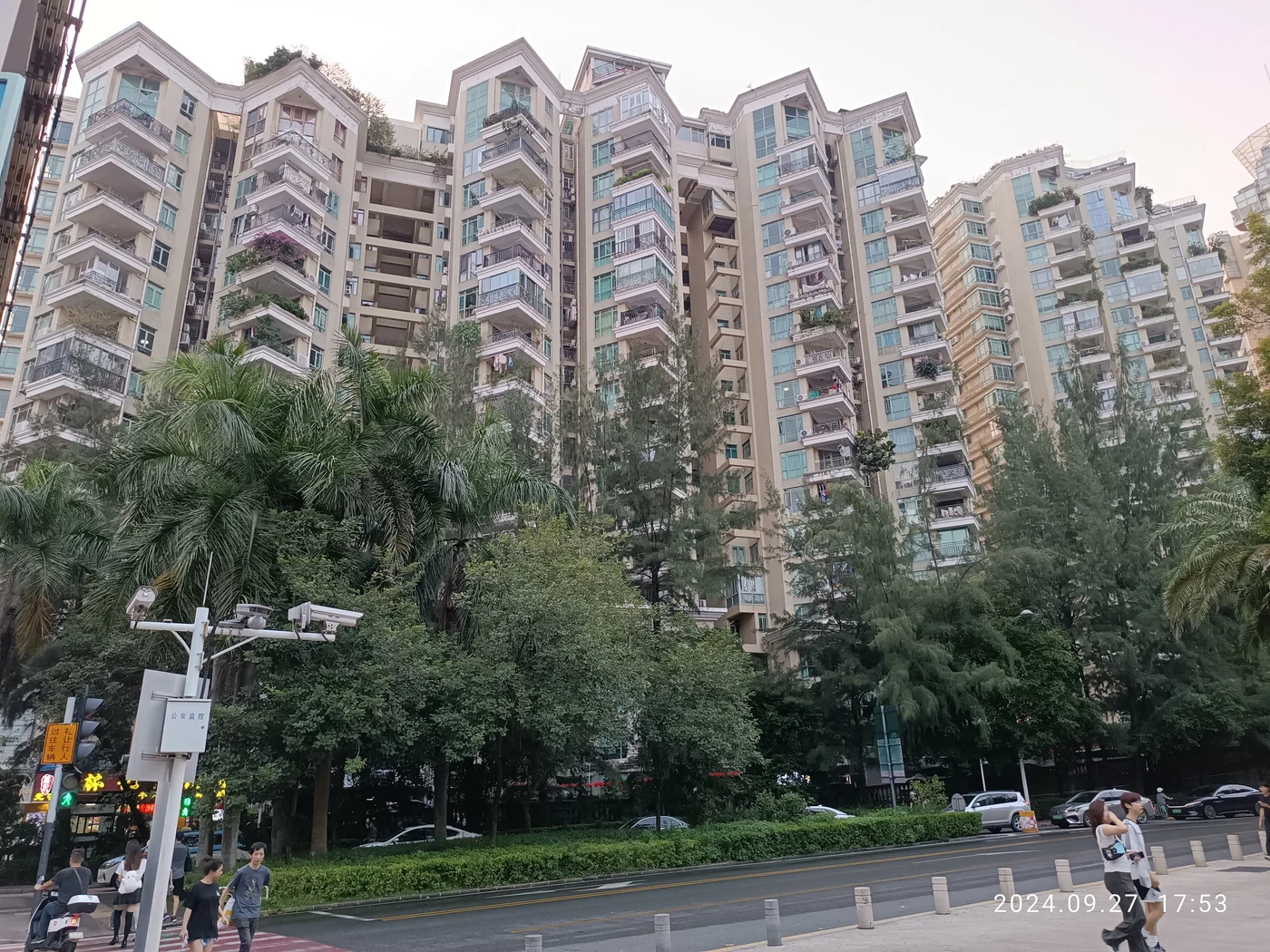
Ask the host to check the province, city, district, street, building and precise dwelling details requested by the system. A development’s marketing name, shopping centre or nearest station may not identify the actual residence accurately. Agreeing the details in advance is more useful than exchanging vague location pins after arrival.

Returning and moving address: two narrowly defined simplifications
NIA’s current interpretation says re-registration is unnecessary in the following circumstances, after the original stay has already been registered as required:
- A foreign national lives in a self-owned residence in China and returns to that same residence after travel within or outside China. “Self-owned” includes a residence in China owned by the foreign national or their spouse.
- A foreign national holds a residence permit or permanent residence permit, lives at a habitual residence in China and returns to it after domestic or overseas travel during the validity of the same permit. A habitual residence is one where the person lives or plans to live long-term; the official explanation defines long-term as more than 180 days.
An ordinary visitor visa or visa-free stay is not a residence permit. A home belonging to a friend is not therefore your self-owned residence. A short-term visitor who registers at a friend’s home, returns to Hong Kong and then comes back should not assume that the previous record creates an exemption. They may be eligible to register independently again while still needing a new registration.
Moving to another friend’s home, or from Shenzhen to a different residence in Guangzhou, is not a return to the same residence covered by those simplifications. If unsure about your permit, ownership or long-term residence, ask 12367 or the local public security authorities using your specific facts. A landlord’s informal reassurance is not a substitute for that check.

Find the record before saving it
After completing the process, use Registration Record Inquiry to check the relevant record and the identity and address details actually displayed. Keep a copy useful for later reference. Screenshots and files may contain personal information; retain them with the guest and necessary registration helpers rather than posting them in public comments or an ordinary quotation form.
If the record is missing, an address is wrong or further information is requested, use the official channel to find out what to do. Account creation, a submission message or an arrival-card QR code should not be treated as completed accommodation registration without checking. This is a checking recommendation, not a claim that every platform uses identical status labels.

Assistance remains available if online registration is difficult
NIA recommends reading the Guide to Online Accommodation Registration within the service, calling 12367, or visiting the public security exit-entry service window or local police station at the place of residence for on-site assistance. See its English policy explanation.
Pingshan’s practical notice, sourced to Shenzhen Daily, also points to Shenzhen’s local police platform, the NIA national service and police stations. Interfaces and evidence requirements can differ between channels. Identify the actual residence and appropriate service first, then follow the official instructions.
For failure to register as required, NIA cites Article 76, under which a warning and potentially a fine may apply. Agreeing who will help, when registration will be completed and how to check the record before moving in is more useful than guessing the consequences afterwards.
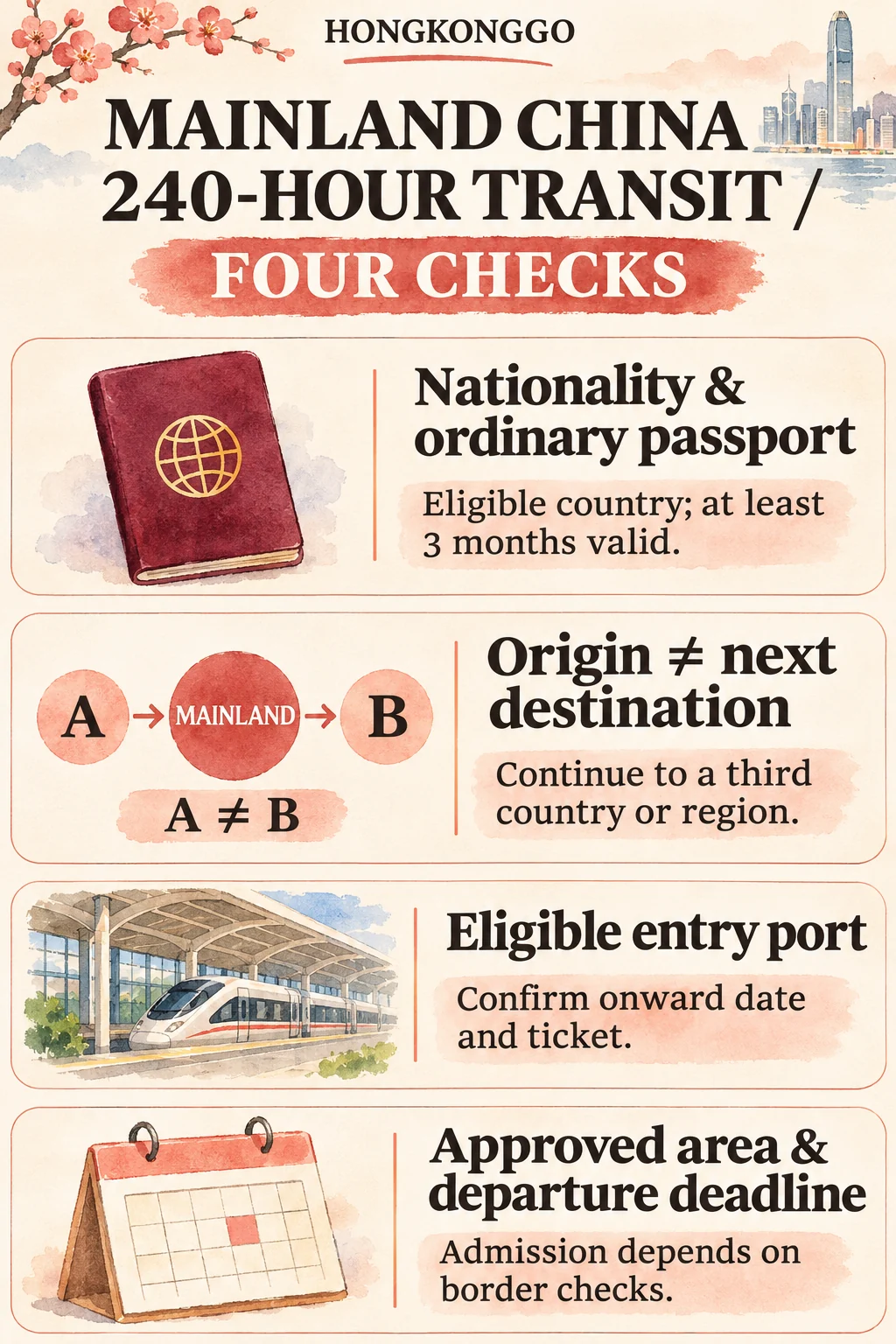
For transit-entry eligibility from Hong Kong, read our 240-hour visa-free transit itinerary guide. Accommodation registration does not extend an authorised stay or make an otherwise ineligible entry route lawful.
Your pre-journey checklist
- Check mainland entry eligibility separately and establish whether the stay is in a hotel or another residence.
- Confirm actual check-in date, time and the complete address with the host.
- Arrange host assistance for the first online registration and completion within 24 hours of check-in.
- Distinguish independent repeat registration from a qualifying exemption from re-registration.
- Check the completed record; seek help through 12367 or the local public security authorities if needed.
Sources & further reading
This article draws on the media coverage and public information below. Event and transport arrangements can change; check the latest details before travelling.
- NIA Announcement No. 7 of 2026: nationwide implementationnia.gov.cn (Opens in a new tab)
- NIA: current accommodation-registration policy interpretationnia.gov.cn (Opens in a new tab)
- NIA: current English policy interpretationen.nia.gov.cn (Opens in a new tab)
- Pingshan government / Shenzhen Daily: practical non-hotel registration guidanceszpsq.gov.cn (Opens in a new tab)
Make it your journey
For a transfer from Hong Kong to a friend’s home in Guangdong, send HONGKONGGO your pickup point, accurate drop-off address, passenger count and luggage. The traveller and host should handle accommodation registration under official instructions; do not submit passports or registration records in the general quotation form.