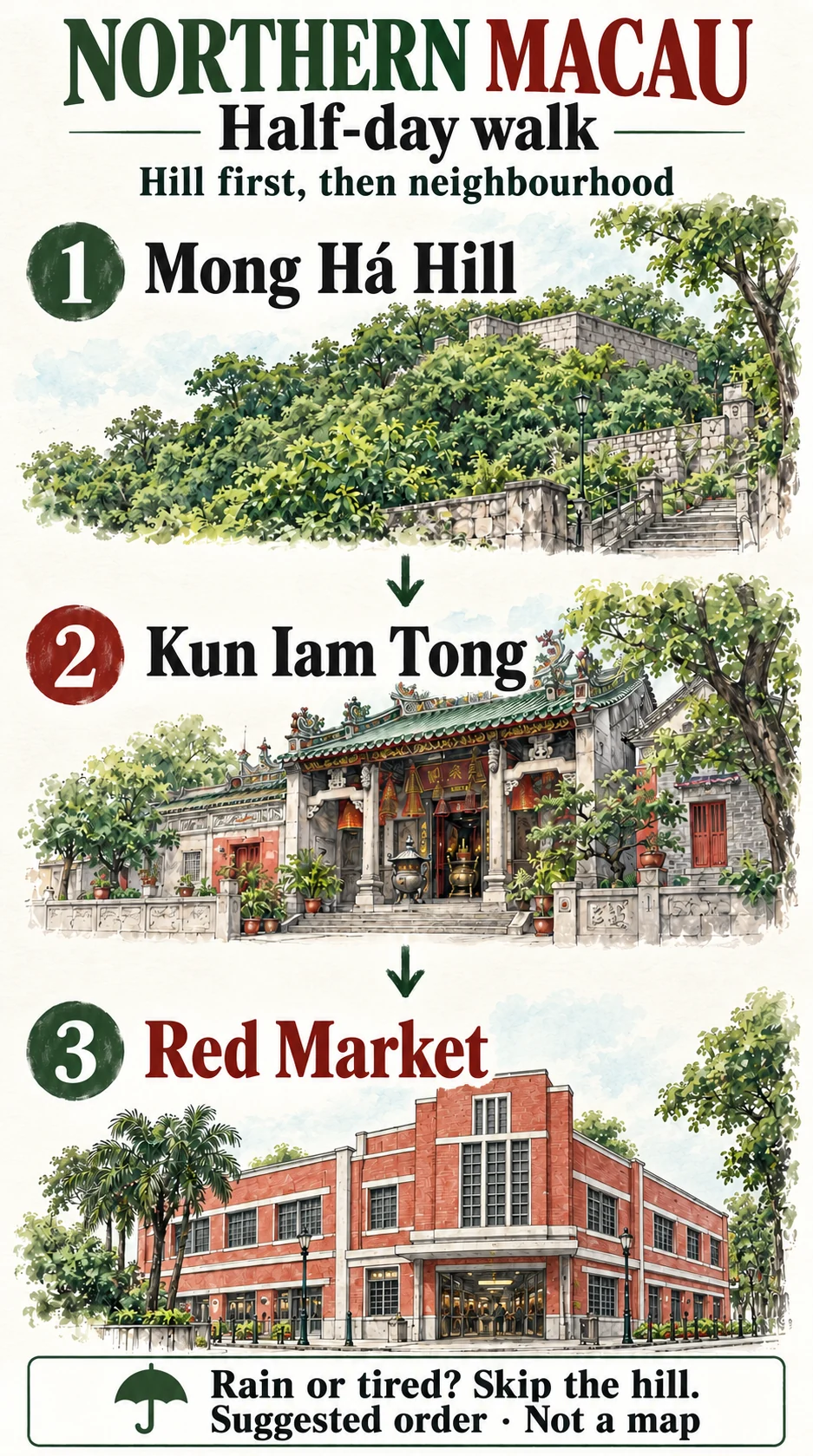
For a different Macau morning, link Mong Há Hill, Kun Iam Tong and the Red Market: take the slope first, visit an active temple quietly, then observe the market and sit down for lunch nearby. Allow about three to four hours, assuming you are already in Macau with luggage stored before 09:30. Hotel transfers, bag collection and departure formalities are additional. In rain, heat or with less appetite for slopes, start at the temple instead.
A hill, a temple and a working neighbourhood
This is not an extension designed to pack more stops onto a St Paul's itinerary. The three places offer different perspectives on the northern peninsula: the relationship between a hill and its former military use, a religious space still in use, and a historic building serving everyday shopping. The sequence is our itinerary suggestion, not an official trail or a navigation map.
Macao Magazine's Red Market feature of 9 October 2026 discusses the neighbourhood role of a market opened in 1936. Macao News' historical feature adds context on the red-brick building and the changing city. Its older reopening announcement should not be read in the present tense: IAM confirmed the market reopened on 30 May 2024. The interest now is a building back in use, not a construction-site photograph.
Keep the morning open and save the three full place names
This example begins around 09:30 and finishes between roughly 12:30 and 13:30, allowing for walking, looking and lunch. These are editorial planning windows, not guaranteed completion times. Slower walkers, longer conversations or a restaurant queue are reasons to remove a stop. Travellers arriving through a border that morning should finish entry procedures and store luggage before deciding whether the full walk still fits.
| Suggested order and time | Focus | What can be shortened |
|---|---|---|
| 09:30–10:30, Mong Há Hill | Open park paths, the old fort and northern-city views | Do not attempt every path on the hill |
| 10:30–11:00, return to street level and approach Kun Iam Tong | Cross roads properly, drink water and use current walking directions to the entrance | Do not race to make up a late start |
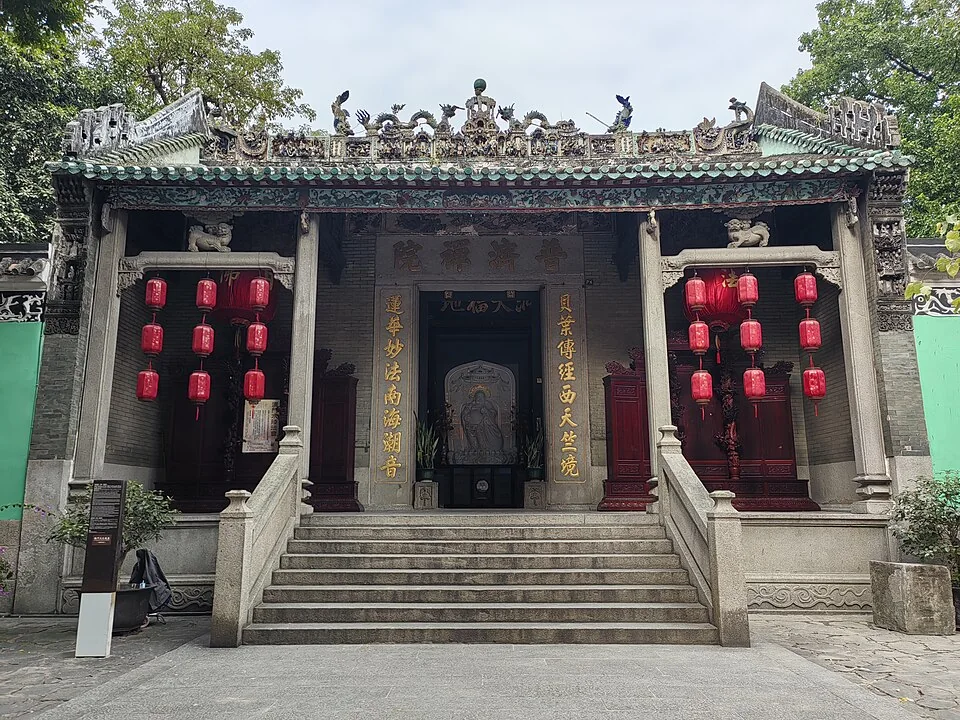
| 11:00–11:40, Kun Iam Tong | Roof details, halls and courtyards, leaving room for worshippers | Keep the visit shorter during ceremonies or busy periods |
| From 11:40, Red Market and lunch | Observe the building and market, then choose a nearby restaurant | If tired, keep the exterior visit and sit down earlier |
Save Mong Há Hill Municipal Park, Kun Iam Tong/Pou Chai Temple and Red Market by their complete names. Kun Iam Tong is at 2 Avenida do Coronel Mesquita. It is not the waterfront Kun Iam Ecumenical Centre or another similarly named temple. Red Market stands around the junction of Avenida do Almirante Lacerda and Avenida de Horta e Costa. These are separate street walks, not connected corridors inside one attraction.
Mong Há Hill: read the terrain before looking for exhibits
The tourism authority's park description dates completion of Mong Há Fort to 1866 and its military use into the 1960s. Today's park combines paths, flower beds and grass around the old walls and slopes. The focus here is the old walls, terrain and urban views.
From permitted stopping places, notice the lines of the old walls, then how tree canopies and surrounding buildings frame the hill. Walking uphill differs from strolling at street level, even inside a city. Wear shoes with grip and bring water. Do not enter closed areas or climb walls to reproduce the angle of an old photograph.
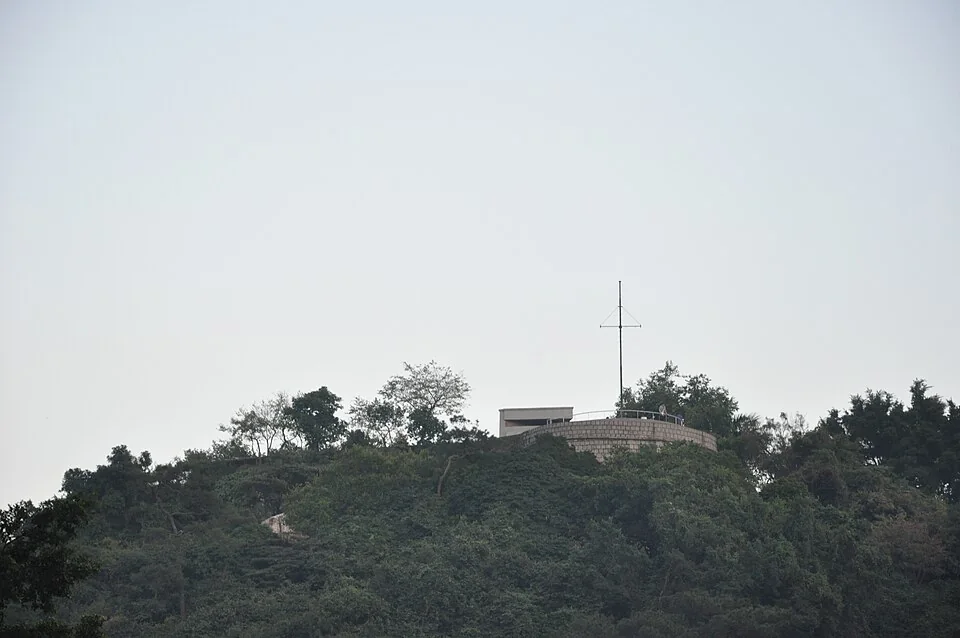
The tourism page lists the park as open 24 hours. That does not establish round-the-clock access to every building or facility, and this itinerary does not recommend a night ascent. We use morning daylight. Temporary closures, thunderstorms or strong winds can still require cancellation. Rest after coming down; if that is enough walking, keep only the temple and lunch rather than adding more park paths.
Kun Iam Tong: visit a place people still use
The official temple page lists 07:30–17:00. It gives no regular weekly closing day in the current information, but ceremonies, maintenance and temporary access changes still need checking. The account dates the present buildings to 1627 and describes halls, courtyards and porcelain figures on the roofline.
Start with the roof silhouette, then compare shaded halls and open courts wherever access is permitted. Give worshippers space. Altars, incense areas and thresholds are not seats for photographs. Ask before photographing people, rituals or devotional interiors; a religious practice is not a performance arranged for tourists.
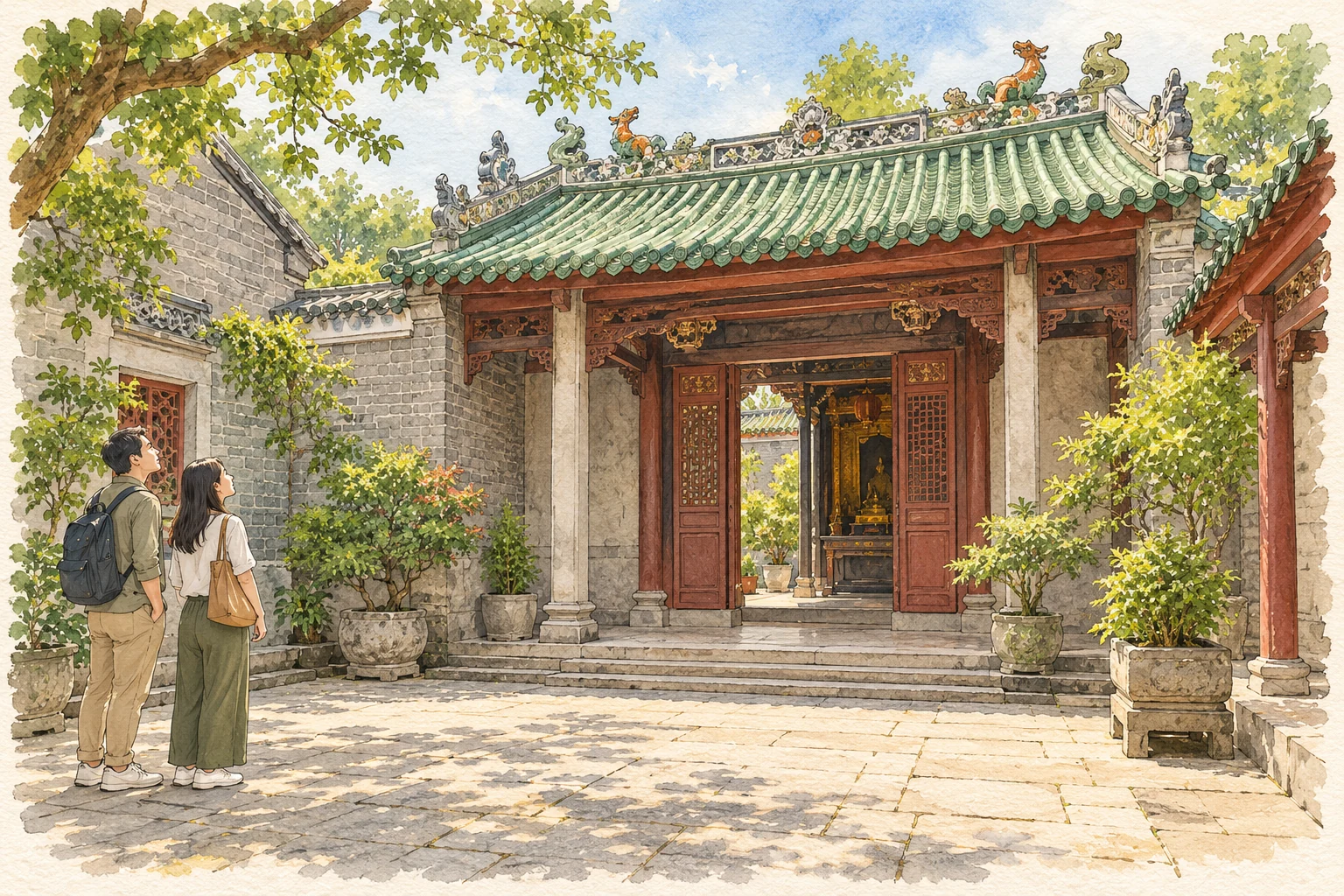
The official account also mentions a stone table in the rear garden associated with the 1844 Treaty of Mong Há. If that area is open and interpretation is available, it can extend the visit. Do not enter a restricted courtyard to find it, or reduce the entire temple to a backdrop for one historical event. Children can look for different roof shapes without being encouraged to call out answers inside a hall.
Incense smoke, steps and thresholds may affect how long someone comfortably stays. Visitors sensitive to smoke or needing assistance can ask about the entrance and open areas, observe briefly from an appropriate external position, then eat earlier. A broad forecourt in a photograph does not demonstrate step-free access throughout the temple.
Red Market: a working building, with lunch planned separately
At Red Market, look from a safe pavement position at the red brick, white window frames and geometric lines, then see how entrances connect to the street. The recent magazine feature places the building within neighbourhood life. That is more revealing than photographing it only as a retro facade: refurbishment has not turned a working market into a visitor-only exhibition.
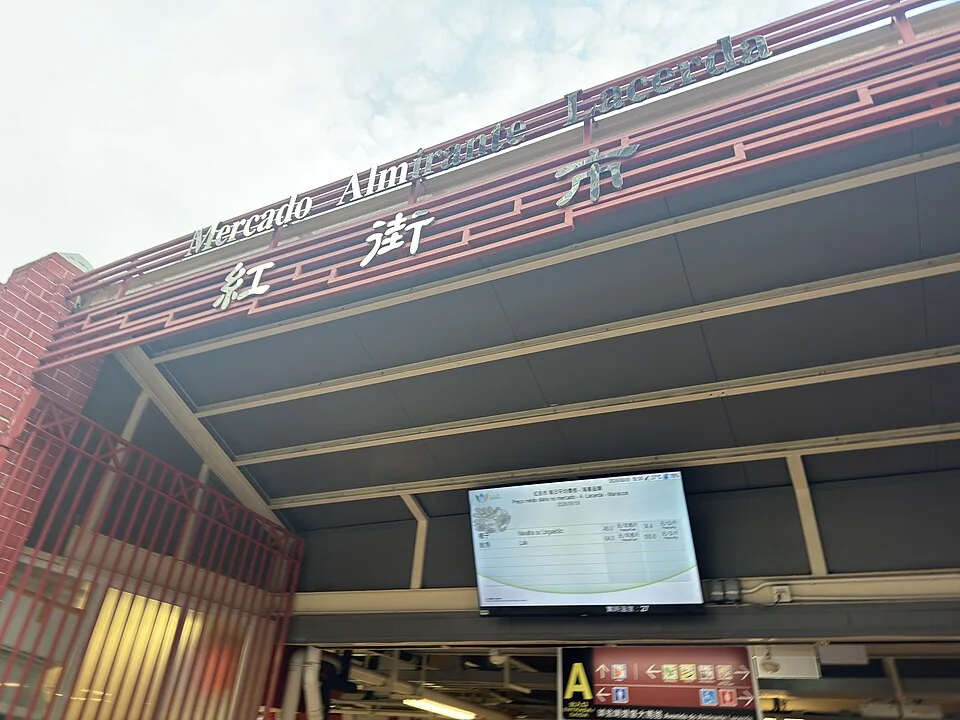
IAM's 2024 reopening announcement lists seafood, fresh meat, chilled products, vegetables, tofu and groceries, and describes added air conditioning and accessible lifts. Do not read this as a promise of a cooked-food hall or assume every purchase is ready to eat. This itinerary places lunch at a suitable nearby restaurant. Check its menu, seating and your companions' dietary needs before ordering.
Inside, stay in open aisles, watch wet floors and working trolleys, and leave deliveries and shoppers room. Ask before photographing a stall. If buying something, establish the unit and quantity first. Individual traders may keep different hours and rest days, so this article does not promise that a particular stall opens every lunchtime.
After lunch, make the finish genuinely a finish
Give lunch a seated interval rather than buying a drink and immediately pursuing another attraction. Ask the actual restaurant about toilets, drinking water and any essential access arrangements. After the hill, it is reasonable to finish in the northern district rather than add Guia Hill or travel across Macau to Coloane.
Check transport against the exact hotel or next-stop address. Do not assume the Macau LRT directly serves the doors of these northern sites. If taking a bus, use the first-time Macau bus guide for boarding and fare preparation, then confirm the current stop and direction for your journey. A vehicle meeting needs a lawful roadside place; a temple entrance or market loading area is not automatically a waiting bay.
If leaving Macau that day, add returning to your hotel, collecting bags, reaching the border or pier and completing formalities. Finishing lunch at 13:00 does not mean being ready to cross the border at 13:00. With a tight onward deadline, choose the temple-and-lunch version from the outset instead of saving a final rush for the whole group.
Three adjustments for weather, a late start and rest
In light rain, oppressive heat or when you want less climbing, begin at Kun Iam Tong, shorten the visit according to conditions, then see the market exterior and eat. With thunderstorms, strong winds or unsafe street conditions, postpone the outdoor walk altogether. A covered market does not make the journey to it safe in severe weather.
For an afternoon arrival, work back from Kun Iam Tong's published 17:00 closure and leave enough visiting time; do not reuse the morning clock times. If the temple is temporarily closed, retain the market and a seated break where practical. If the market also does not suit that day, end the outing. Wheelchair and pushchair access requires checks for slopes, thresholds and street connections individually; this is not presented as an entirely step-free route.
Your pre-journey checklist
- Be in Macau with luggage stored before 09:30; the three-to-four-hour allowance covers this outing only.
- Save Mong Há Hill Municipal Park, Kun Iam Tong at 2 Avenida do Coronel Mesquita and Red Market by name.
- Keep the hill for suitable weather and energy; 24-hour park access does not cover every facility.
- Kun Iam Tong lists 07:30–17:00; religious activities and temporary arrangements take priority.
- Respect a working market and choose lunch separately nearby; do not obstruct trade for photographs.
- Add hotel, luggage and departure travel separately rather than treating the end of lunch as border arrival.
Sources & further reading
This article draws on the media coverage and public information below. Event and transport arrangements can change; check the latest details before travelling.
- Macau Government Tourism Office: Mong Há Hill Municipal Parkmacaotourism.gov.mo (Opens in a new tab)
- Macau Government Tourism Office: Kun Iam Tongmacaotourism.gov.mo (Opens in a new tab)
- Macao News: Red Market historical background, 2024 reportmacaonews.org (Opens in a new tab)
- Macao Magazine: Red Market and neighbourhood life, 9 October 2026macaomagazine.net (Opens in a new tab)
- Municipal Affairs Bureau: Red Market reopening on 30 May 2024gov.mo (Opens in a new tab)
Make it your journey
For another Macau neighbourhood experience, compare the Taipa Village half-day itinerary. Giving the two districts separate half-days leaves more room to notice their different everyday rhythms.