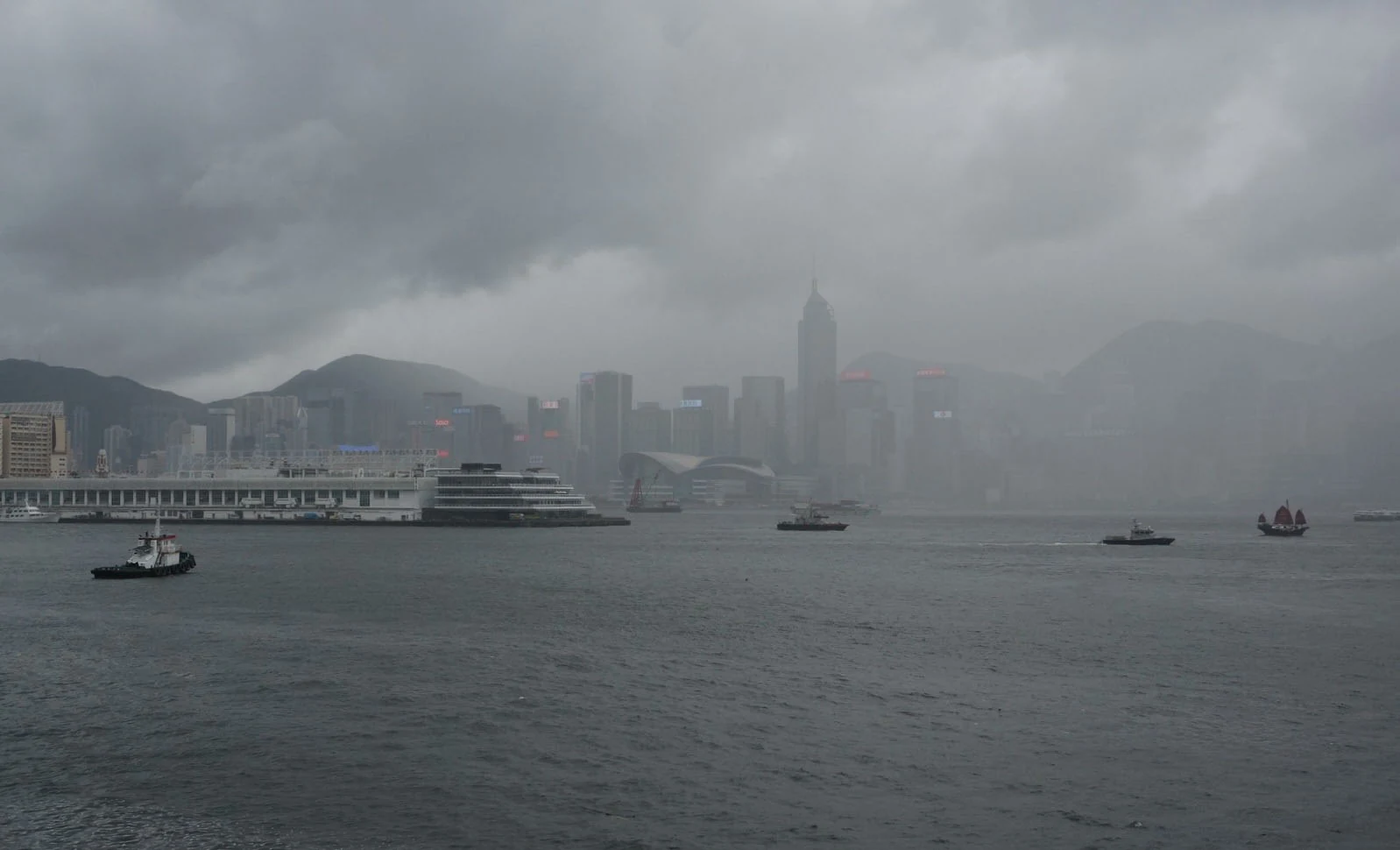
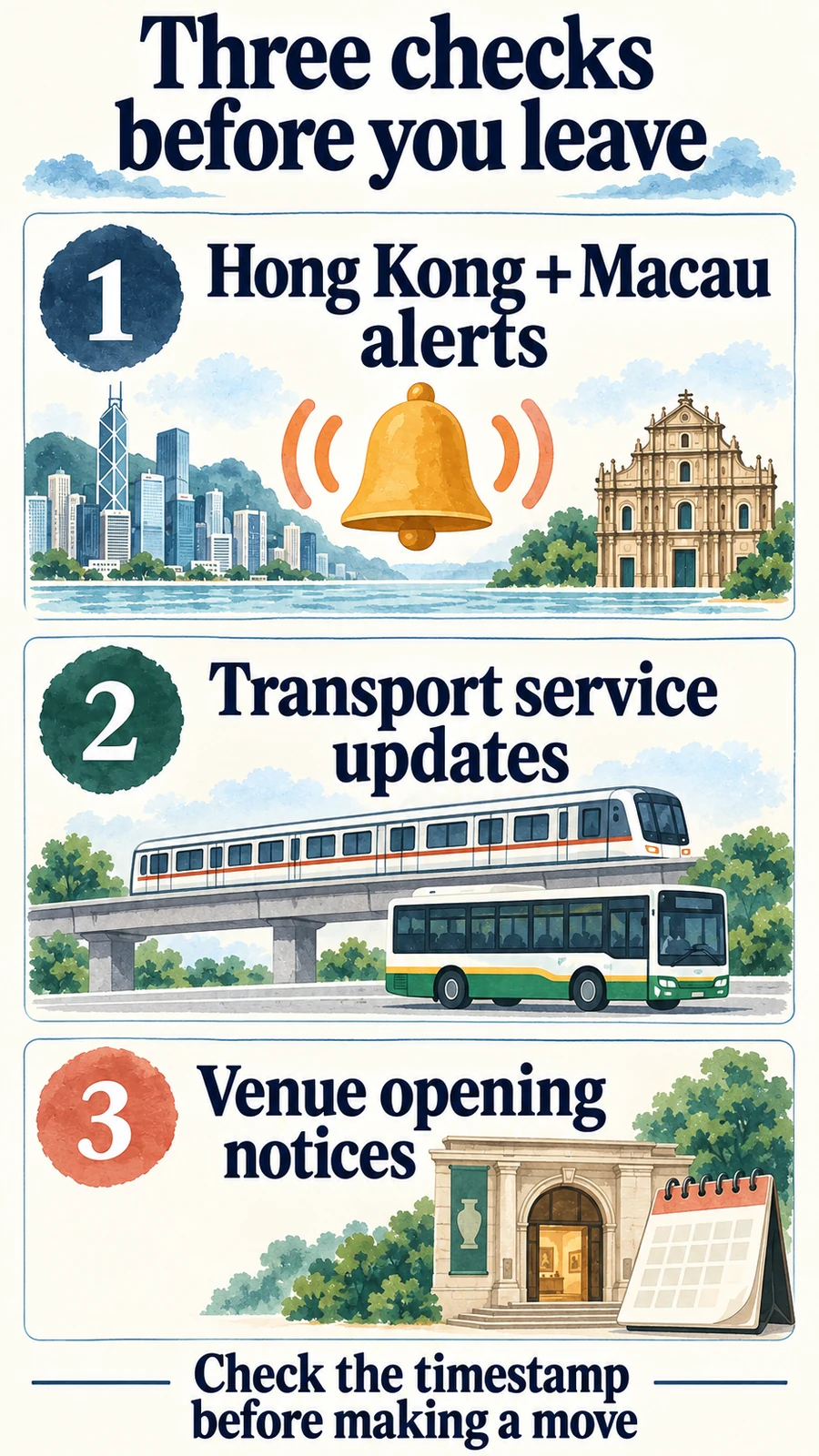
During a typhoon or heavy rain in Hong Kong or Macau, check the warnings in both destinations, then confirm actual transport services and venue opening separately. If severe weather has arrived and you are somewhere safe, stay there. A lower warning or clearer sky is a reason to reassess the whole journey, not an automatic signal to leave. This planning guide was checked on 15 October 2026; it is not a live weather bulletin.
Typhoon signals and rainstorm warnings tell you different things
A tropical cyclone can affect your plans even when it is not raining: a distant storm may produce dangerous swells. Heavy rain can also occur without a typhoon. A rain icon in a weather app cannot tell you whether a ferry trip, waterfront walk or cross-border journey is sensible.
Hong Kong and Macau issue their own tropical cyclone and rainstorm warnings. No warning in Hong Kong does not mean there is no warning in Macau, and the rainstorm thresholds differ. The comparison below explains the systems. It is not a rule for deciding that a particular street is safe from an app’s local rainfall reading.
| Rainstorm warning | Hong Kong | Macau |
|---|---|---|
| Amber / Yellow | Rainfall generally exceeding 30 mm an hour, likely to continue | Widespread rainfall forecast to reach about 20 mm in an hour, or 20 mm recorded in the past hour, with rain expected to continue |
| Red | Rainfall generally exceeding 50 mm an hour, likely to continue | Widespread rainfall forecast to reach about 50 mm in an hour, or 50 mm recorded in the past hour, with rain expected to continue |
| Black | Rainfall generally exceeding 70 mm an hour, likely to continue | Widespread rainfall forecast to reach about 80 mm in an hour, or 80 mm recorded in the past hour, with rain expected to continue |
Either destination can issue a higher-level warning without first issuing Yellow or Amber. The Hong Kong Observatory also considers factors such as prolonged rainfall; the system is not simply a single-hour numerical trigger. In Macau, the three rainstorm warning levels are not issued separately while Typhoon Signal No. 8 or above is in force. The absence of a separate rainstorm warning therefore does not mean the absence of heavy-rain risk. See the Hong Kong Observatory’s explanation and the Macao government’s SMG guidance.
Move the most vulnerable plans before conditions deteriorate
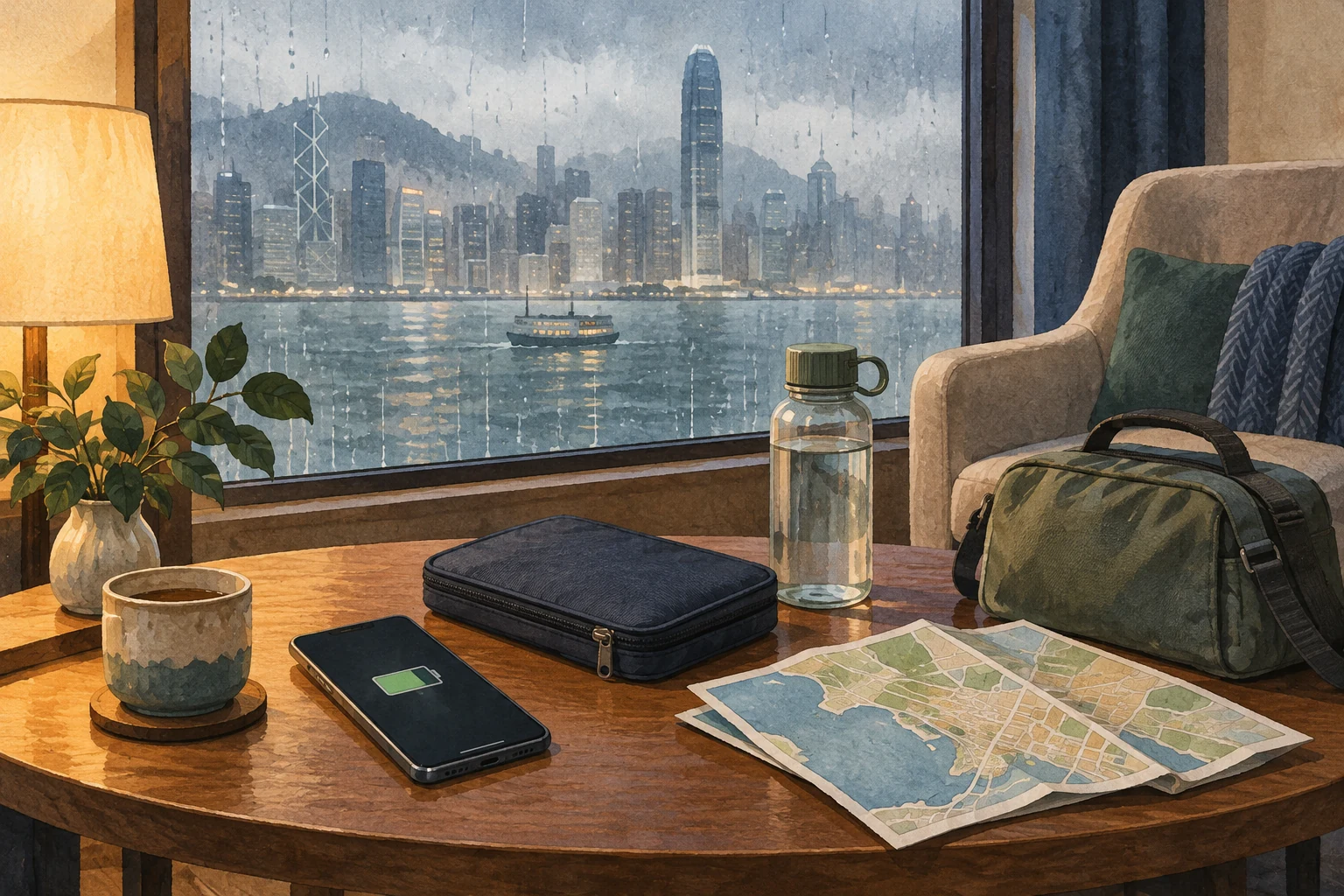
A waterfront walk, a ferry journey to another city or an evening border crossing before a flight needs more flexibility than an ordinary neighbourhood visit. Make the alternative plan before you leave, not after you have carried your luggage to the pier.
- Save your accommodation address, booking details, transport orders and essential phone numbers for offline access. Charge your phone and power bank, and have regular medication and drinking water available.
- Ask your accommodation about check-in, check-out or extending your stay. If your group is in different places, agree how to keep in touch rather than having everyone make a hurried journey to meet.
- Read the change terms for transport tickets, shows and attraction bookings. Save disruption notices. Bad weather does not automatically entitle every booking to a refund; follow the terms attached to yours.
- Prioritise changes to waterfronts, outlying islands, hill routes and journeys dependent on a sea crossing. Keep any replacement activity local and easy to cancel.
The Hong Kong Observatory warns that swells may already affect the sea under Signal No. 1. Under Signal No. 3, people should stay away from the shoreline and stop water activities. Seeing other visitors taking photographs by the water is not evidence that it is safe to join them. Tropical cyclone precautions
In severe weather, an indoor attraction is not a safety guarantee
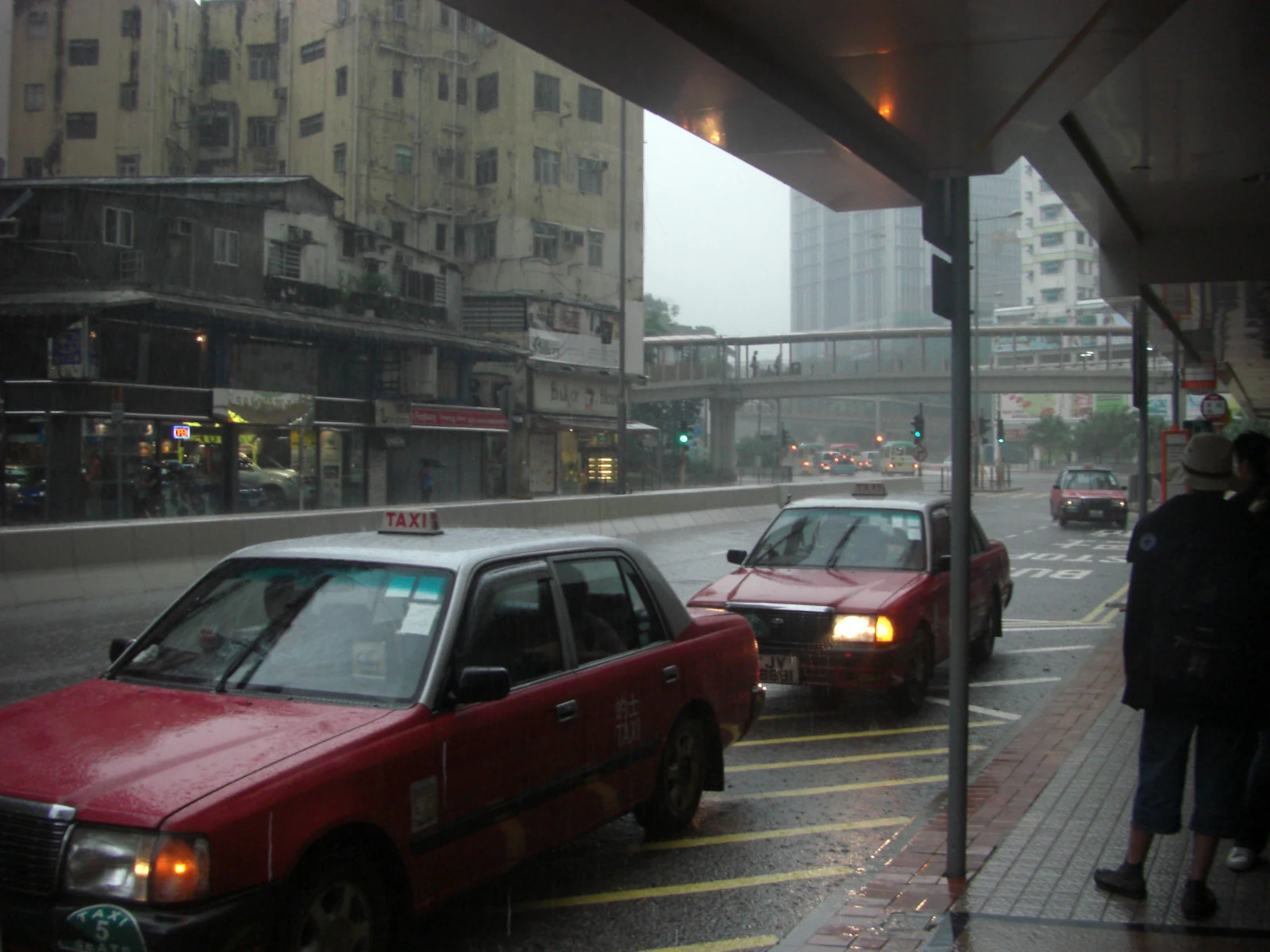
During a Black Rainstorm Warning, Hong Kong’s guidance is to stay indoors or take safe shelter until the heavy rain passes. With Signal No. 8, complete precautions and avoid remaining on the street; returning to your accommodation depends on conditions allowing a safe journey. Under No. 9 or No. 10, if you are already protected in a sheltered place, stay there rather than crossing dangerous streets just to reach your original hotel. Rainstorm guidance and cyclone precautions
Macao Government Tourism Office similarly advises visitors to stay indoors and suspend outdoor and marine activities under Signal No. 8, while watching for storm-surge information. Cross-sea bridges may close as conditions require; an ordinarily available road route is not guaranteed. Macau typhoon-season guidance
Replacing the waterfront with a shopping centre or museum can still mean crossing flooded roads, exposed interchanges or streets affected by strong winds. Being indoors at the destination and reaching it safely are separate questions. Avoid flooded routes and watercourses, and do not bypass closures to save time. Keeping people in places where they are already safe can be more practical than trying to reunite a scattered group immediately.
Check transport and opening notices one leg at a time
A weather warning describes risk; it does not replace an operator’s service announcement. Check the publication time, direction of travel and extent of any resumption in this order:
- First leg: accommodation to the station, airport or border point. Safe pedestrian access and local buses are separate from whether the main service runs. A car appearing in a booking app does not establish that roads are clear.
- Main leg: the service you will actually use. Read the airline, ferry, rail or bus operator’s current notice. Distinguish suspended service, limited operation and gradual resumption; yesterday’s timetable cannot settle today’s situation.
- Final leg: onward transport and the destination. Reaching a Macau border point does not guarantee your planned local connection. An open venue may still have closed outdoor facilities. Confirm that day’s access, opening arrangements and booking changes with the destination.
MTR is an example of why a broad statement can mislead. Under Signals No. 9 and No. 10, open sections of the railway, Light Rail and MTR Bus are suspended. Underground sections may provide limited service if safe, and service can be suspended if conditions worsen. After a downgrade to No. 8, open sections resume gradually when safe; debris or repair work may delay this. “MTR is operating” does not necessarily mean your complete journey is available. MTR typhoon arrangements
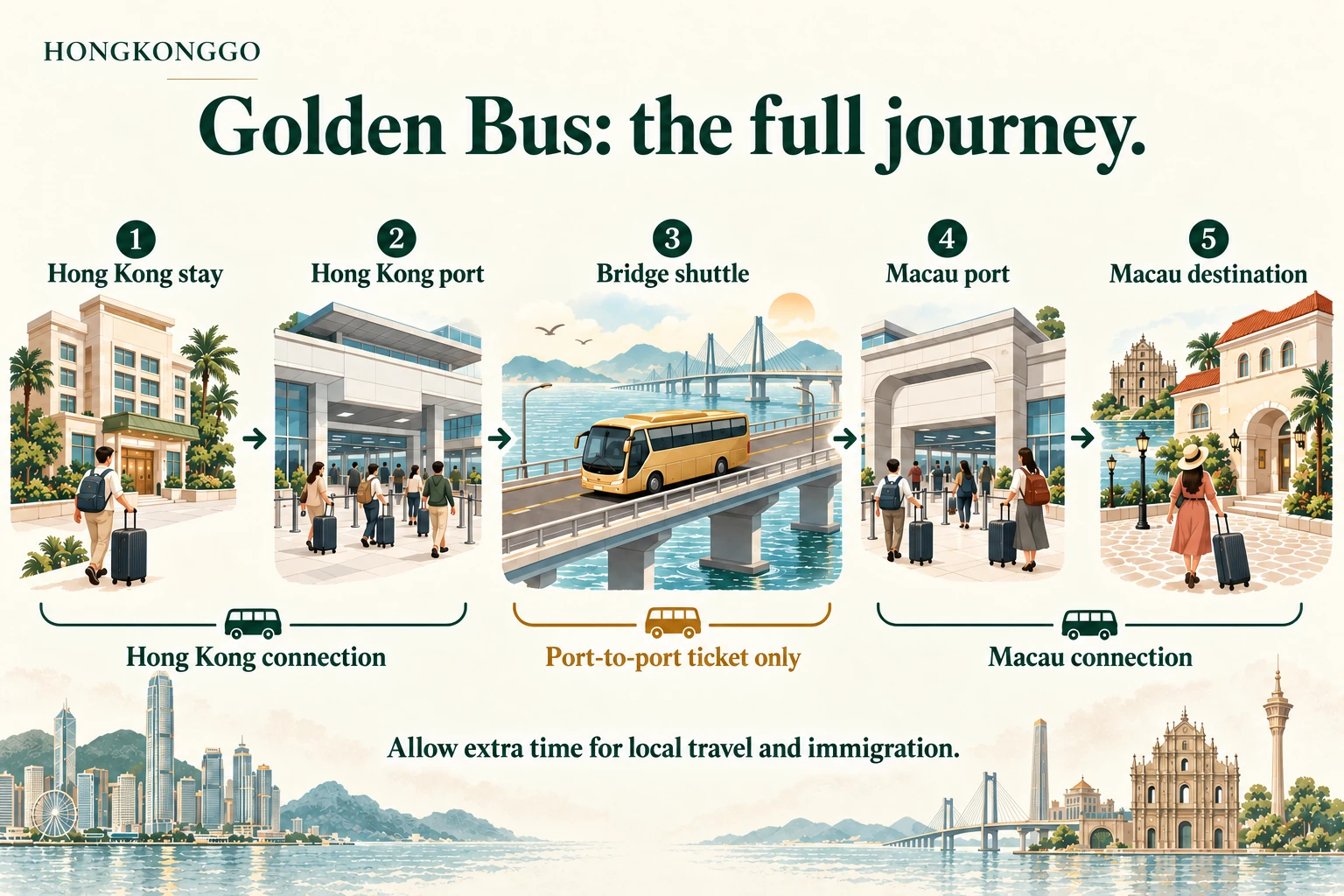
The same reasoning applies across the border. If ferries stop, check bridge-bus operation, access at both ends and onward road transport before choosing another route. A connected line on a map is not enough reason to move your luggage to a different departure point.
A practical example: Tsim Sha Tsui to Coloane and back
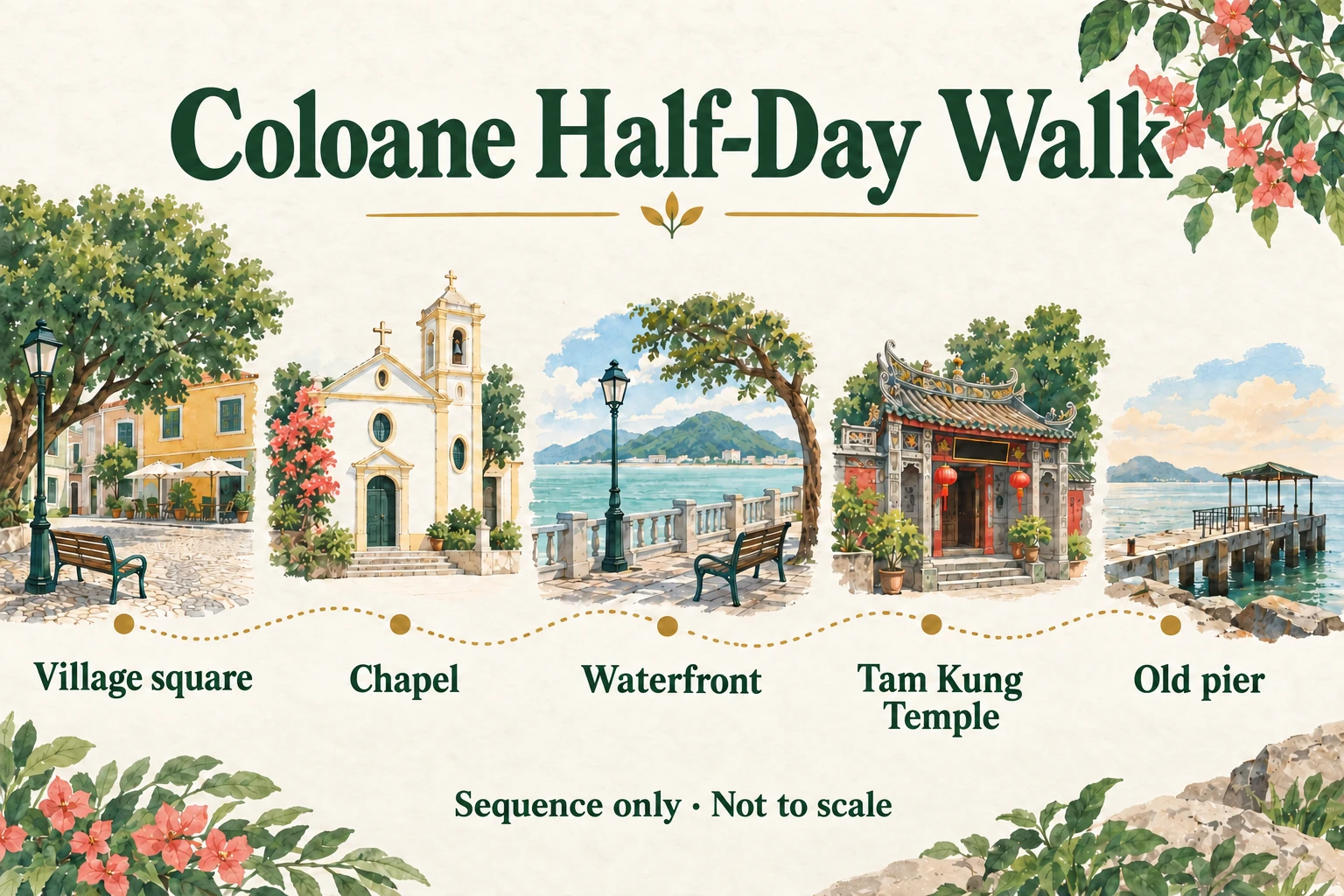
Suppose you are staying in Tsim Sha Tsui and planned to visit Coloane in Macau, returning to Hong Kong that evening. If a clear severe-weather risk develops before departure, pause the cross-border decision. Check warnings in both destinations, the outward and return services, and local connections in Macau. Finding one outward departure is not enough. If those conditions cannot be established, moving Coloane to another day is usually easier than searching for a way back after arrival.
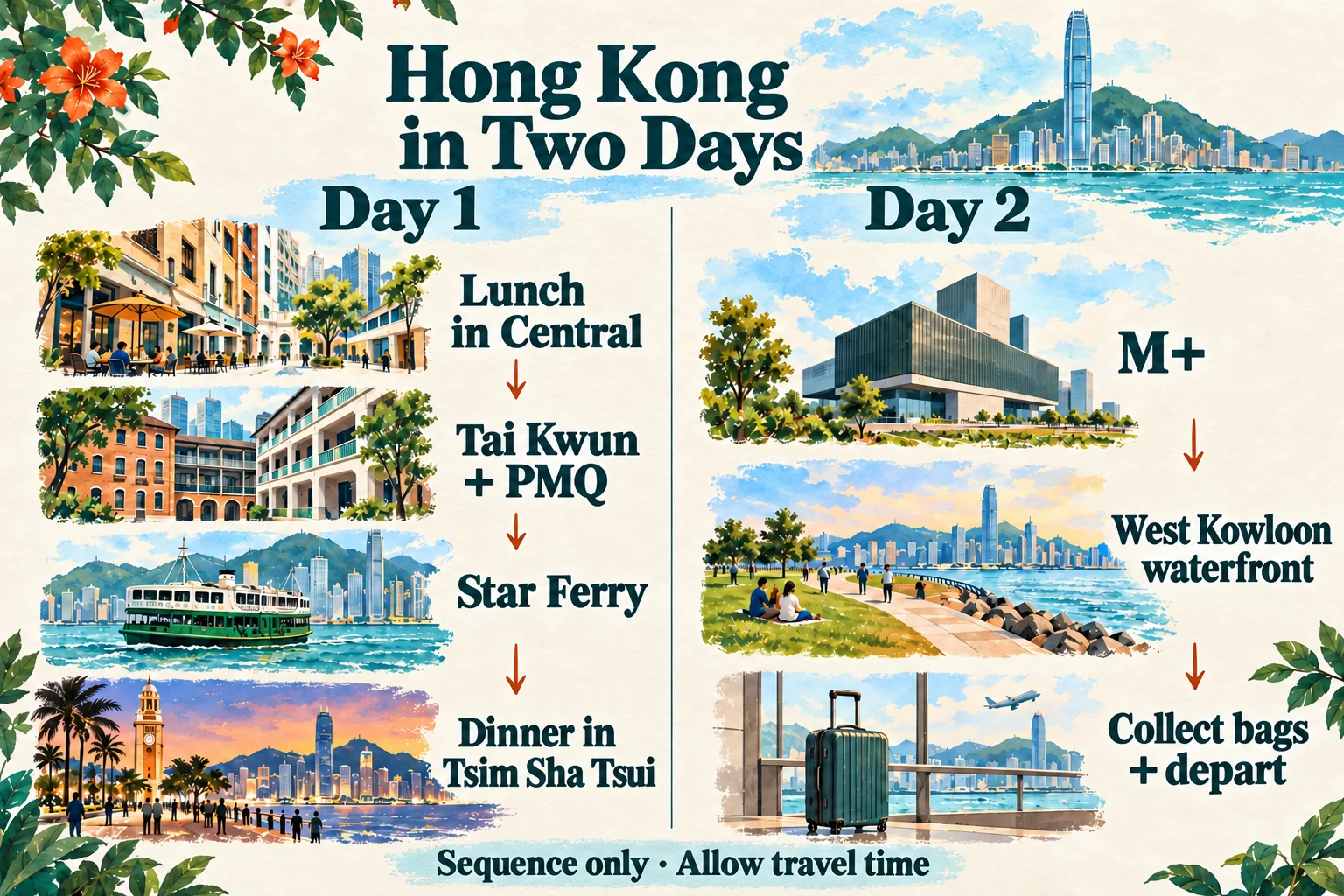
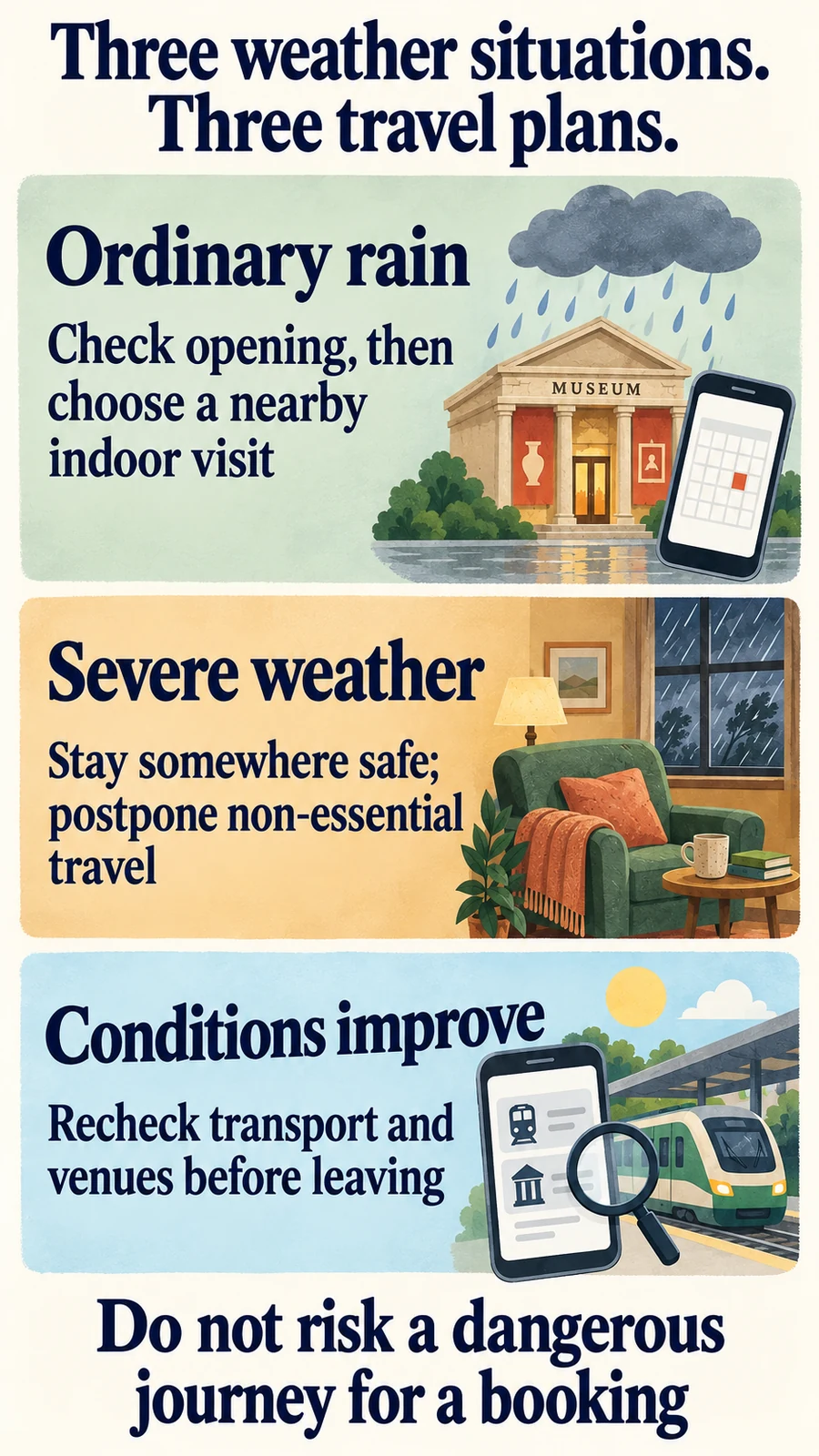
In ordinary rain, without dangerous weather or road conditions, a nearby indoor visit can be an option once access and opening are confirmed. During severe weather, the alternative should be staying somewhere safe: rest, sort photographs, read or plan a later day. Time Out’s typhoon activity suggestions also distinguish activities indoors from going out after conditions calm down. A rainy-day itinerary should not become a reason to travel through dangerous weather.
After a warning drops, resist the urge to catch up on everything
A brief pause in the wind or rain does not necessarily mean the danger has ended. The Hong Kong Observatory specifically warns that the passage of a typhoon’s eye can bring temporary calm followed by stronger winds. Some areas may remain windy after a cyclone moves away. Use official signals and actual safety conditions, not a few quiet minutes outside the window. Observatory precautions
Before restarting, repeat the three checks: have warnings changed in either destination, is the part of the transport network you need operating, and has the venue reopened? Roads, trees, piers and outdoor facilities may need inspection or clearance. Keep at least one activity optional rather than compressing the original itinerary into the remaining hours.
Your pre-journey checklist
- Save Hong Kong Observatory and Macau SMG warning pages, and check the latest publication times before departure.
- Confirm all three stages: leaving your accommodation, the sea or border crossing, and the onward connection.
- Keep booking details and change terms available; discuss check-in or an extended stay with your hotel early.
- Prepare phone power, regular medication, drinking water and a way to contact everyone in your group.
- Include staying somewhere safe as a real alternative, rather than filling every available hour with another attraction.
Sources & further reading
This article draws on the media coverage and public information below. Event and transport arrangements can change; check the latest details before travelling.
- Hong Kong Observatory: rainstorm warning systemhko.gov.hk (Opens in a new tab)
- Hong Kong Observatory: tropical cyclone precautionshko.gov.hk (Opens in a new tab)
- Macao government / SMG: rainstorm warningsgov.mo (Opens in a new tab)
- Macao Government Tourism Office: typhoon-season guidancemacaotourism.gov.mo (Opens in a new tab)
- MTR: service during tropical cyclonesmtr.com.hk (Opens in a new tab)
- Time Out Hong Kong: things to do during a typhoontimeout.com (Opens in a new tab)
Make it your journey
Place cross-city journeys in a period when both weather and transport conditions are suitable, and leave room to change the day. If warnings or service arrangements remain unclear, secure safe accommodation and deal with bookings through the relevant operators before choosing your next route. The original schedule is not worth a hazardous journey.