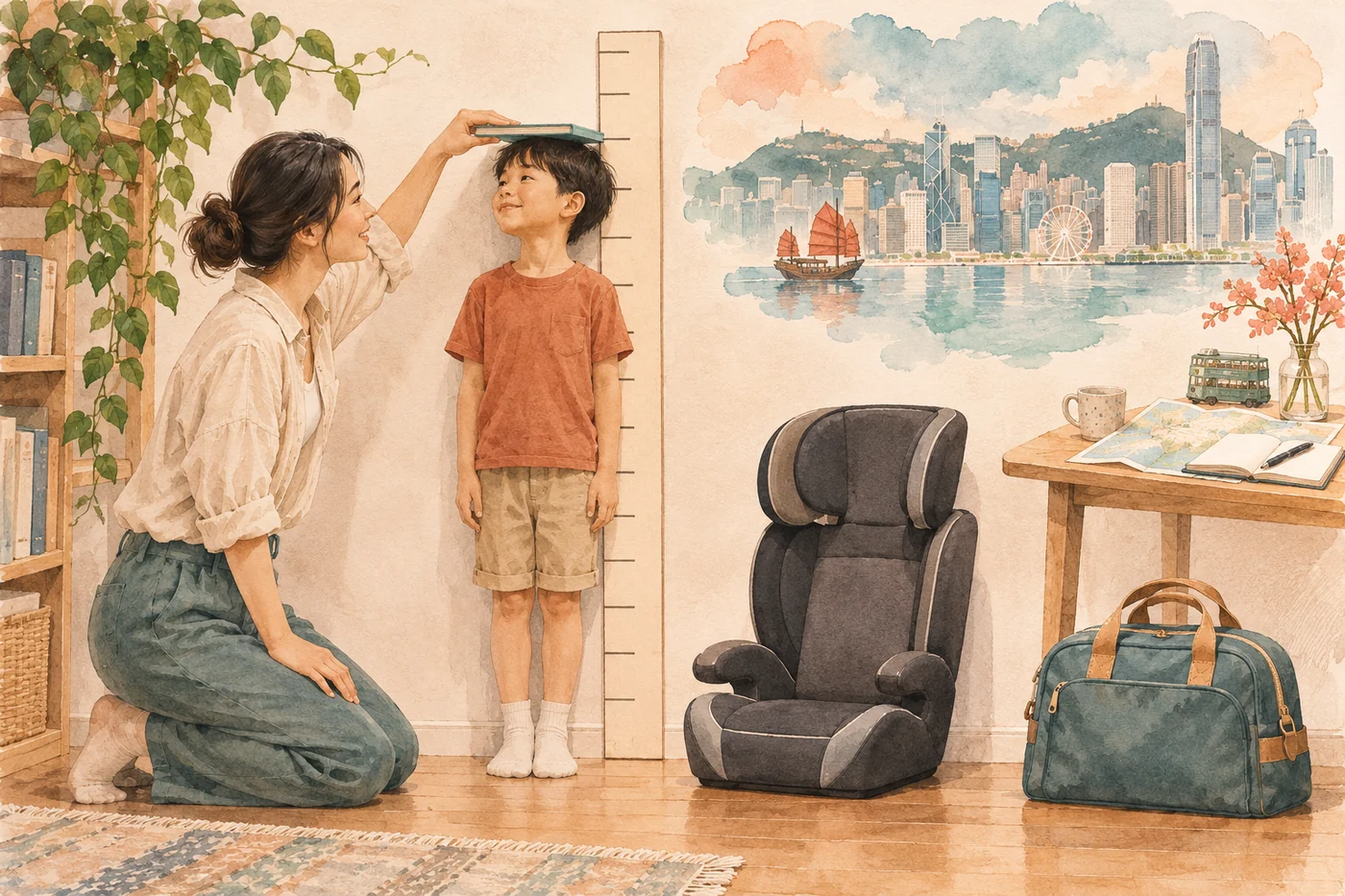
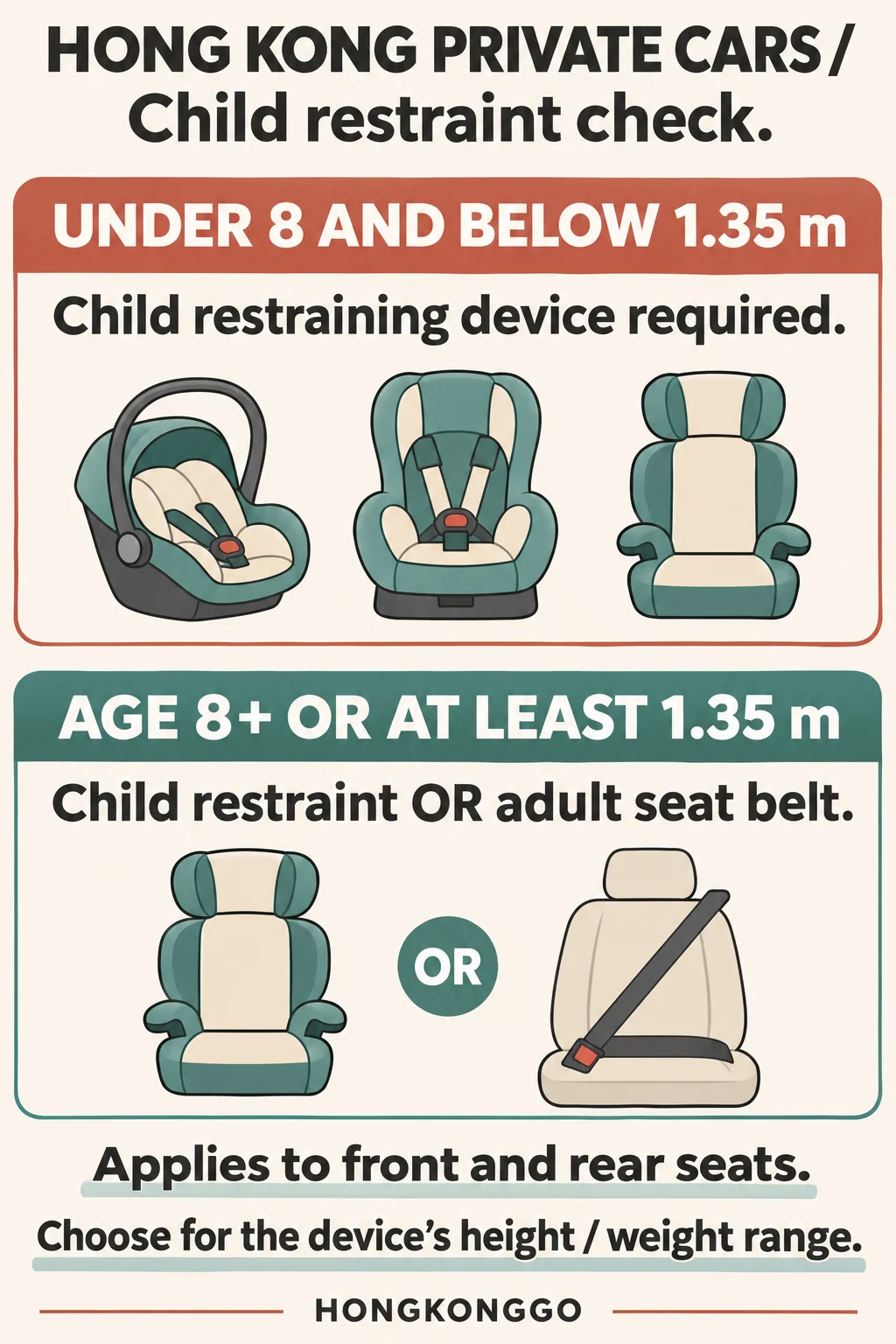
When taking a child in a Hong Kong private car, consider age and height together. A passenger under eight who is also below 1.35 metres must use a child restraining device, in either the front or rear seat. A passenger aged eight or above, or at least 1.35 metres tall, must use a child restraint or an adult seat belt. These requirements have applied since 1 November 2025. Choosing the actual device requires a separate check of the child’s size and its compatibility with the vehicle.
Read “and” and “or” carefully
The Transport Department’s child restraining device page distinguishes the two conditions. Below eight and below 1.35 metres means an appropriate child restraining device (CRD) is required. Reaching either the age or height threshold permits a CRD or an adult seat belt. The second group still needs restraint; being tall enough does not mean travelling unbelted.
| Actual age and height | Requirement in a Hong Kong private car |
|---|---|
| Seven years old, 1.30 metres | Below both thresholds: a CRD is required. |
| Seven years old, exactly 1.35 metres | Height threshold reached: CRD or adult seat belt. |
| Eight years old, 1.30 metres | Age threshold reached: CRD or adult seat belt. |
These examples explain the legal thresholds, not whether one particular seat fits every child. TD advises choosing a device primarily for its specified height and/or weight range, using age only as a reference. Measure the child before travelling rather than sending “primary-school age”. If a birthday is approaching, give the age on the day of the journey.
Identify the vehicle category, including on a cross-border trip
The government’s 24 October 2025 announcement expressly addresses local and cross-boundary private-car drivers carrying children in Hong Kong. Arriving from Shenzhen, making only a short hotel transfer or offering a friend a free lift does not, by itself, create an exemption for the Hong Kong part of the journey.
Paragraph 25 of the Legislative Council report explains that taxis and other public transport have a different regulatory scope from this private-car amendment. Do not apply this private-car rule unchanged to every vehicle, or infer that other vehicles have no seat-belt or child-safety requirements. TD separately states that children aged two or below in the front seat of a private light bus or goods vehicle must use a CRD. Confirm the actual vehicle category, rather than relying on marketing descriptions such as “private transfer”, “seven-seater” or “luxury”.
This article explains the Hong Kong leg. Mainland China and Macao have their own applicable requirements and operating arrangements; compliance in Hong Kong does not automatically establish compliance elsewhere. Ask whether the device stays in the same seat throughout and whether any vehicle change is planned.
Check the child, the standard and the vehicle
Start with the height and/or weight range in the device instructions. A general “for children” label cannot cover babies, preschool children and larger children equally. The Department of Health’s Family Health Service guidance advises using a rear-facing child safety seat for infants and young children until they outgrow its height or weight suitability. Do not change its direction simply because a few months have passed.
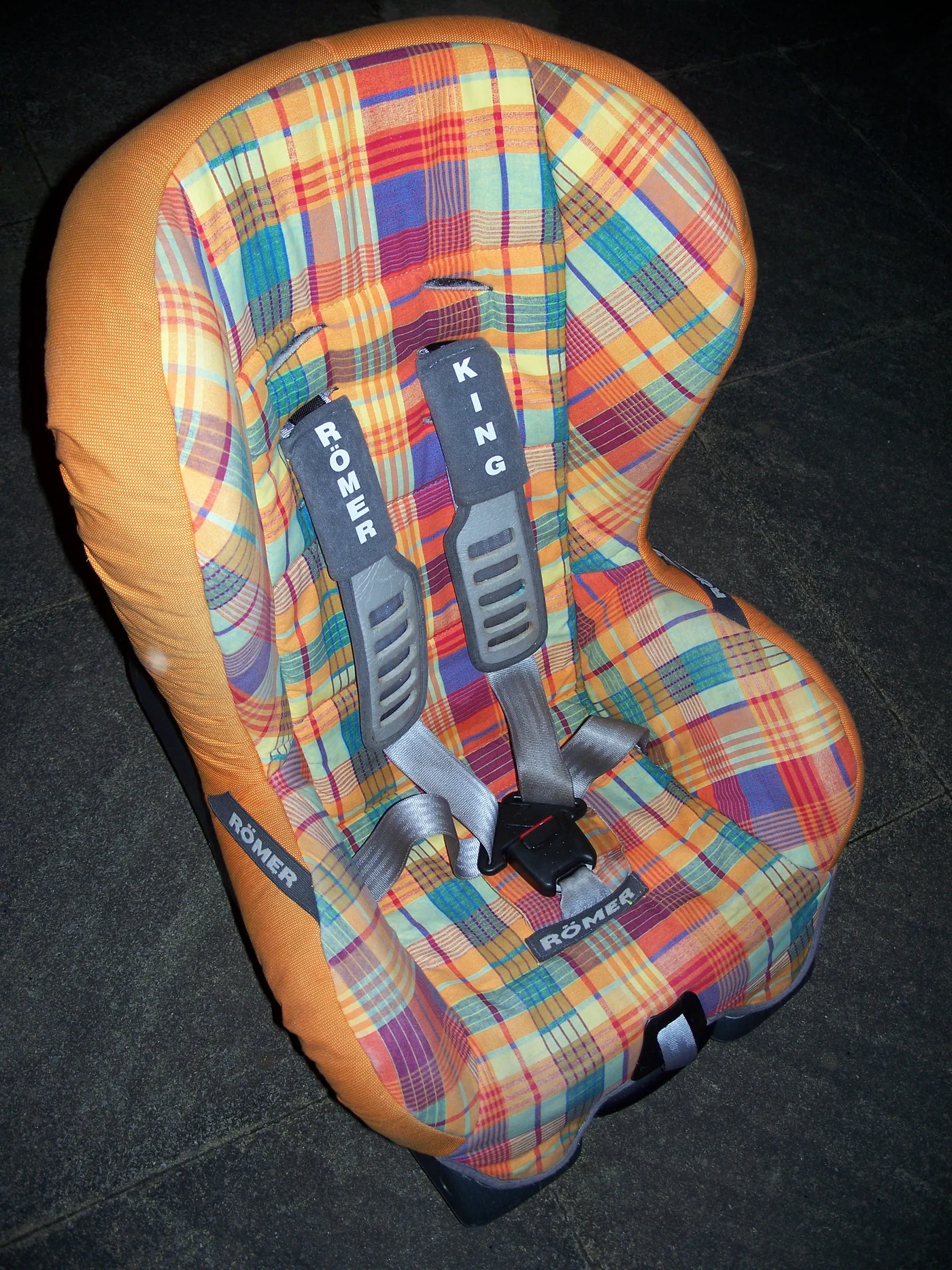
Next, inspect the permanent standard marking and ask the manufacturer or retailer whether the device meets the specifications listed in Hong Kong legislation. TD lists several recognised standards and their applicable versions, including UN Regulation No. 129. A vague claim of “international certification” is not enough. Photographs in this guide do not certify an old model or a product currently on sale.
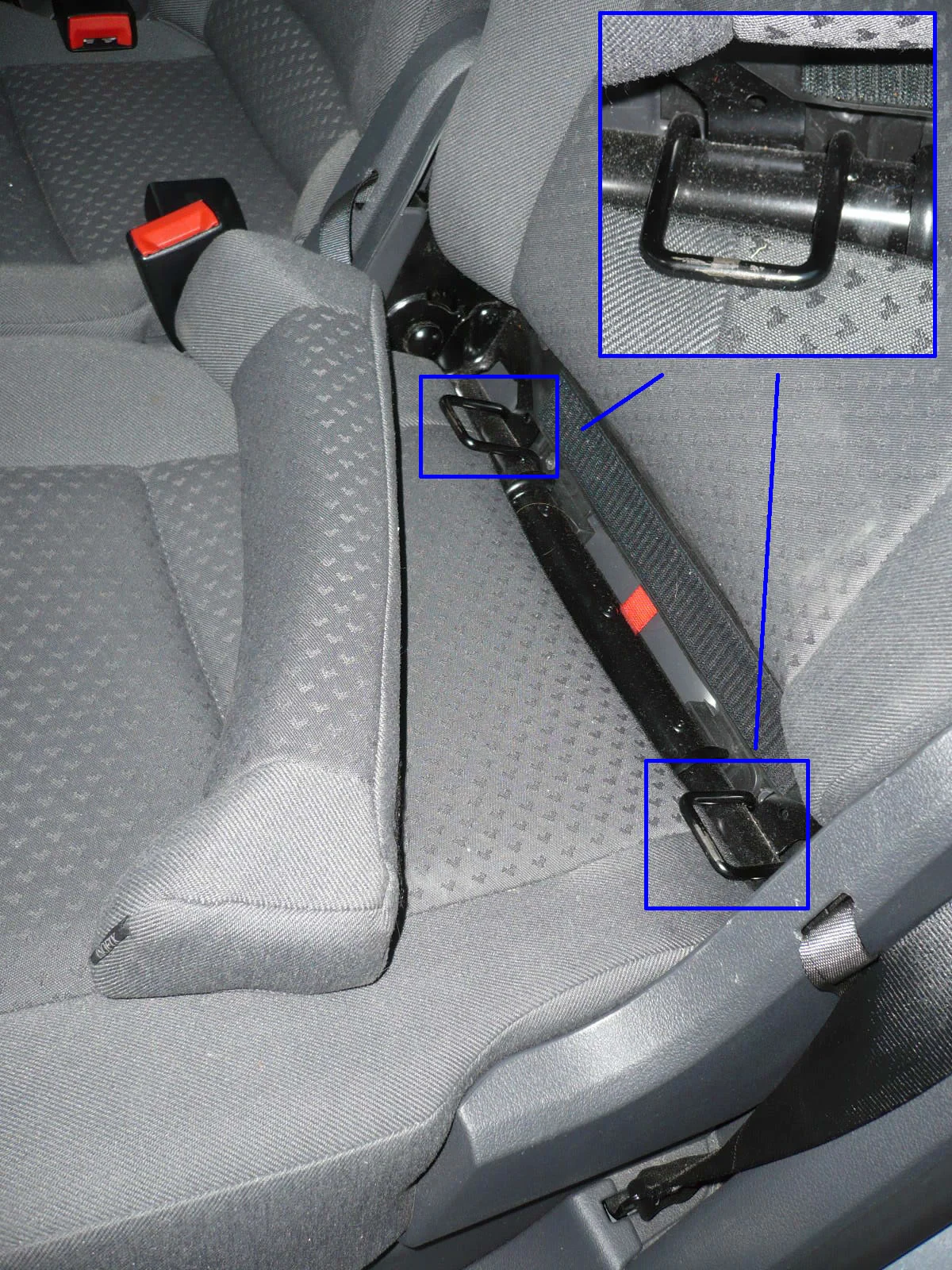
The third check is the vehicle and seating position. For an ISOFIX seat, TD recommends consulting the supplier’s list of compatible vehicle models. An ISOFIX logo or a photograph of anchor points cannot replace matching the device to the actual car and seat. If the operator supplies the device, ask for its model, fit range and installation method. If you bring your own, provide those details before pickup rather than discovering a mismatch beside the vehicle.
Portable restraints also have conditions
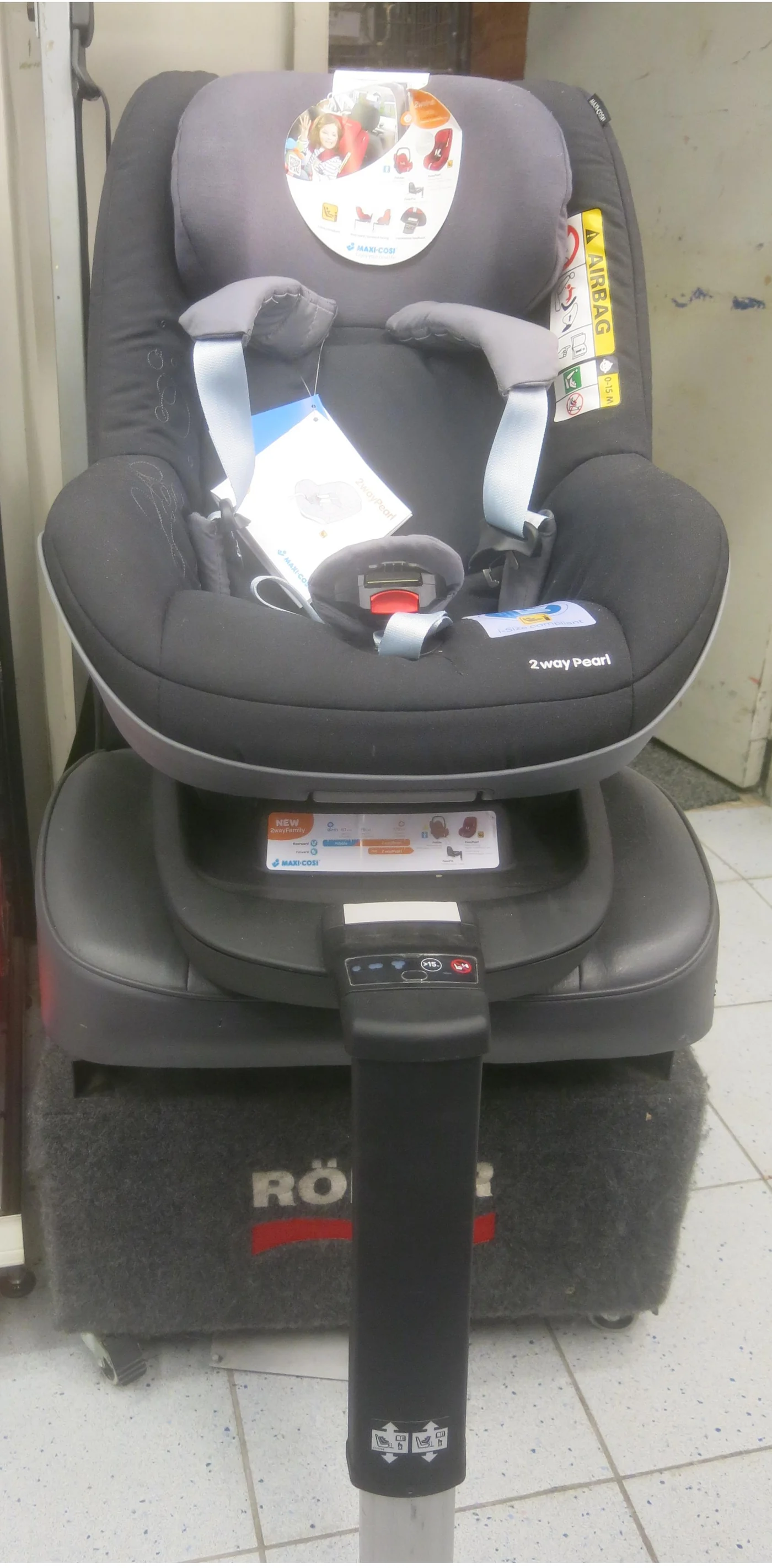
Recognised device types are not limited to conventional child safety seats. TD discusses seat-belt adjusters, wearable restraint vests and boosters. These portable devices must still meet the relevant legal specifications or standards and fit the child.
TD also explains that portable designs generally lack the side pads and seat backs found on child safety seats, giving them less protection in side impacts. Portability solves a luggage problem; it does not demonstrate identical protection. Do not treat an ordinary cushion, an unverified belt clip or an improvised pad as a compliant restraint.
Complete the checks before the car moves
Install the device correctly and securely according to its manufacturer’s instructions, with the responsible person checking it before departure. Family Health Service advises against damaged devices, devices involved in a collision or those of unknown history. TD notes that an apparently undamaged seat can still have internal structural damage after a collision. Ask the same history questions when borrowing from friends or relatives.
Holding a child is not a substitute for the required CRD. The health guidance specifically warns front-seat passengers against holding a child or having one on their lap; a baby carrier should not replace suitable restraint in a vehicle requiring seat belts. Follow the particular device and vehicle manuals for belt routing, angle, fixing points and airbag requirements. A general illustration cannot demonstrate every installation.
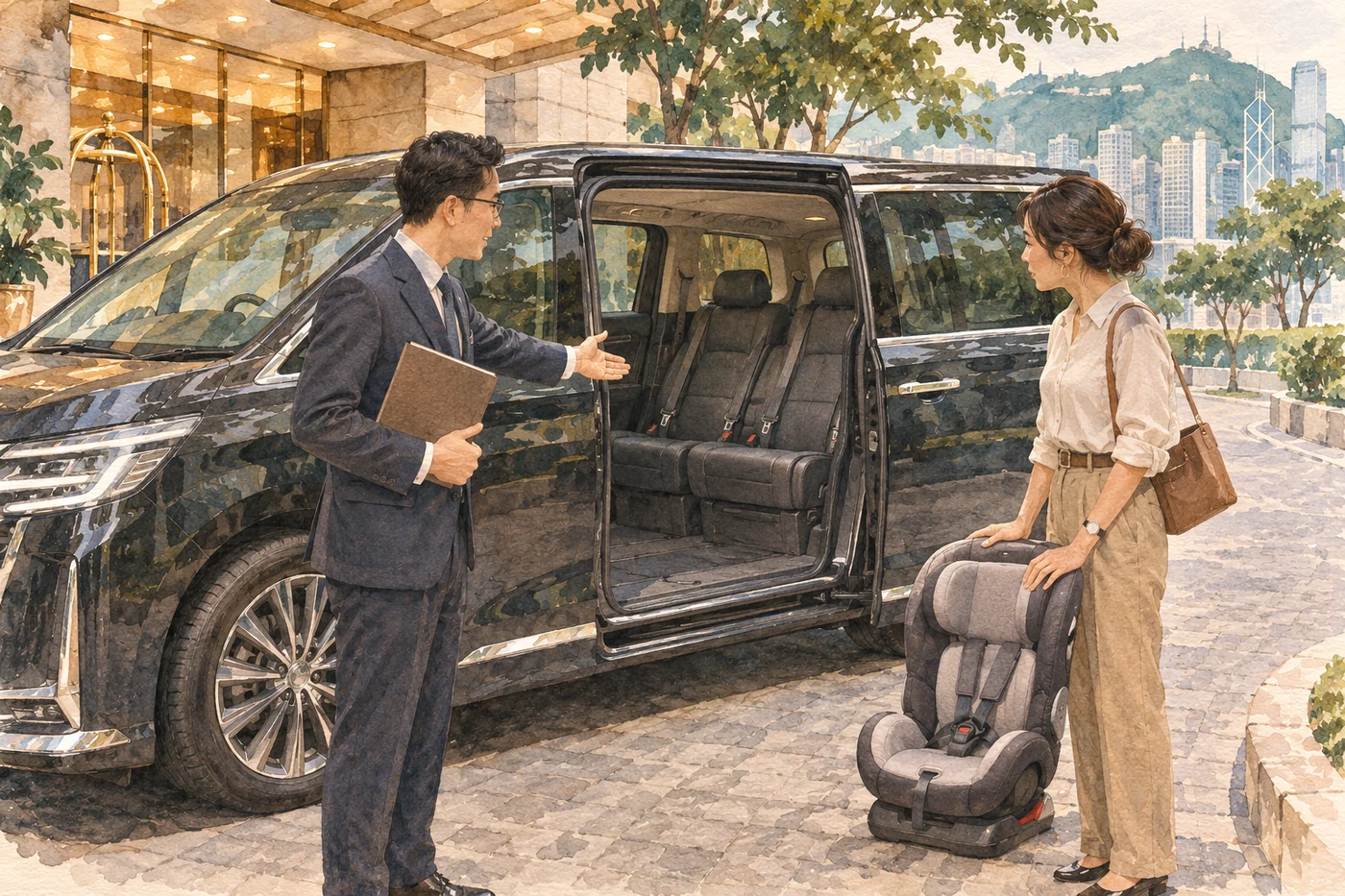
If the supplied device does not fit, installation is uncertain or there are too few devices, resolve the problem before departure. A late flight, a show starting soon or an urgent booking is not a reason to plan a journey without restraint. The statutory defences described in the February 2025 announcement, including emergency transport for treatment, concern particular exceptional circumstances rather than ordinary holiday time pressure.
Send a useful booking message
Organise the information into child, equipment and journey details, listing each child separately. For example: “On the travel date, our two children will be [age / height / weight] and [age / height / weight]. We [will bring model X / need you to confirm suitable equipment]. Our route is [Hong Kong pickup to destination]. Please confirm a suitable device for each child, the actual vehicle and seating position, any vehicle change, and equipment availability and charges.”
“We can arrange a seven-seater” does not yet answer whether appropriate devices are available in sufficient numbers. Restraints also affect adult seating and luggage arrangements, so include the stroller and bags. Do not assume every model and departure time offers the same equipment; obtain explicit confirmation.
For wider family and older-passenger planning, see our family transfer preparation guide.
For vehicle space, browse the fleet introductions. A vehicle photograph does not establish that a particular restraint has been matched to it.
Your pre-journey checklist
- Check age on the travel date and actual height, understanding “under eight AND below 1.35 metres”.
- Match each child’s height and weight to the device’s permitted range.
- Confirm vehicle category, model, installation position and standard marking.
- Agree who supplies the devices, their number, charges and any vehicle changes.
- Complete installation checks before departure; being in a hurry is not an exemption.
Sources & further reading
This article draws on the media coverage and public information below. Event and transport arrangements can change; check the latest details before travelling.
- Hong Kong Transport Department: CRD rules and selectiontd.gov.hk (Opens in a new tab)
- Hong Kong government: local and cross-boundary private-car requirementsinfo.gov.hk (Opens in a new tab)
- Hong Kong Transport Department: commencement, responsibility and statutory defencesinfo.gov.hk (Opens in a new tab)
- Hong Kong Department of Health: safe use of child restraintsfhs.gov.hk (Opens in a new tab)
- Legislative Council report paragraphs 25–26: vehicle scope and commencementlegco.gov.hk (Opens in a new tab)
- on.cc: reporting on lifts for relatives and portable deviceshk.on.cc (Opens in a new tab)
Make it your journey
Send HONGKONGGO each child’s age, height and weight, your luggage and Hong Kong departure route. Confirm whether the vehicle and child equipment can meet your needs before finalising the transfer.